 Image: Jalbatros
Haymaking in the Auvergne
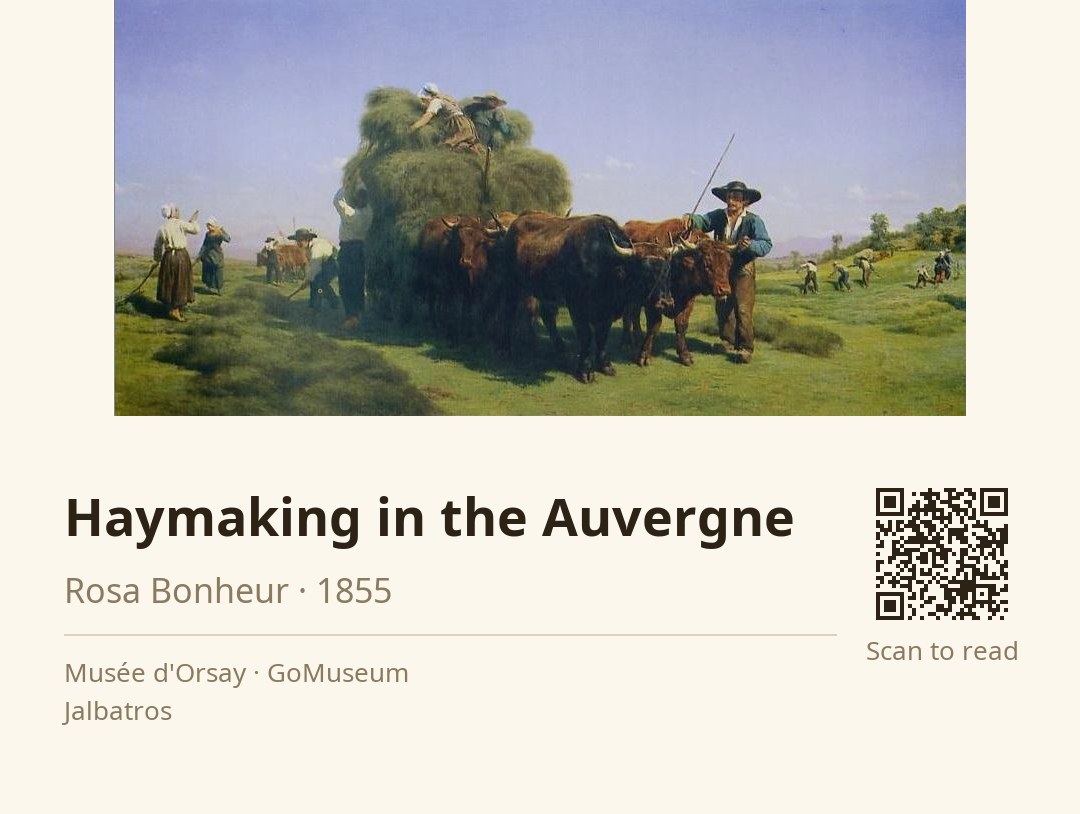
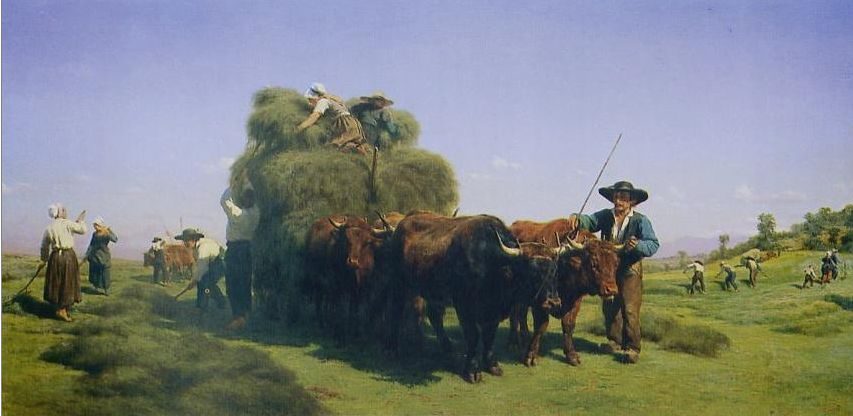
🎧 This work has audio narration — listen in the appTake a moment to really absorb the scene in front of you. "Haymaking in the Auvergne" by Rosa Bonheur is a stunning portrayal of rural life, capturing the essence of a summer's day in the French countryside. Notice how the light dances across the canvas, illuminating the figures and the hay as they work together in harmony.
Look closely at the oxen, their powerful bodies straining against the cart, while a farmer gently holds one by the horns. This detail isn’t just about the animals; it speaks to the deep connection between humans and nature, a theme Bonheur masterfully conveys. The way she captures their strength and patience reflects her own respect for the laborers and their toil.
Bonheur created this piece in 1855, during a time when the realism movement was gaining momentum in art. She was one of the few women artists to achieve such acclaim, and her work often highlighted the dignity of rural life, challenging the norms of her time. This painting won a gold medal at the 1855 Exposition Universelle, solidifying her status as a leading artist.
As you stand here, think about the stories these figures could tell. What do you imagine their lives were like? How does this scene resonate with your own experiences of hard work and community?
Rosa Bonheur, born Marie-Rosalie Bonheur on March 16, 1822, in Bordeaux, was a pioneering French painter and sculptor renowned for her realistic depictions of animals. Raised in an artistic family, she faced early challenges, including the loss of her mother at eleven. Her father, a painter, nurtured her talent, leading her to study animal anatomy in Paris and create detailed studies that would inform her celebrated works. Bonheur gained fame with her monumental painting "The Horse Fair," exhibited in 1853, which showcased her exceptional skill and unique perspective on animal life.
Living openly with her partner Nathalie Micas for over 40 years, Bonheur defied societal norms of her time. Despite facing gender biases, she became the most famous female artist of the 19th century, earning accolades and commissions, including "Ploughing in the Nivernais." Her work fell into obscurity in the 20th century but has seen a resurgence in appreciation in the 21st century. Bonheur's legacy as a trailblazer for women in art and her dedication to capturing the essence of animals solidify her place in art history. She passed away on May 25, 1899, leaving behind a rich artistic heritage.
The painting was first exhibited at the 1855 Exposition Universelle in Paris, where it won a gold medal, further solidifying her reputation as a leading artist of her time. After its exhibition, the French state purchased the painting for 20,000 francs, a significant sum that reflected its value. Over the years, it has been displayed in various prestigious venues, including the Musée du Luxembourg and the Château de Fontainebleau, where it remains today.
As you gaze at 'Haymaking in the Auvergne,' pay attention to the dynamic brushwork that brings the scene to life. Bonheur employed a technique that combines meticulous detail with a sense of movement, capturing the laborers and animals in action. The light in this painting is particularly striking; it bathes the figures and the hay in a warm glow, creating a sense of serenity and harmony. Notice how the composition is structured with a linear perspective that draws your eye into the depth of the landscape, guiding you from the foreground, where the workers are engaged in their tasks, to the distant mountains. The scale of the painting, measuring over 2 meters high and nearly 4.5 meters wide, immerses you in the scene, making you feel as if you are part of this idyllic summer day. The vibrant colors, especially the lush greens and the golden hues of the hay, evoke the richness of the Auvergne countryside, inviting you to appreciate the beauty of rural labor.
Rosa Bonheur was commissioned to create 'Haymaking in the Auvergne' after her earlier success with 'Ploughing in the Nivernais,' which had garnered significant acclaim at the Salon of 1849.
Growing up in a family of artists and losing her mother at a young age, Bonheur was encouraged by her father to pursue her artistic talents, particularly in painting animals, which became her signature subject.
Bonheur studied animal anatomy and osteology by visiting abattoirs in Paris and even dissecting animals at the National Veterinary Institute, which provided her with a deep understanding of her subjects.