Woman with cat
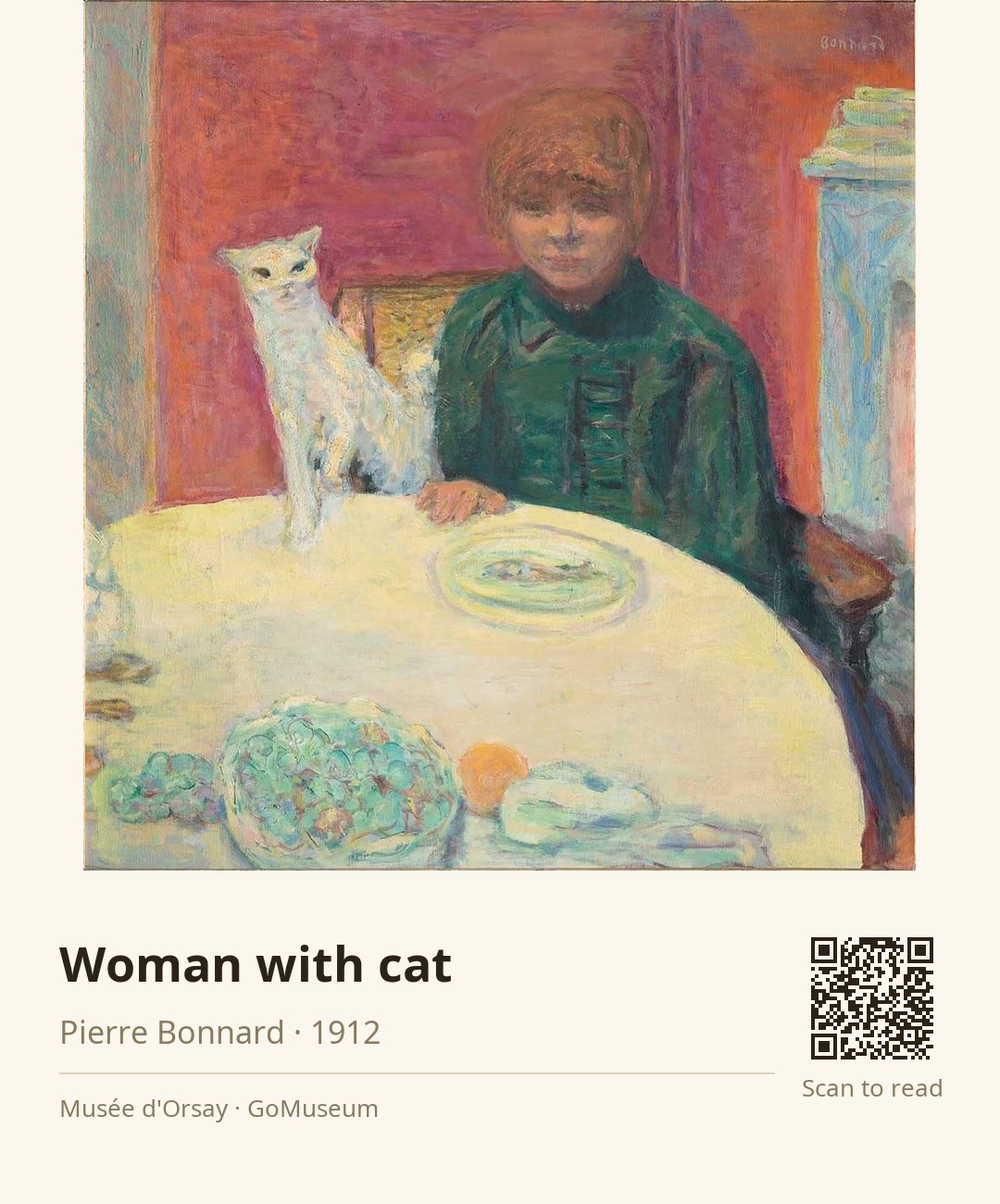
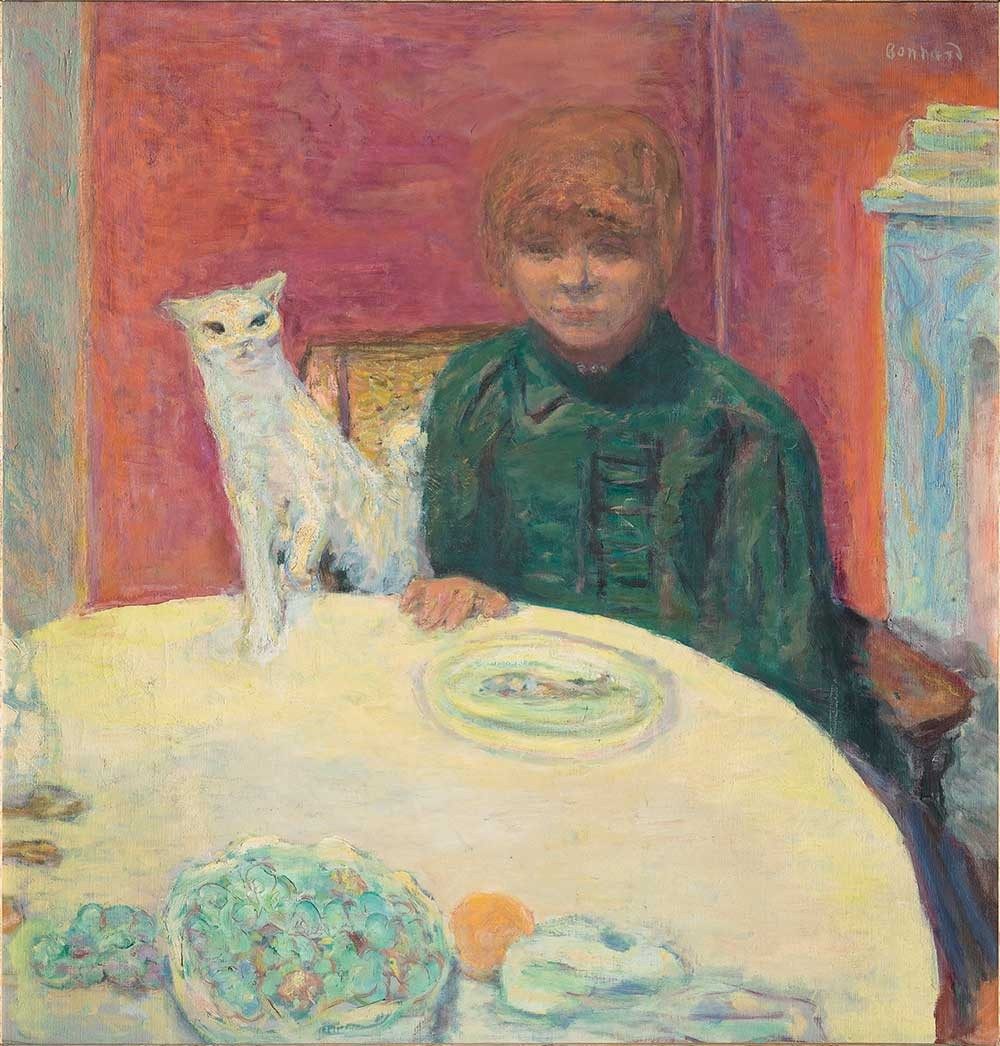
🎧 This work has audio narration — listen in the appMarthe Bonnard sits at a round table, her dark green garment contrasting with the warm, reddish-pink wall behind her. A white cat perches upright on the table, its gaze meeting yours, while a plate with a small fish and a bowl of green grapes and an orange hint at a meal in progress. The soft blending of colors creates an intimate atmosphere, inviting you into this domestic scene.
This portrayal of Marthe, who was both Bonnard's wife and muse, captures a moment of everyday life infused with warmth and familiarity. The cat's direct stare adds a playful element, while the carefully arranged fruits suggest a sense of abundance and comfort. Bonnard's loose brushwork reflects his interest in capturing the essence of a moment rather than precise details, emphasizing the emotional resonance of the scene.
Influenced by Japanese prints, Bonnard's work often features bold colors and simplified forms, a hallmark of the Nabis group he co-founded.
Pierre Bonnard was a French painter born on October 3, 1867, in Fontenay-aux-Roses. A founding member of the Post-Impressionist group Les Nabis, he was known for his vibrant colors and decorative style. His early influences included Paul Gauguin and Japanese art, which shaped his unique approach to painting. Bonnard's work often prioritized color and composition over subject matter, reflecting his belief in the emotional power of art.
Despite initially pursuing a career in law, Bonnard's passion for art led him to study at the Académie Julian and the École des Beaux-Arts, where he formed lasting friendships with fellow artists. His personal life was marked by a long relationship with Marthe de Méligny, who became his muse and model. Bonnard's paintings often depicted intimate domestic scenes, capturing the essence of everyday life with a sense of joy and nostalgia.
Over his prolific career, Bonnard transitioned from Impressionism to a more modern aesthetic, becoming one of the foremost colorists of the 20th century. His legacy endures as he is celebrated for his innovative use of light and color, positioning him as a significant figure in the evolution of modern art. Bonnard passed away on January 23, 1947, leaving behind a rich body of work that continues to inspire.
The painting was first exhibited at the gallery Bernheim-Jeune in Paris, where it was well received, showcasing Bonnard's unique blend of color and intimacy. By 1923, it made its way to the Carnegie Institute in Pittsburgh for the twenty-second annual international exhibition of paintings. Over the years, the painting changed hands several times, passing through notable collectors like Alphonse Kahn and Baroness Eva Gebhard-Gourgaud, who ultimately donated it to the Musée National d'Art Moderne in 1965. It was later transferred to the Musée d'Orsay in 1977, where it continues to captivate audiences with its warmth and domesticity.
Marthe Bonnard was originally named Maria Boursin before she changed her name.