The woman with the umbrella
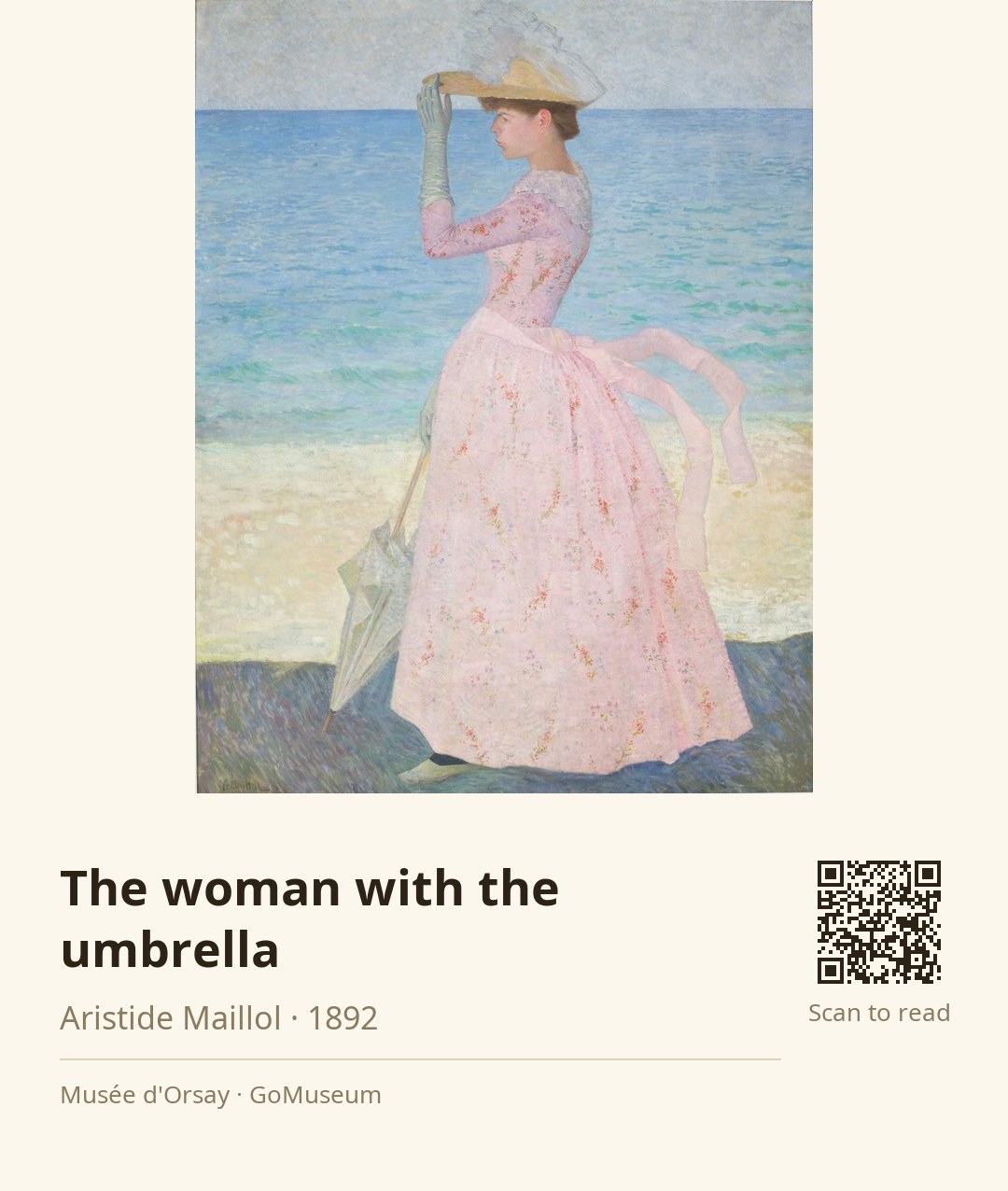
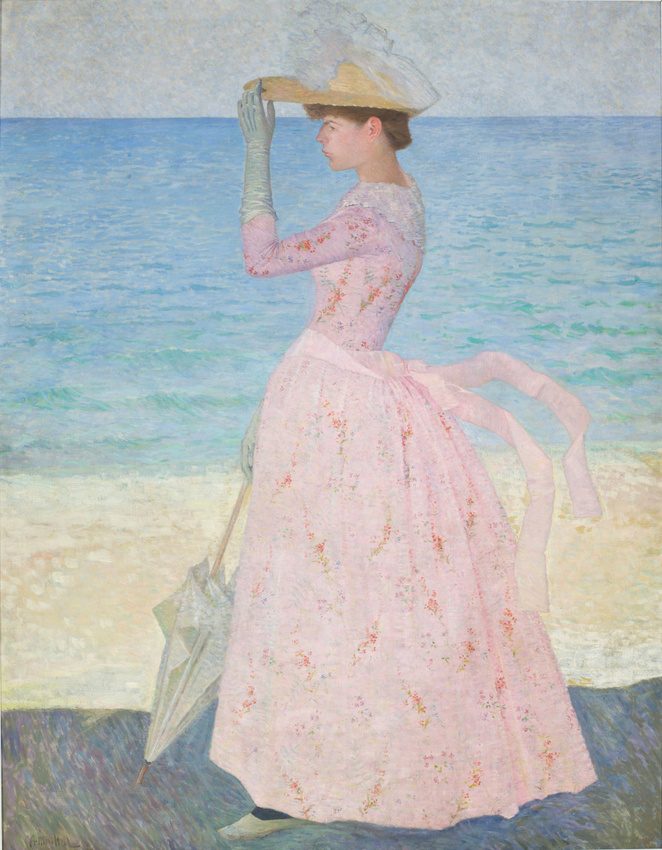
🎧 This work has audio narration — listen in the appA woman in a long, pink dress stands gracefully on the beach, her figure framed against the tranquil sea. The delicate floral patterns on her dress flutter gently in the breeze, while a wide ribbon flows behind her, adding a sense of movement. In her left hand, she rests a parasol on the ground, while her right hand adjusts a wide-brimmed hat adorned with feathers, emphasizing her elegance and poise.
This scene captures a moment of serene leisure, reflecting the charm of coastal life in the late 19th century. The smooth brushwork and harmonious palette of blues and greens evoke a tranquil seaside atmosphere, inviting viewers to experience the calmness of the setting. The woman’s profile, facing the horizon, suggests a connection to nature and the fleeting beauty of the moment, as if she is lost in thought, contemplating the vastness of the sea before her.
Created in 1892 by Aristide Maillol, this painting titled "The Woman with the Umbrella" showcases the artist's early exploration of the female form and the interplay of fashion and nature. Maillol’s work would later evolve into iconic sculptures, but this piece remains a testament to his roots in painting and his fascination with the female figure.
Aristide Maillol, born on December 8, 1861, in Banyuls-sur-Mer, was a prominent French Catalan sculptor, painter, and printmaker. Initially pursuing painting, he shifted his focus to sculpture in his early forties, becoming one of the most celebrated sculptors of his era. His works, characterized by a classical treatment of the female form, influenced notable artists like Picasso, Matisse, and Moore, marking a significant transition in modern sculpture.
Maillol's artistic journey began in Paris, where he studied at the École des Beaux-Arts under renowned instructors. His early works were shaped by the decorative arts, particularly tapestry, which he explored before fully dedicating himself to sculpture. His first major piece, "A Seated Woman," completed in 1902, exemplified his unique style, blending simplicity with a profound sense of beauty.
Throughout his career, Maillol received acclaim for his serene and monumental sculptures, which emphasized form over narrative. His public commissions included memorials and monuments, solidifying his legacy in art history. Despite the challenges he faced, including the loss of many artworks during the Nazi occupation, his influence persisted, with a significant collection of his works housed in the Musée Maillol in Paris. Maillol passed away in an automobile accident on September 27, 1944, leaving behind a transformative body of work that continues to resonate in the art world.
Aristide Maillol's painting, 'The Woman with the Umbrella,' was created in 1892, a time when the artist was still establishing his identity in the art world. The painting was first exhibited at the Musée des Beaux-Arts in Nancy in 1953, where it garnered attention for its serene depiction of coastal life. It wasn't until 1955 that it entered public collections, eventually finding its home at the Musée d'Orsay in Paris in 1977. The journey of this artwork through various exhibitions and collections highlights its growing recognition and the evolution of Maillol's reputation as a significant figure in modern art.
Maillol's technique in 'The Woman with the Umbrella' showcases his mastery of oil painting, with smooth brushwork that creates a soft, inviting atmosphere. The harmonious palette of blues and greens not only captures the essence of the seaside but also enhances the tranquility of the scene. The way he layers the paint allows for a depth that draws you into the moment, making the viewer feel the gentle breeze and the warmth of the sun. The composition is vertical, emphasizing the woman's elegant posture and the flowing lines of her dress and ribbon, which dance in the wind. This choice of scale and structure directs your attention to her profile, creating a sense of intimacy and connection with nature, as if she is part of the landscape itself.
Maillol employed smooth brushwork in his oil painting technique, which contributed to the soft and inviting atmosphere of the scene.