The Dubourg Family
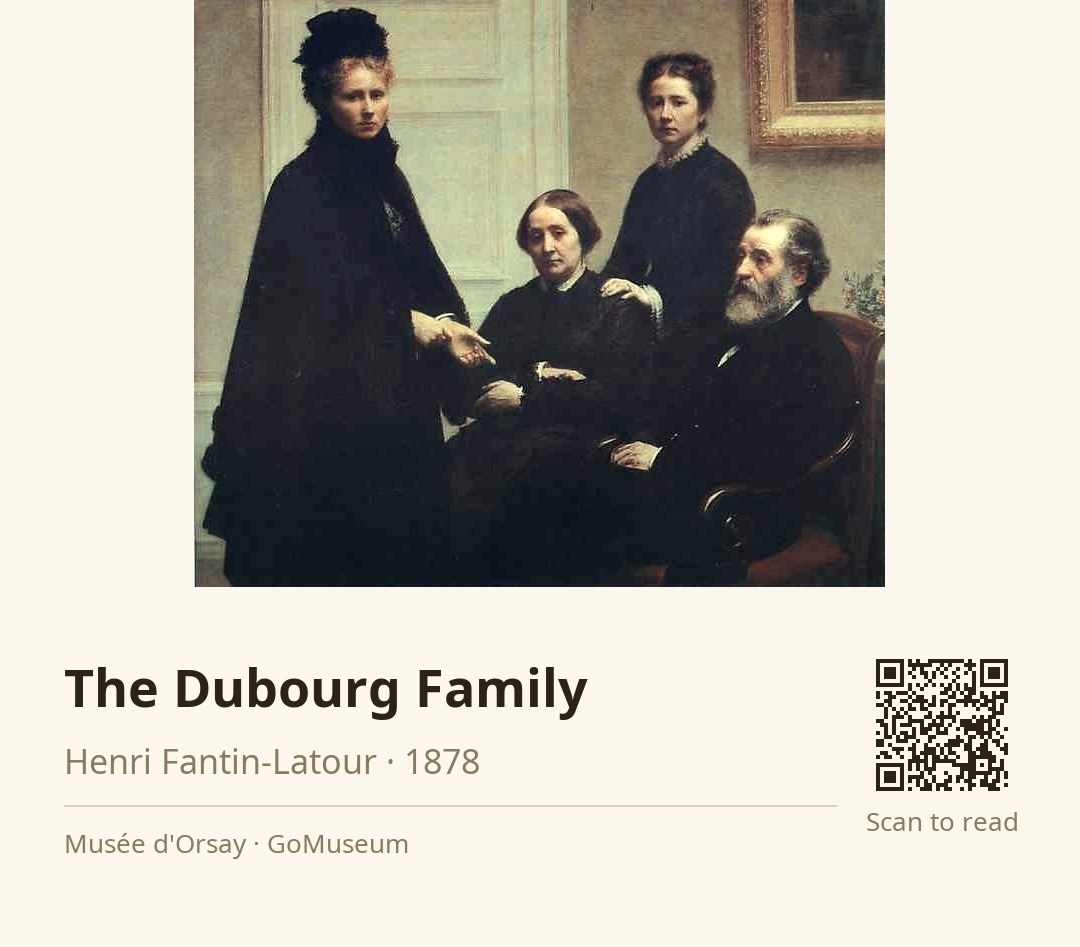
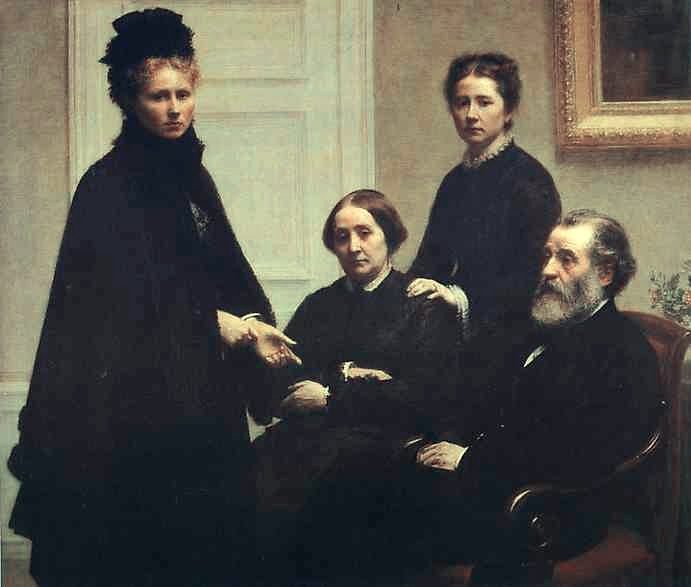
🎧 This work has audio narration — listen in the appThe four figures in "The Dubourg Family" create a striking tableau of domestic life, with the standing woman on the left capturing immediate attention in her dark dress and black hat, her gaze directed outward as if inviting you into their world. Seated in the center, two women in similar dark clothing share a quiet moment, one of them delicately holding a small object, while the bearded man on the right, dressed in dark attire, adds a sense of solemnity to the scene.
This arrangement not only establishes a familial bond but also reflects the societal norms of the late 19th century, where such portraits often served to document lineage and social status. The subdued color palette, dominated by dark tones, emphasizes the figures against a lighter background, creating a sense of intimacy and focus on their expressions and interactions. The closed white door and framed picture in the background hint at the private nature of their gathering, suggesting a moment captured within the confines of their home.
Henri Fantin-Latour painted this work in 1878, showcasing his ability to blend realism with an intimate portrayal of family life, a theme that resonated with the era's artistic movements. The painting was exhibited at the Salon des artistes français in Paris the same year, marking its introduction to the public eye.
Ignace Henri Jean Théodore Fantin-Latour, born on January 14, 1836, in Grenoble, was a notable French painter and lithographer renowned for his exquisite flower paintings and group portraits of contemporary artists and writers. His artistic journey began under the guidance of his father, a painter, and continued in Paris, where he studied at the École des Beaux-Arts alongside future Impressionists like Edgar Degas and Alphonse Legros. Despite his connections to the avant-garde, Fantin-Latour's style remained rooted in realism and tradition.
In the 1860s, he gained acclaim for his still lifes, particularly in England, where his works were celebrated for their vibrant colors and textures. Encouraged by James McNeill Whistler, he embraced this genre, which was often undervalued in the hierarchy of art. His still lifes, characterized by their simplicity and focus on form, defied academic conventions and showcased his mastery of color.
Fantin-Latour's contributions to collective portraiture, such as "A Studio at Les Batignolles," positioned him as a bridge between Romanticism and Impressionism. Despite being overshadowed by his contemporaries, his legacy endures, with his works held in prestigious museums and a lasting influence on subsequent generations of artists. He passed away on August 25, 1904, leaving behind a rich artistic heritage that continues to be appreciated today.
The painting made its debut at the Salon des artistes français in Paris that same year, where it was well-received, showcasing Fantin-Latour's unique ability to blend realism with intimate family portrayals. Following its initial exhibition, the painting traveled to Brussels in 1878 and then to London in 1879, further establishing its reputation. It was also featured in the 1882 International Exhibition in Vienna and the 1900 Exposition Universelle in Paris, reflecting its enduring appeal.
The technique in "The Dubourg Family" is a masterclass in oil painting, showcasing Fantin-Latour's meticulous brushwork and keen eye for detail. The artist employs a subdued color palette dominated by dark tones, which not only reflects the attire of the figures but also creates a somber yet intimate atmosphere. The standing woman on the left, with her direct gaze, draws the viewer in, while the seated figures form a triangular composition that guides the eye across the canvas. Fantin-Latour's handling of light subtly illuminates the faces, emphasizing their expressions and interactions, while the closed white door in the background adds a layer of privacy to the scene. This careful arrangement and the choice of scale—large enough to command attention but intimate enough to evoke a sense of closeness—enhance the emotional resonance of the family portrait.
Interestingly, Fantin-Latour was not only a painter of portraits but also a celebrated flower painter. His still lifes gained significant acclaim in England, where he found a market that appreciated his floral compositions, which were largely overlooked in France at the time. This duality in his work highlights his versatility and the varying receptions of his art across different cultures.
Fantin-Latour was also well-known for his flower paintings, which gained significant acclaim, particularly in England.
In England, Fantin-Latour's still lifes were highly appreciated, while in France, they were largely overlooked during his lifetime.