A Cart on the Snowy Road at Honfleur
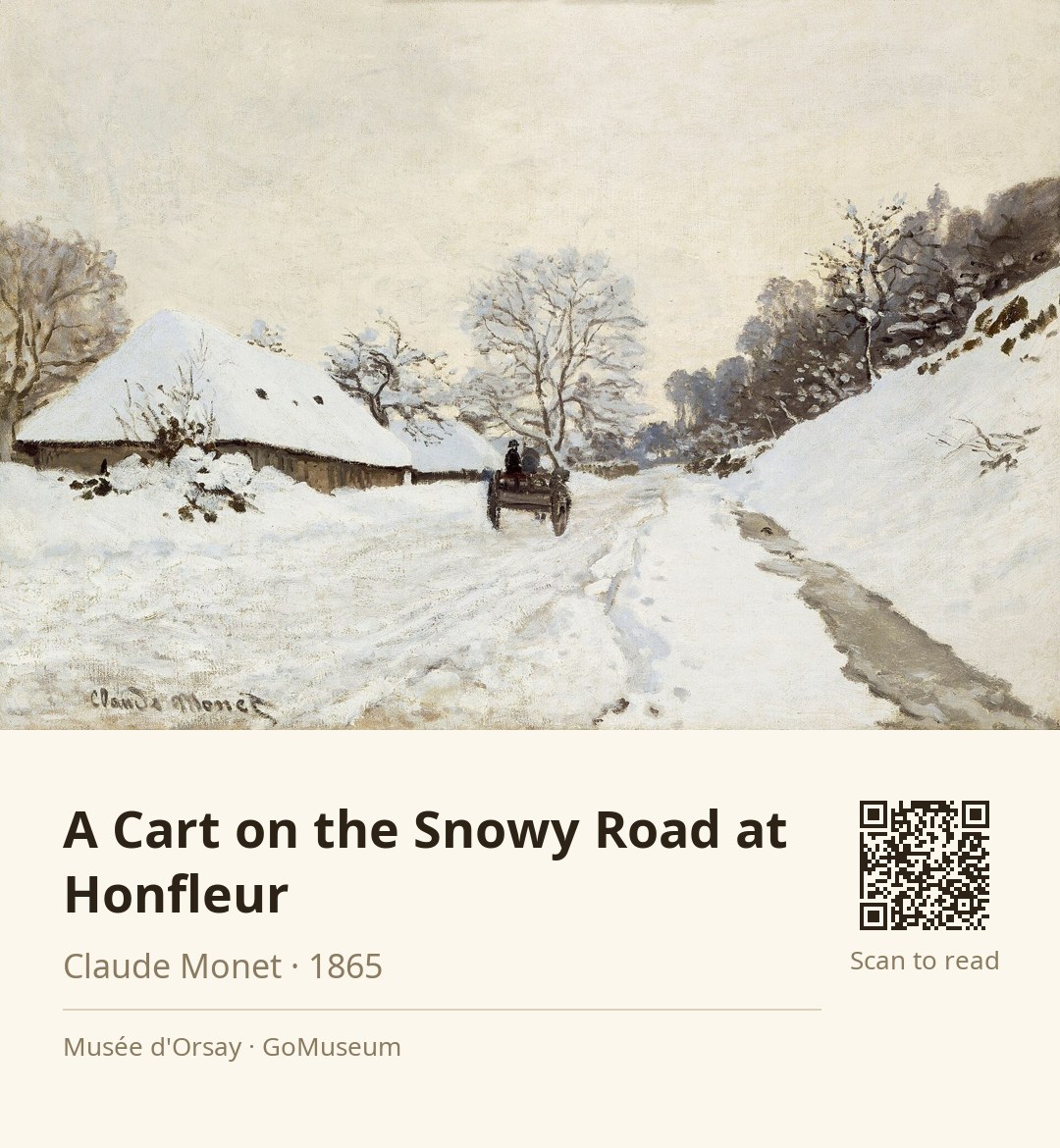
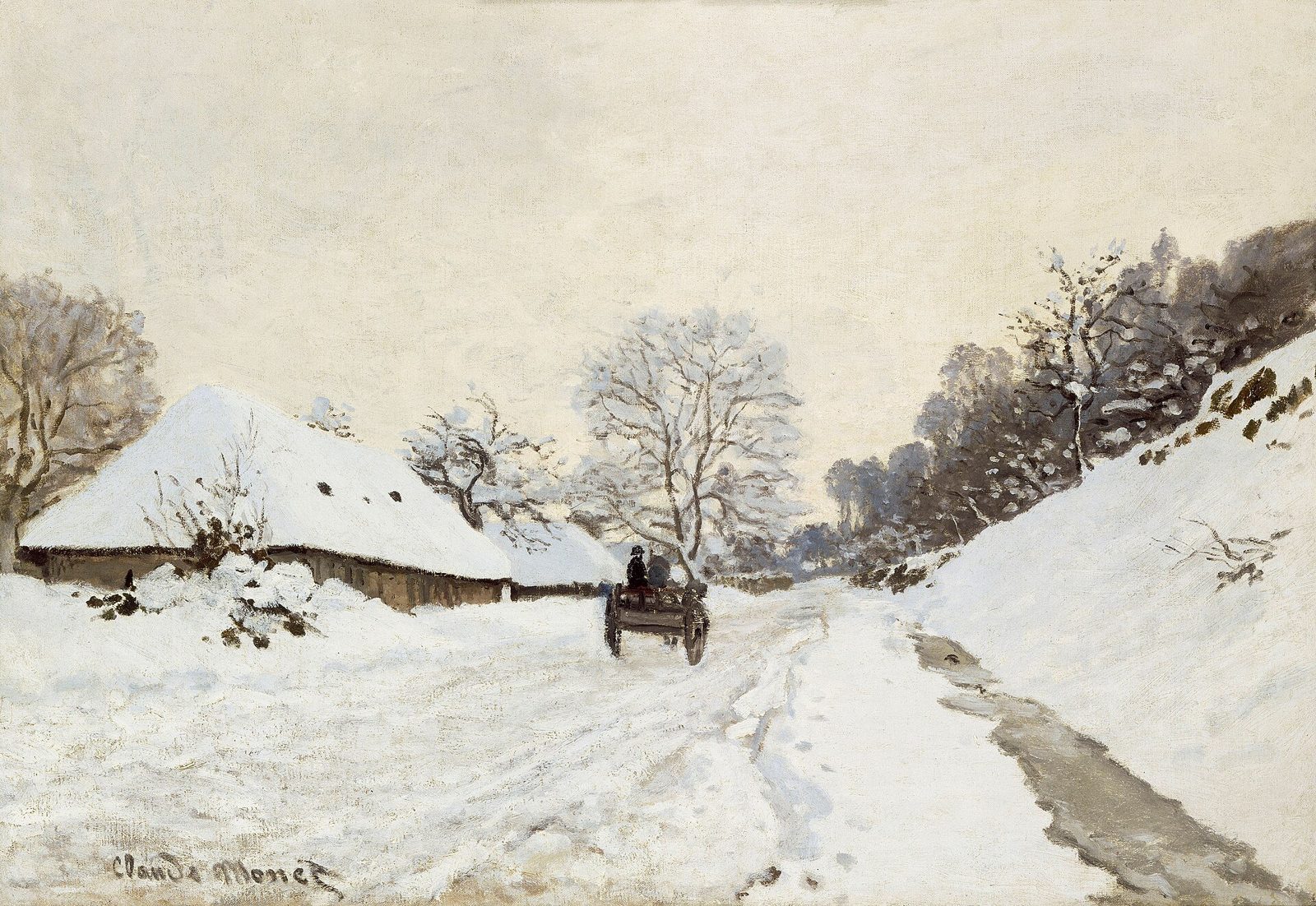
🎧 This work has audio narration — listen in the appTake a moment to really look at "A Cart on the Snowy Road at Honfleur." Notice how the snow blankets the landscape, transforming the familiar into something almost magical. The cart, with its solitary figure, seems to glide through this winter wonderland, don’t you think?
Now, focus on the way Monet captures the light reflecting off the snow. It’s not just white; there are hints of blue and lavender peeking through, creating a vibrant tapestry of color. This isn’t just a depiction of winter; it’s Monet’s way of inviting you into the moment, to feel the chill and the quiet beauty of the scene.
Monet painted this in 1865, during a time when he was exploring the effects of light and atmosphere in his work. This piece is one of his earliest snowscapes, and you can see how he was influenced by Japanese art, particularly in the way he uses a single vanishing point to draw your eye into the distance.
As you stand here, think about how Monet was one of the pioneers of Impressionism, striving to capture fleeting moments of nature. What do you think he wanted you to feel as you gaze at this snowy path?
Oscar-Claude Monet, born on November 14, 1840, in Paris, was a pioneering French painter and a founder of Impressionism, a movement that transformed the art world. Raised in Le Havre, he developed a passion for nature and painting early on, encouraged by his mother, while his father hoped he would pursue a business career. After his mother's death in 1857, Monet moved in with his aunt, who supported his artistic ambitions.
Monet's career began with caricatures, but he soon sought formal training, studying under Eugène Boudin, who introduced him to plein air painting. His breakthrough came in 1866 with "La Femme à la robe verte," which garnered attention at the Salon. The term "Impressionism" originated from his work "Impression, Sunrise," exhibited in 1874, marking a shift away from traditional art.
Throughout his life, Monet focused on capturing the essence of light and color in nature, creating series of paintings that depicted the same scenes under varying conditions, such as his famous haystacks and water lilies. He settled in Giverny in 1883, where he cultivated a beautiful garden that became his muse. Despite personal hardships, including the loss of loved ones and health issues, Monet's relentless dedication to his craft solidified his place in art history as a master of modernism, influencing countless artists and leaving a lasting legacy. He died on December 5, 1926, in Giverny, celebrated as one of the most significant figures in art.
It represents one of Monet's early explorations into snowscapes, a genre he would become renowned for, painting nearly 140 such works throughout his career. The piece captures a solitary cart traversing a snow-covered road in Honfleur, a picturesque town in Normandy that Monet often painted. It was later acquired by the Galerie Durand-Ruel in Paris in 1889, a significant gallery that played a crucial role in promoting Impressionist artists. The painting eventually passed through various hands, including a sale involving Gauguin and was bequeathed to the museum by Isaac de Camondo in 1911.
As you gaze at this painting, notice the dynamic brushwork that Monet employs. The strokes are not just random; they create a sense of movement, almost as if the snow is gently swirling around the cart. The color palette is a masterclass in subtlety, with layers of white interspersed with blues and lavenders that breathe life into the scene. Monet's choice of a single vanishing point draws your eye into the distance, inviting you to journey along the snowy path. The composition balances the cart and figure against the vastness of the snow, emphasizing their solitude in this winter landscape. This technique of layering paint and varying brushstrokes gives the snow a textured, almost tactile quality, making you feel the chill in the air. It's a brilliant example of how Monet captures not just a moment in time, but the very essence of winter itself.
Interestingly, 'A Cart on the Snowy Road at Honfleur' is one of nearly 140 snowscapes Monet painted throughout his career. This particular piece is thought to have been inspired by the works of Japanese artist Utagawa Hiroshige, reflecting Monet's fascination with Japanese art and its influence on his approach to composition and color. The single vanishing point and the varied hues of snow are elements that echo Hiroshige's style, showcasing the cross-cultural exchanges that enriched Monet's artistic vision.
Monet was known to have been deeply affected by the loss of his mother just a few years prior, which may have influenced his choice of subjects and the melancholic yet serene atmosphere in his winter landscapes.
Growing up in Normandy, Monet was familiar with the region's snowy winters, which likely inspired his fascination with capturing the unique qualities of snow and light in his paintings.