Rouen Cathedral, Portal, Front View
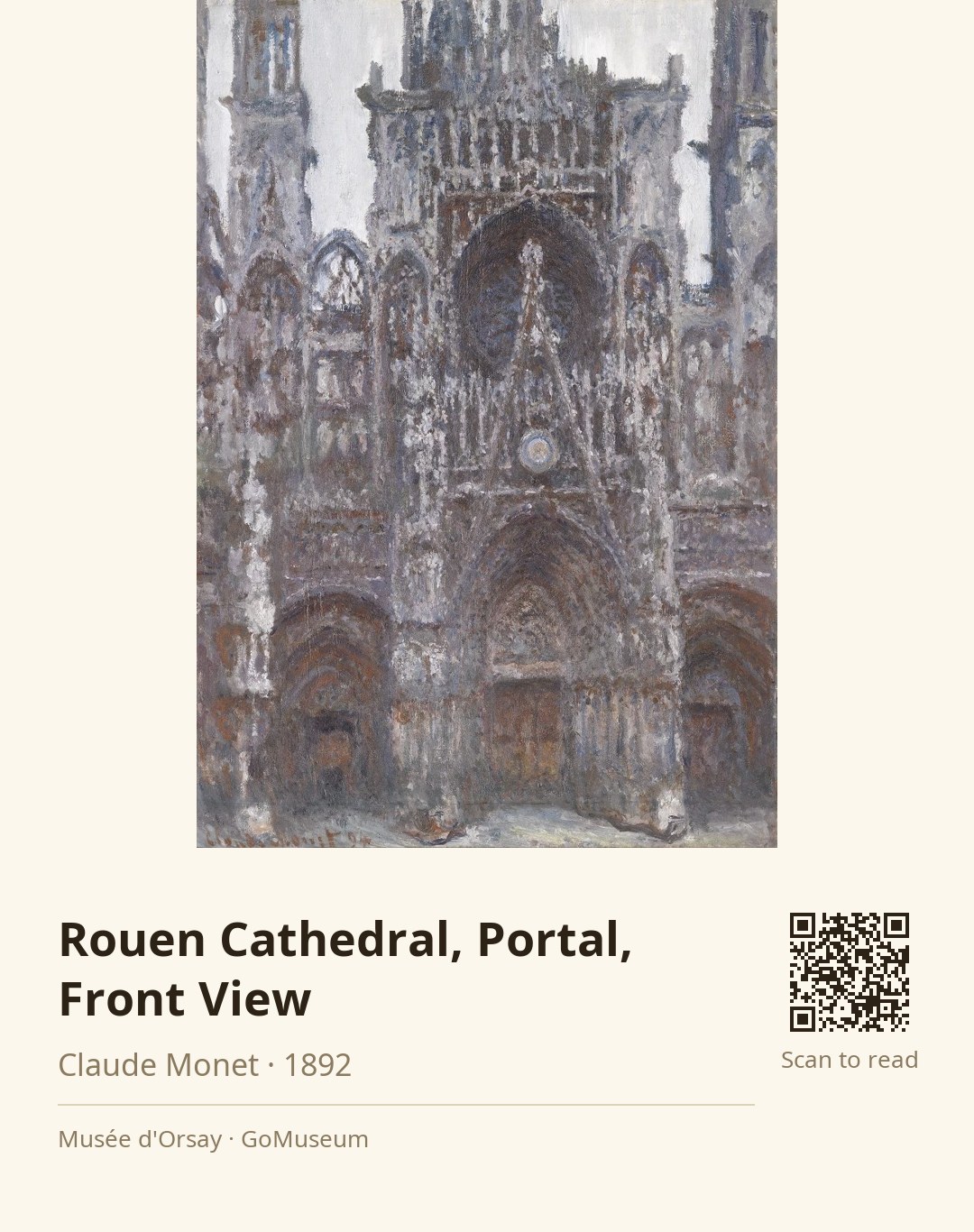
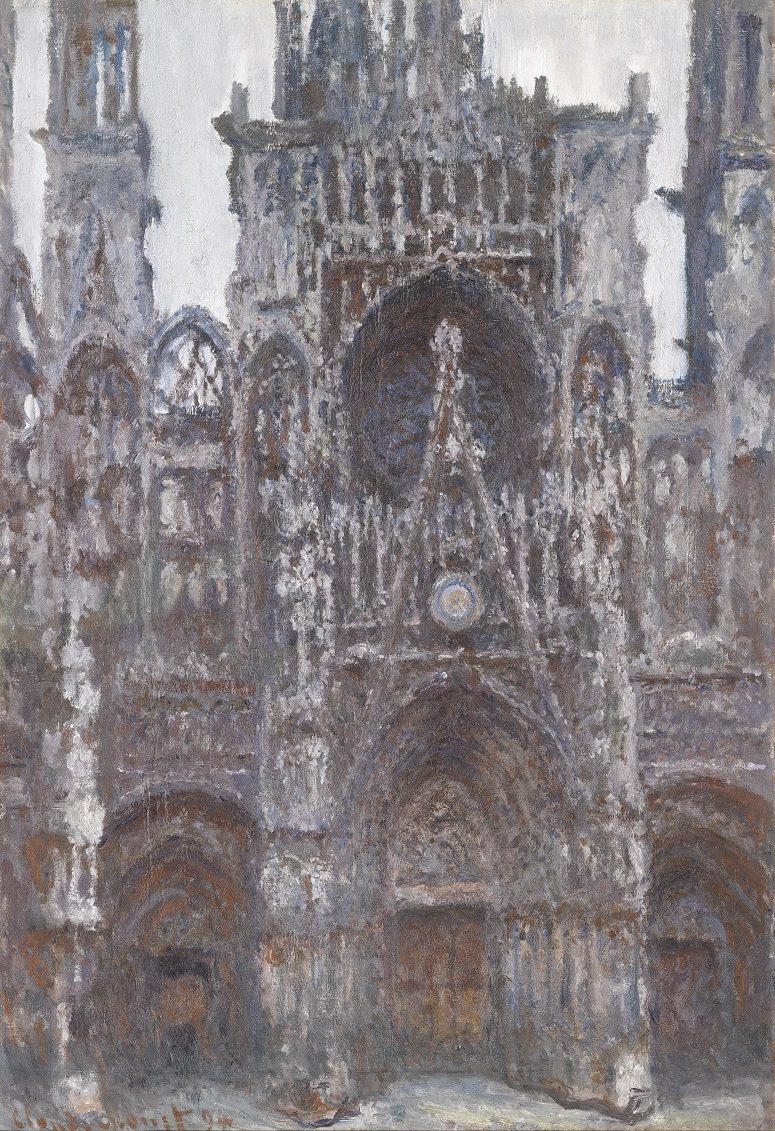
🎧 This work has audio narration — listen in the appThree dark arched doorways sit at the base of a Gothic facade, and the tallest, in the center, seems to pull everything above it upward. Look at the wall itself: the carved edges have been dissolved into short, crusty dabs of lilac, grey and slate, with flecks of rust and ochre in the arches. The round window above the central doorway is there, and so is the small circular disc beneath it, but they arrive as texture rather than as crisp shapes.
That blurring is the point. Monet was less interested in the cathedral as a building than in how it looked to his eye at a particular moment, when light and air softened its outline. The thick, broken paint keeps the surface alive, so the cathedral reads as something caught in changing weather rather than fixed in stone.
Monet came back to the same facade again and again. From 1892 onward he worked on a whole series of views of the cathedral, painting it in different hours and seasons, and this canvas belongs to that effort.
Oscar-Claude Monet, born on November 14, 1840, in Paris, was a pioneering French painter and a founder of Impressionism, a movement that transformed the art world. Raised in Le Havre, he developed a passion for nature and painting early on, encouraged by his mother, while his father hoped he would pursue a business career. After his mother's death in 1857, Monet moved in with his aunt, who supported his artistic ambitions.
Monet's career began with caricatures, but he soon sought formal training, studying under Eugène Boudin, who introduced him to plein air painting. His breakthrough came in 1866 with "La Femme à la robe verte," which garnered attention at the Salon. The term "Impressionism" originated from his work "Impression, Sunrise," exhibited in 1874, marking a shift away from traditional art.
Throughout his life, Monet focused on capturing the essence of light and color in nature, creating series of paintings that depicted the same scenes under varying conditions, such as his famous haystacks and water lilies. He settled in Giverny in 1883, where he cultivated a beautiful garden that became his muse. Despite personal hardships, including the loss of loved ones and health issues, Monet's relentless dedication to his craft solidified his place in art history as a master of modernism, influencing countless artists and leaving a lasting legacy. He died on December 5, 1926, in Giverny, celebrated as one of the most significant figures in art.
The painting is a tall, upright canvas, roughly 107 by 73 centimetres, and the facade fills almost all of it. The palette is muted lilac, grey, blue-violet and slate, warmed by rust, brown and ochre in the arches and lower stonework. The paint is thick and broken, laid on in short dabs and crusty strokes, so the architecture dissolves into a surface of texture. Only a narrow strip of pale grey-white sky shows behind the stone, and the pavement at the bottom is only loosely suggested, with no figures in it.
The title is also given in French as "La cathédrale de Rouen ; le portail vu de face ; harmonie brune", which means that the work carries the subtitle "harmonie brune", or brown harmony, alongside the simpler descriptive title.
Not usually. According to the French biography, he began each canvas on the spot, covering the whole surface from the first sketches, but he finished most of his paintings in the studio, using the first pictures of a series as models for the rest, despite claiming otherwise.