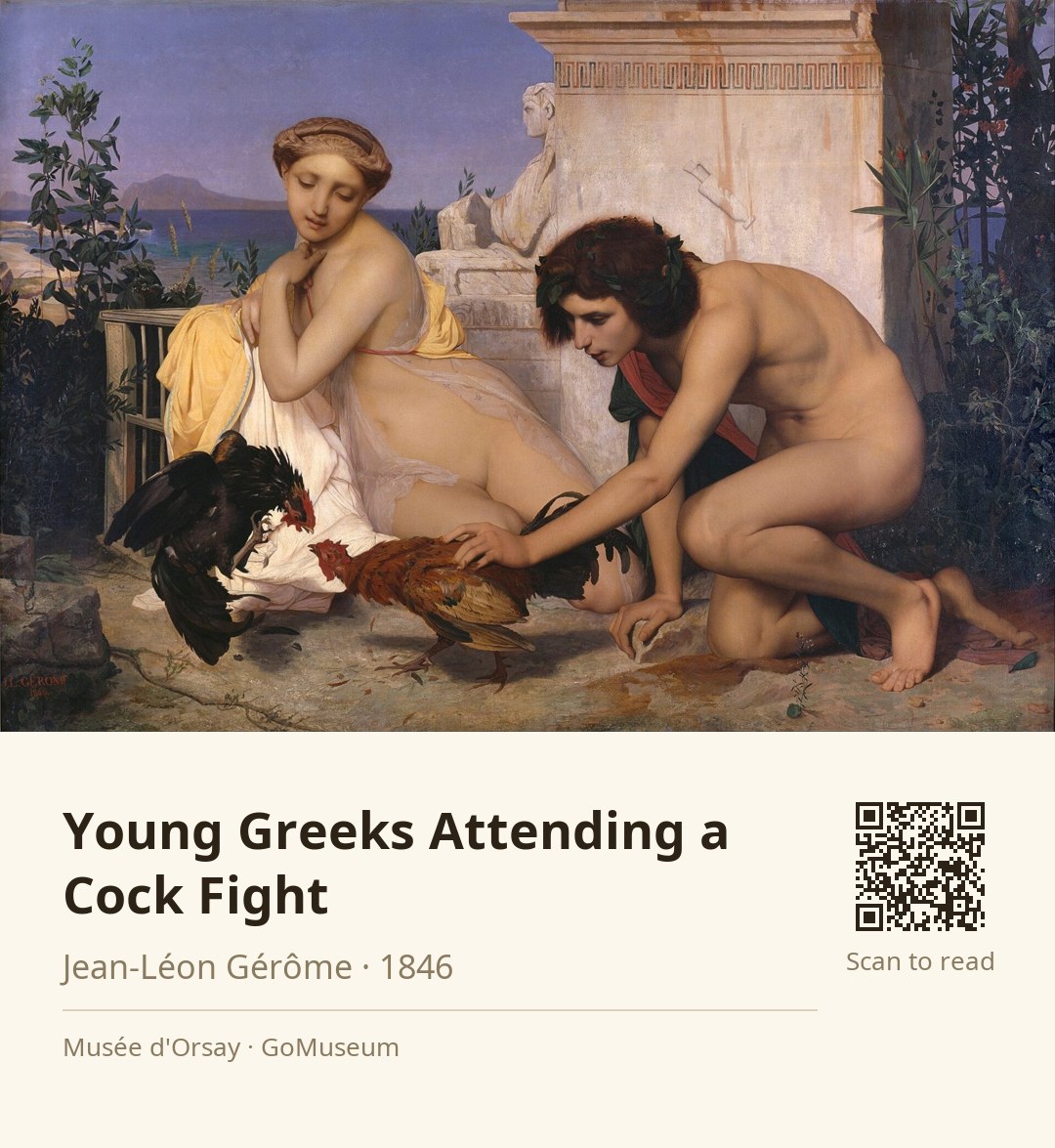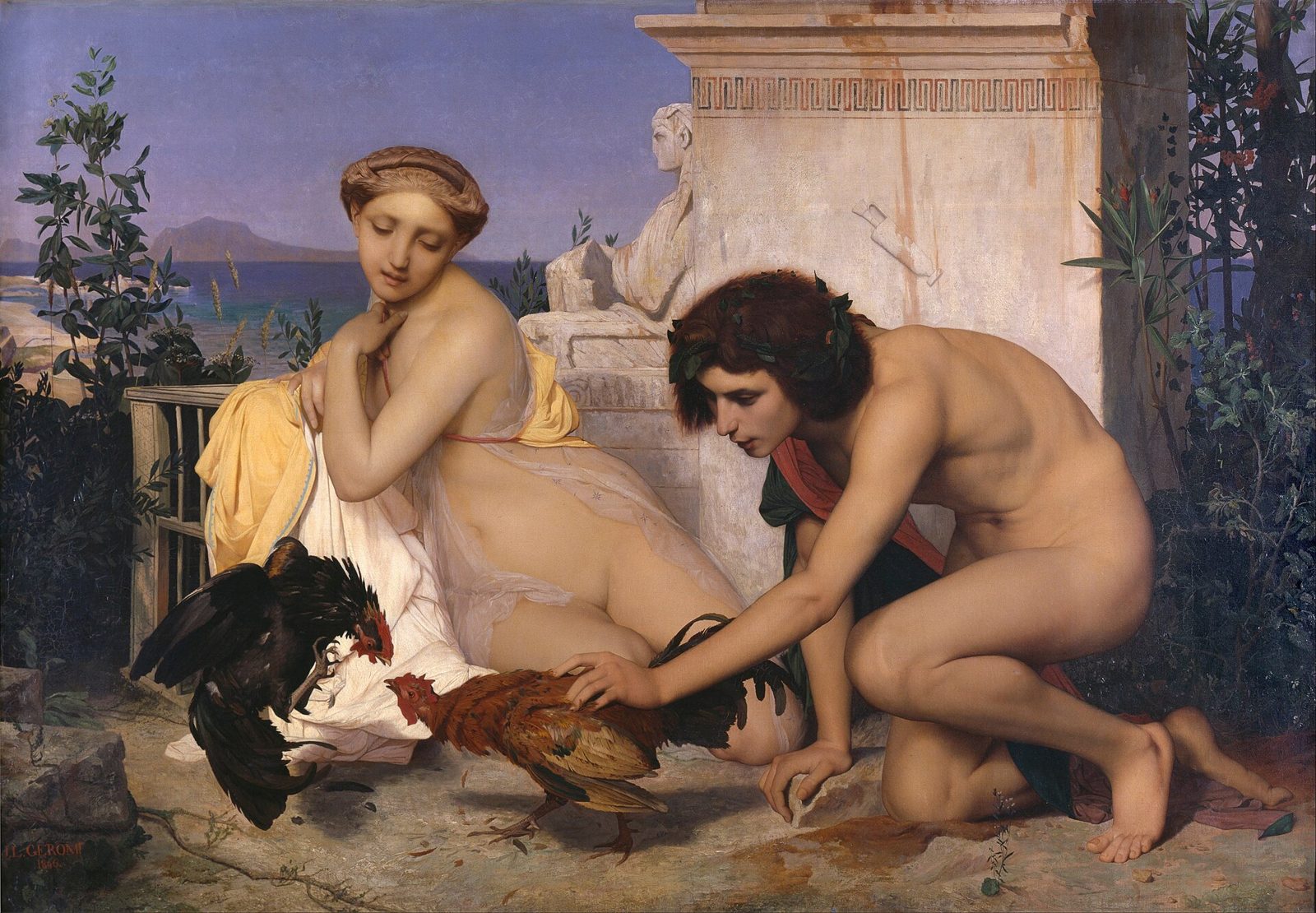
Young Greeks Attending a Cock Fight
🎧 This work has audio narration — listen in the appTake a moment to really look at "Young Greeks Attending a Cock Fight." Notice how the young men and women are depicted in a lively, almost playful manner, their bodies relaxed yet engaged in the action before them. The way the sunlight dances on their skin and the vibrant colors of the background draw you into this scene of youthful exuberance.
Now, focus on the intricate details of the stone monument behind them. It’s not just a backdrop; it hints at a rich cultural heritage, suggesting that this cockfight is more than a simple game—it's a celebration of life and tradition in ancient Greece. Gérôme captures this moment with a sense of authenticity that transports you to another time and place.
Created in 1846, this painting marked one of Gérôme's first major successes, showcasing his mastery of the Neo-Grec style. His teacher, Paul Delaroche, encouraged him to exhibit this work at the Salon, where it was well-received and earned him a bronze medal. This moment was pivotal in launching his illustrious career.
As you stand here, think about the energy of the scene. What stories might these young Greeks share as they watch the roosters fight? What does this painting say about youth, competition, and the spirit of community? Let that question linger as you take in the vibrant life captured on this canvas.
Jean-Léon Gérôme, born on May 11, 1824, in Vesoul, France, was a prominent painter and sculptor known for his academic style. He gained fame in the mid-19th century, becoming arguably the most celebrated artist of his time. Gérôme's work spanned various genres, including historical, mythological, and Orientalist themes, showcasing his meticulous attention to detail and vibrant compositions. His early education in drawing laid the foundation for his artistic journey, which included studies under notable mentors in Paris.
Gérôme's career flourished after his debut at the Paris Salon in 1847, where his painting "The Cock Fight" garnered critical acclaim. He became a leading figure in the Neo-Grec movement and later embraced Orientalism after travels to Egypt and the Ottoman Empire. His works often depicted exotic scenes, blending accurate architectural details with idealized figures. As a teacher at the École des Beaux-Arts, he influenced a generation of artists, including Mary Cassatt and Thomas Eakins.
Despite his initial success, Gérôme's resistance to modern movements like Impressionism led to a decline in his reputation after his death on January 10, 1904. However, his art experienced a revival in the late 20th century, inspiring filmmakers and continuing to be celebrated for its technical prowess and historical significance. With around 600 paintings and numerous sculptures, Gérôme remains a key figure in the academic art tradition of the Second Empire.
Jean-Léon Gérôme's 'Young Greeks Attending a Cock Fight' was created in 1846, during a pivotal moment in his artistic journey. After a disappointing attempt to win the Prix de Rome, Gérôme hesitated to showcase this work, fearing another setback. However, his mentor, Paul Delaroche, encouraged him to submit it to the Salon of 1847. The painting was met with great acclaim, earning Gérôme a bronze medal and marking his emergence as a significant figure in the Neo-Grec movement. Initially purchased by Mr. Roux-Laborie, it changed hands several times before being acquired by the French state in 1873, thanks to art dealer Adolphe Goupil. It was first displayed at the Musée du Luxembourg, later moving to the Louvre in 1920, and finally finding its home at the Musée d'Orsay in 1986. This trajectory not only reflects the painting's popularity but also Gérôme's rise in the art world, solidifying his legacy as a master of academic painting.
In 'Young Greeks Attending a Cock Fight,' Gérôme employs a meticulous technique that showcases his mastery of light and color. The sunlight bathes the figures in a warm glow, enhancing their youthful vitality and the dynamic atmosphere of the scene. Notice how the brushwork feels both precise and lively; each stroke brings texture to the skin and fabric, creating a sense of movement. The composition is carefully structured, with the figures arranged in a semi-circle around the cockfight, drawing your eye into the action. The background, with its detailed stone monument, not only grounds the scene in a specific cultural context but also contrasts with the fluidity of the figures, emphasizing their engagement in the moment. This interplay between the static and the dynamic heightens the painting's emotional impact, inviting you to feel the excitement of the event.
Jean-Léon Gérôme's 'Young Greeks Attending a Cock Fight' is a pivotal piece in the Neo-Grec movement, showcasing a blend of classical themes with contemporary life. This painting not only marked one of Gérôme's first major successes but also influenced a generation of artists exploring similar themes of genre and nudity within an academic framework. The work's detailed realism and vibrant storytelling captivated audiences at the 1847 Salon, earning Gérôme a bronze medal and solidifying his reputation. It laid the groundwork for his later explorations into Orientalism and historical subjects, making him a key figure in 19th-century art. Remember, this painting was a launching pad for a career that would shape the academic art scene for decades to come.
Here's a little nugget for you: Jean-Léon Gérôme was hesitant to show this painting, fearing it might not be well-received after a previous setback in his career. But his teacher, Paul Delaroche, encouraged him to enter it into the Salon. It turned out to be a huge success! Gérôme snagged a bronze medal and launched his career with this very piece. It’s fascinating to think how one person’s belief in another can change the course of an artist’s life, isn’t it?