Young Girl in a Ball Gown
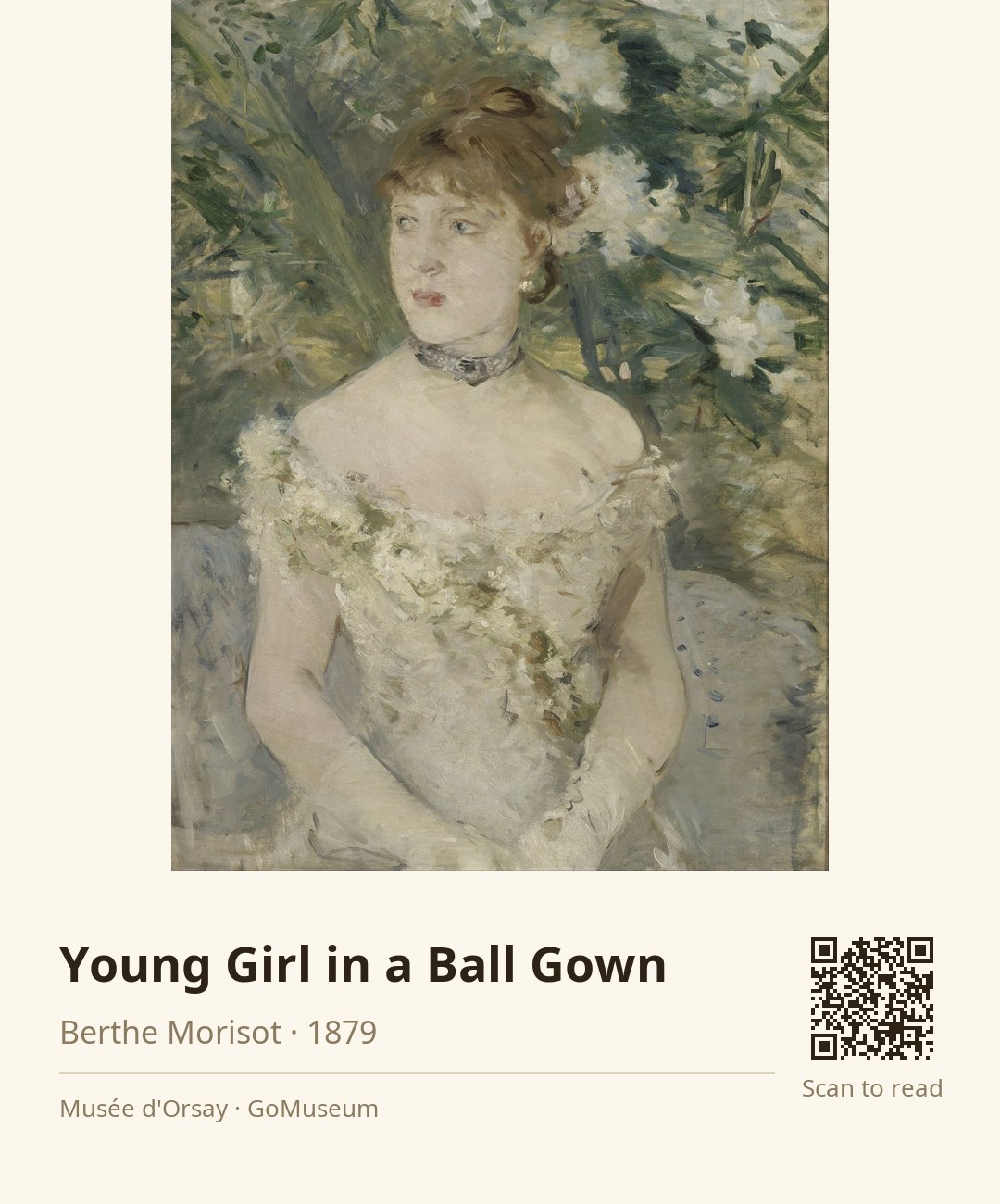
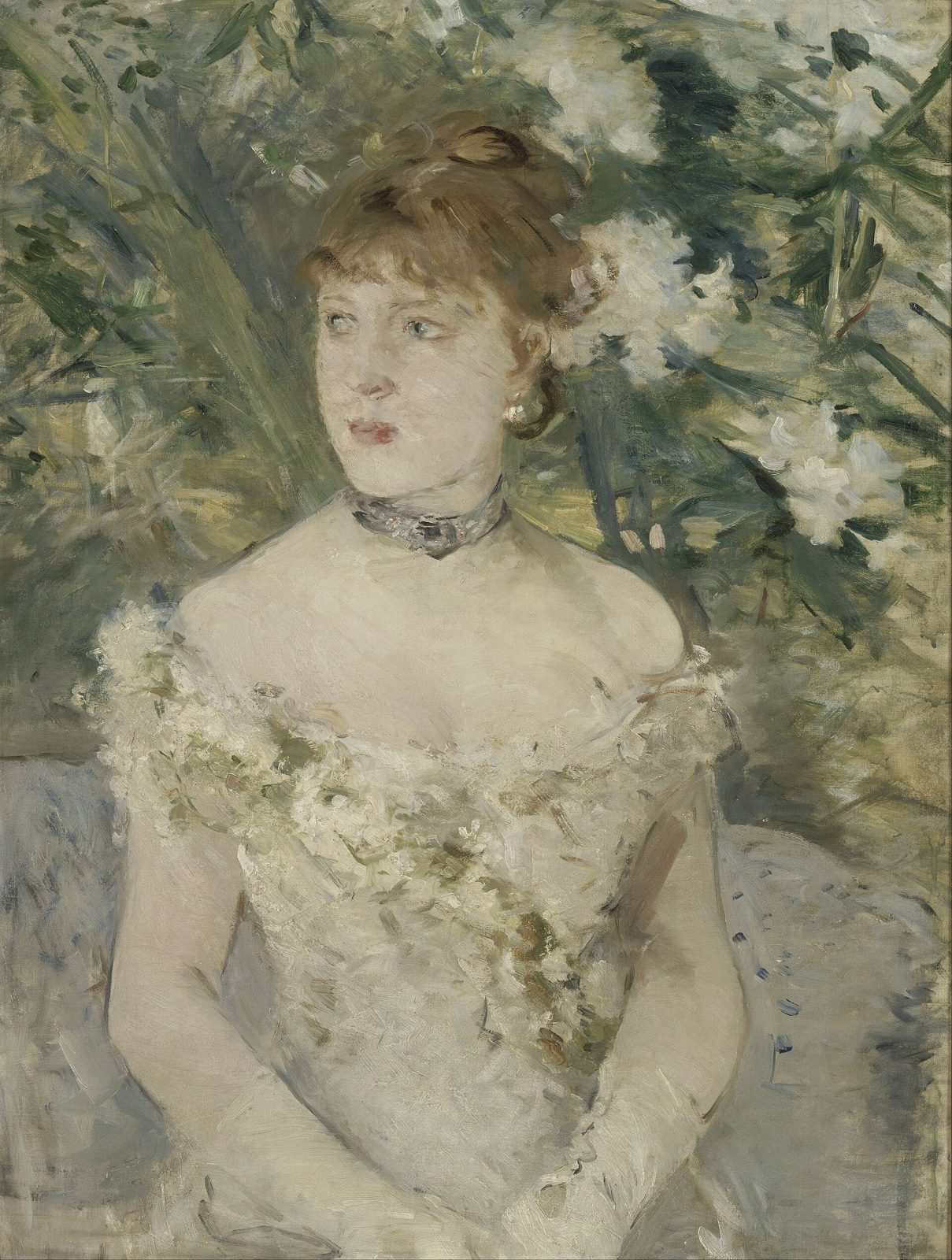
🎧 This work has audio narration — listen in the appThe young woman in an elegant ball gown captures your attention with her poised gaze and delicate attire. The off-the-shoulder gown, adorned with intricate floral details, hints at both sophistication and youthfulness, while a flower tucked behind her ear adds a touch of whimsy. The lush background, a blend of greens and whites, envelops her in an impressionistic atmosphere, enhancing the sense of intimacy and grace.
Morisot's choice of muted colors—soft pinks, greens, and whites—creates a serene ambiance that reflects the delicate nature of her subject. This painting, created in 1879, is not just a portrait; it embodies the essence of femininity during a time when women were often relegated to the background in art. Morisot, a pioneering female artist in the Impressionist movement, was known for her ability to capture the subtleties of women's lives, and this work exemplifies her unique perspective.
Berthe Morisot was a pioneering French painter born on January 14, 1841, in Bourges. Coming from an affluent family, she received a private art education alongside her sisters, fostering a deep passion for painting. Morisot first exhibited her work at the Paris Salon in 1864 and became a key figure in the Impressionist movement, participating in nearly all of its exhibitions from 1874 to 1886. Her innovative approach, characterized by light brushwork and a focus on domestic life and women’s experiences, distinguished her in a male-dominated art world. Married to Eugène Manet, brother of fellow artist Édouard Manet, she maintained close relationships with prominent Impressionists like Monet and Renoir. Art critic Gustave Geffroy recognized her as one of the three great ladies of Impressionism, alongside Mary Cassatt and Marie Bracquemond. Morisot's legacy endures as she broke barriers for women in art, leaving an indelible mark on the Impressionist movement before her death on March 2, 1895.
Berthe Morisot's 'Young Girl in a Ball Gown' was painted in 1879 and first showcased at the fifth Impressionist exhibition in Paris in 1880. This work was acquired shortly after by Giuseppe De Nittis, a fellow artist, before passing into the hands of art critic Théodore Duret. Duret sold the painting to the French state in 1894, following encouragement from the poet Stéphane Mallarmé, which led to its display at the Musée du Luxembourg. Since the opening of the Musée d'Orsay in 1986, it has been a prominent part of their collection, frequently featured in exhibitions celebrating Impressionism and the contributions of female artists. Morisot's work was well-received, celebrated for its delicate portrayal of femininity and the subtleties of women's lives during a time when such perspectives were often overlooked in art.
In 'Young Girl in a Ball Gown,' Morisot employs loose, fluid brushwork that creates an ethereal quality, allowing the viewer to feel the softness of the fabric and the gentle ambiance of the scene. The oil paint on canvas is handled with a deft touch, layering muted greens, whites, and soft pinks to evoke a sense of intimacy. The three-quarter view of the subject, combined with the impressionistic background, draws the eye to the young woman while simultaneously enveloping her in a lush, dreamlike environment. This technique not only highlights the elegance of her gown but also reflects the delicate nature of her character. The overall composition, with its harmonious palette and soft transitions, invites a contemplative response, capturing the fleeting essence of youth and grace.
Berthe Morisot was married to Eugène Manet, who was the brother of the famous artist Édouard Manet, establishing a familial link between them.
Growing up in an affluent family that moved to Paris allowed Berthe Morisot access to art education and the vibrant art scene, which significantly influenced her development as an artist.