The seated armed Man
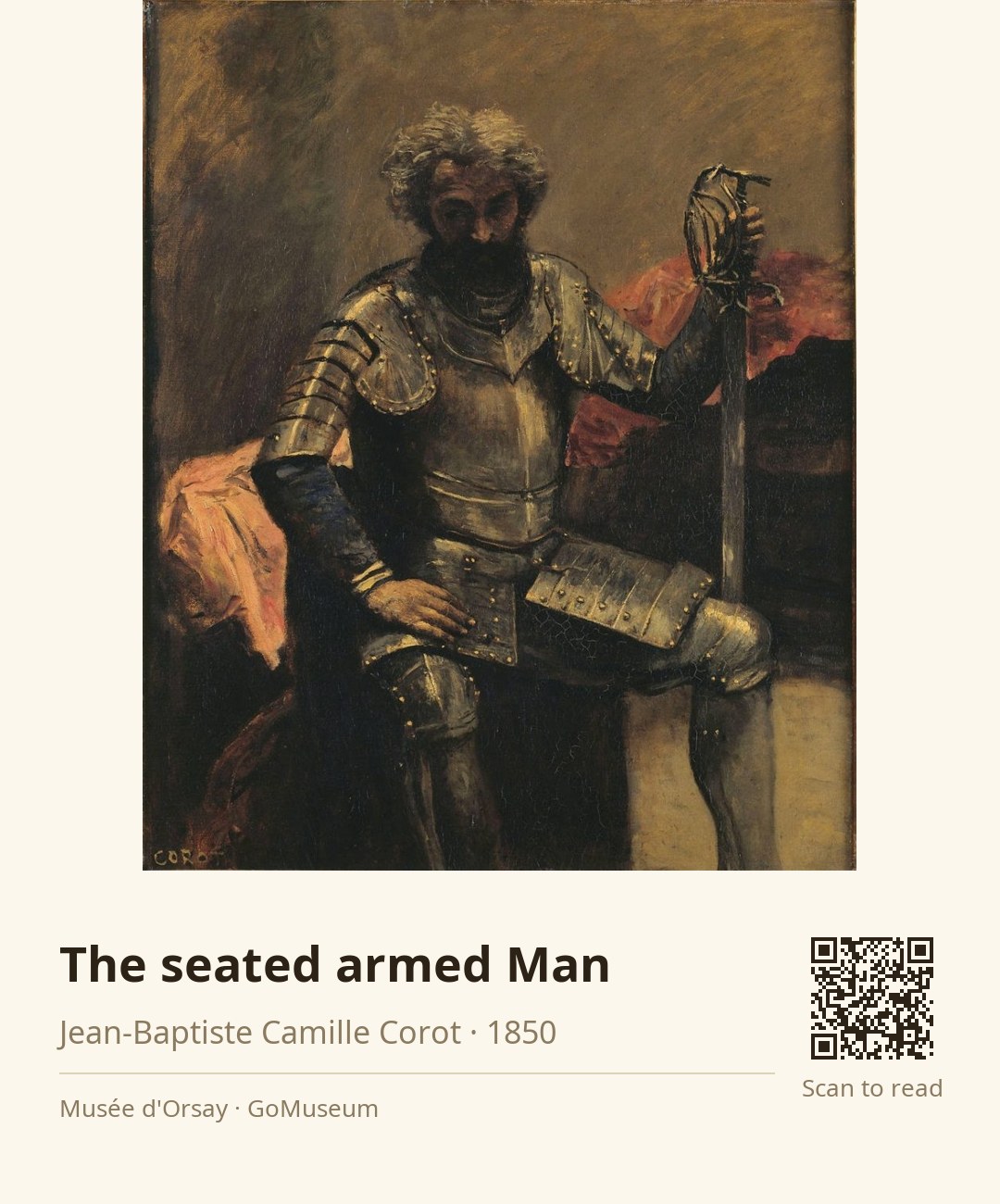
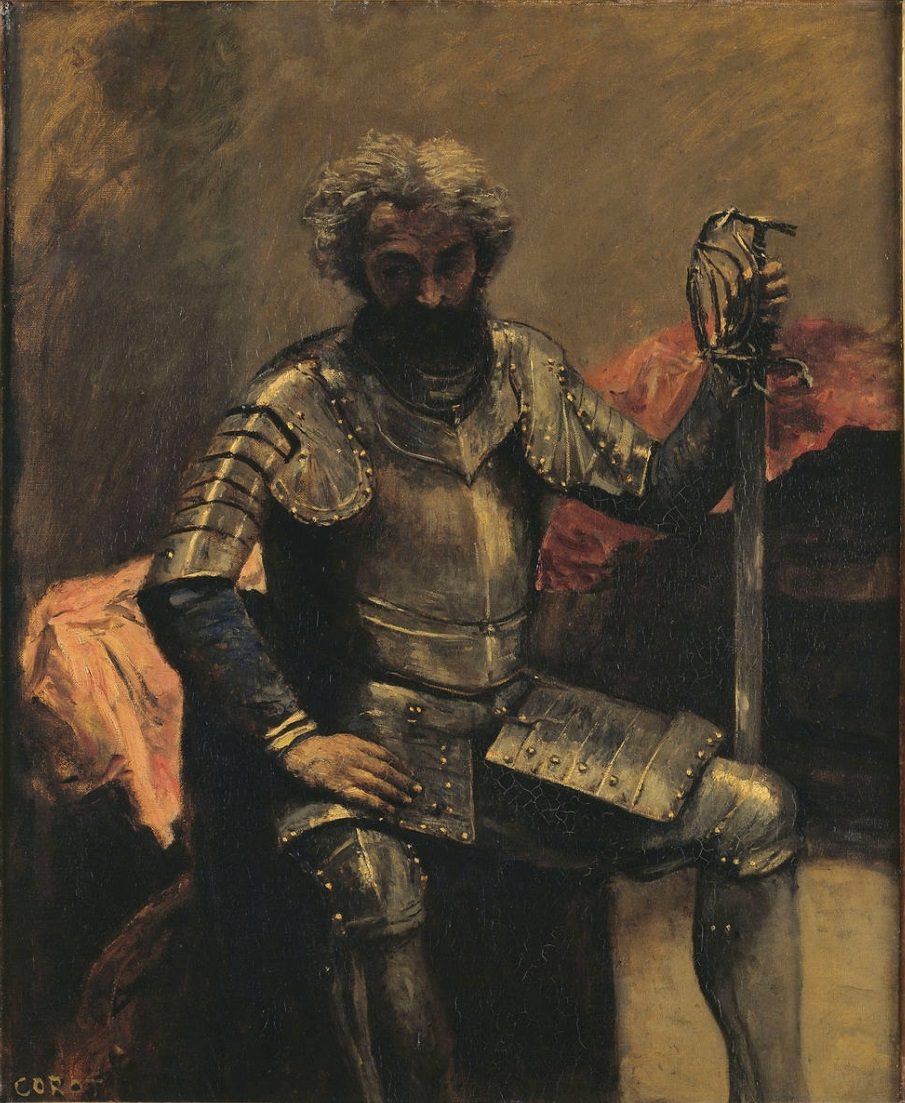
🎧 This work has audio narration — listen in the appYou are looking at a bearded man in full steel armor, one hand gripping a sword whose blade stands upright beside him, his face half-lost in shadow. The gleam of the breastplate and the banded shoulder guards are rendered in muted silver-gray with yellowish highlights, and the surface shows a fine web of cracking that gives the metal an almost old, worn quality.
Notice the sword hilt, held firmly in the raised left hand, and the drapery in salmon pink and red bunched at the edges of the picture. Against those warm touches the dark, brushed brown-ochre background seems to press in on him. The hand resting on the thigh and the downcast eyes suggest a man caught between action and rest, and it is this quiet stillness, rather than any battle, that carries the painting.
What the material gives us about the work itself is limited, but it is clear on a few points. It is catalogued as a portrait of an unidentified man, a "homme d'armes assis," so the sitter has never been named in the records we have. The painting passed through several hands: it was owned by a collector named de Knyff in 1875, offered at the Sourigues sale in Paris on 28 February 1881, handled by the Brame gallery, and later belonged to Édouard Martell in 1888. It was shown in a major Corot retrospective at the École des Beaux-Arts in Paris in 1875, the year the artist died.
Jean-Baptiste-Camille Corot, born on July 16, 1796, in Paris, was a pivotal French landscape and portrait painter whose work bridged the Neo-Classical tradition and the emerging Impressionist movement. Coming from a well-off bourgeois family, he was able to pursue art without financial constraints after receiving a yearly allowance following his sister's death in 1822. Initially uninterested in art, Corot's passion ignited during nature walks with a family friend, leading him to study under Achille Etna Michallon, who encouraged outdoor painting.
Corot's early career was marked by a struggle between commercial obligations and his artistic aspirations, but he eventually dedicated himself fully to painting. He became known for his serene landscapes, often capturing the essence of light and atmosphere, which would later influence Impressionists. Despite being regarded as an amateur for much of his life, he gained recognition around 1850 and became a founding figure of the Barbizon School, emphasizing realism in nature. Corot's legacy endures as a bridge between classical ideals and modern artistic expression, making him a significant figure in art history. He passed away on February 22, 1875, leaving behind a vast and influential body of work.
Look at how little of the man is actually lit. His face sits in shadow, eyes lowered, and only the pale highlights on the steel pull him out of the gloom. The armor is built from riveted plates and banded shoulder pieces, all in muted silvers with yellowish gleams, and the surface carries a fine web of cracks that makes the metal look weathered. Behind him the dark ochre ground is brushed in diagonal strokes, and two salmon-pink and red drapes bunch at the edges like curtains pulled back on a stage. At lower right a pale patch of floor opens up, while dark masses press in from the right and lower left. The figure is cropped at mid-body, turned a little toward one side, so he feels close to us and boxed in at once.
Its recorded owners include a collector named de Knyff in 1875, the Sourigues sale in Paris in 1881, the Brame gallery, and Édouard Martell in 1888.
Yes, it appeared in a Corot exhibition at the École des Beaux-Arts in Paris in 1875, the year the artist died.