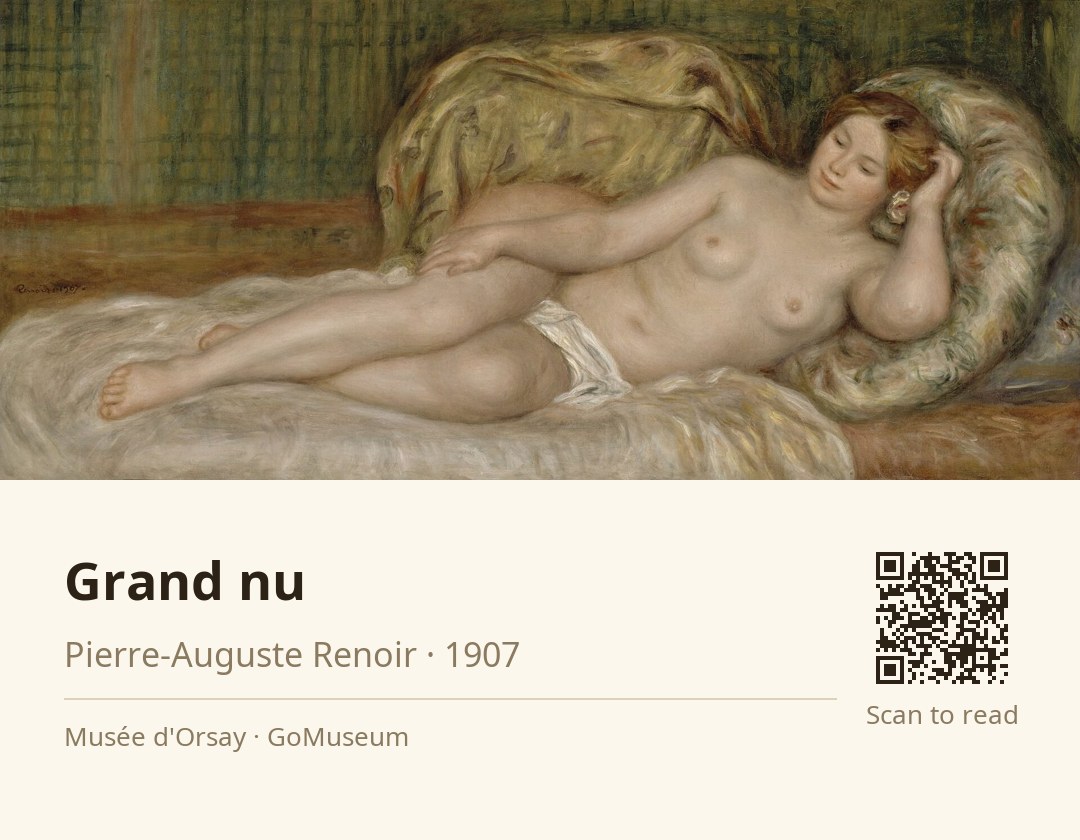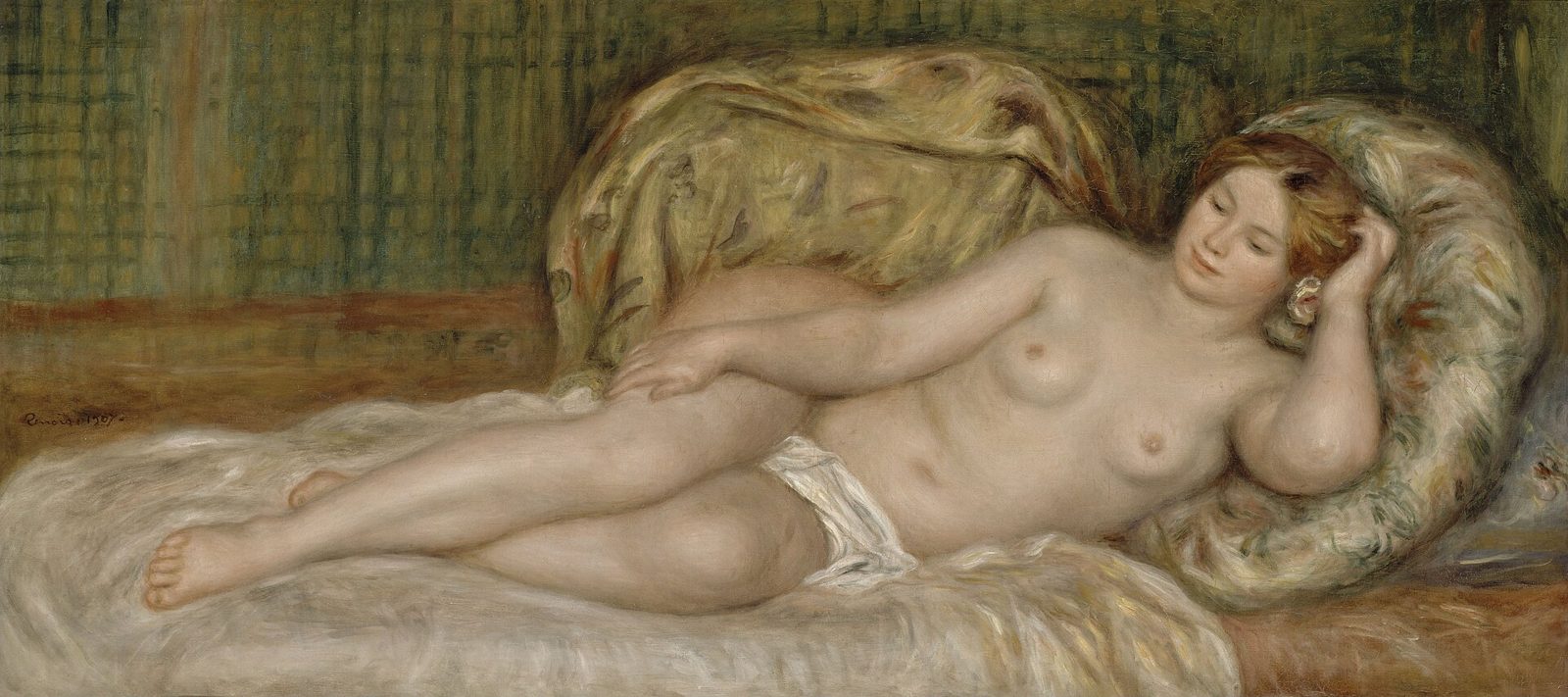
Take a moment to really look at Renoir's "Grand nu." Notice how the soft curves of the woman's body seem to melt into the cushions, almost as if she’s part of the fabric itself. The way the light dances across her skin brings a warmth that feels both intimate and inviting. These details matter because they reveal Renoir's masterful ability to capture not just the physical form, but the essence of femininity and comfort. The gentle play of light and shadow creates a sense of tranquility, inviting you into a private moment of repose. It’s a celebration of the human body, rendered with a tenderness that speaks to Renoir’s deep appreciation for beauty. Created in 1907, this painting reflects Renoir's evolution as an artist, moving towards a more realistic style while still embracing the Impressionist roots that defined his earlier work. He was known for his portraits and nudes, and this piece is a perfect example of his fascination with the female form. As you stand here, think about the emotions this painting evokes. What story do you imagine the woman is lost in, nestled among those cushions?
Pierre-Auguste Renoir, born on February 25, 1841, in Limoges, France, emerged as a pivotal figure in the Impressionist movement. His early life in a modest family led him to Paris, where he honed his artistic skills amidst the masterpieces of the Louvre. Initially apprenticed in a porcelain factory, Renoir's passion for painting flourished, particularly after studying under Charles Gleyre, where he befriended fellow artists like Monet and Sisley.
Renoir's work celebrated feminine beauty and vibrant social scenes, exemplified in iconic pieces like "Dance at Le Moulin de la Galette." Despite facing criticism early on, he gained recognition, especially after participating in the first Impressionist exhibition in 1874. His style evolved over the years, transitioning towards realism influenced by classical masters like Raphael.
Throughout his life, Renoir balanced personal struggles, including health issues, with a prolific output, reportedly creating around four thousand works. He became a beloved figure in art history, known for his warm palette and expressive brushwork. Renoir passed away on December 3, 1919, leaving a legacy that continues to inspire artists and art lovers alike.
Renoir's "Grand nu" was created in 1907, during a pivotal time in his career as he transitioned towards a more realistic style while still holding onto his Impressionist roots. This painting was part of a series of nudes he produced, reflecting his ongoing fascination with the female form. Originally exhibited at the 1913 Renoir exhibition in Paris, it garnered attention for its intimate portrayal of femininity. Over the years, it changed hands several times, starting with Amélie Diéterle in Paris and later moving through various collections, including that of Étienne Vautheret until 1933. After several notable exhibitions, it was accepted by the state as a donation in 1975, eventually finding its home at the Musée d'Orsay in Paris. The painting's journey through different collections highlights its growing significance in the art world, culminating in its recognition as a masterpiece of early 20th-century art.
As you gaze at "Grand nu," pay attention to Renoir's masterful brushwork. The way he layers paint creates a soft, almost velvety texture that enhances the warmth of the woman's skin. Notice how he uses light to sculpt her body, allowing it to blend seamlessly into the cushions. The composition is intimate, drawing your eye to the figure's curves and the gentle play of shadows. Renoir's choice of a relatively small scale, just 1.55 by 0.7 meters, invites you to step closer, to engage with the painting on a personal level. The color palette is rich yet soft, dominated by warm tones that evoke a sense of comfort and tranquility. This technique not only captures the physical beauty of the subject but also conveys a deeper emotional resonance, making you feel as if you are part of this serene moment.
One surprising tidbit about "Grand nu" is that it was originally titled "Nu sur les coussins" when it was first exhibited. This title emphasizes the intimate setting and the relaxed pose of the figure, which Renoir captures with such tenderness.
Renoir had a long-standing relationship with Lise Tréhot, who was not only his lover but also a frequent model, influencing his artistic exploration of feminine beauty and intimacy, as seen in this painting.
During the Paris Commune in 1871, Renoir was nearly thrown into the Seine River by Communards who mistook him for a spy, but he was saved when a leader recognized him as someone who had previously helped him.