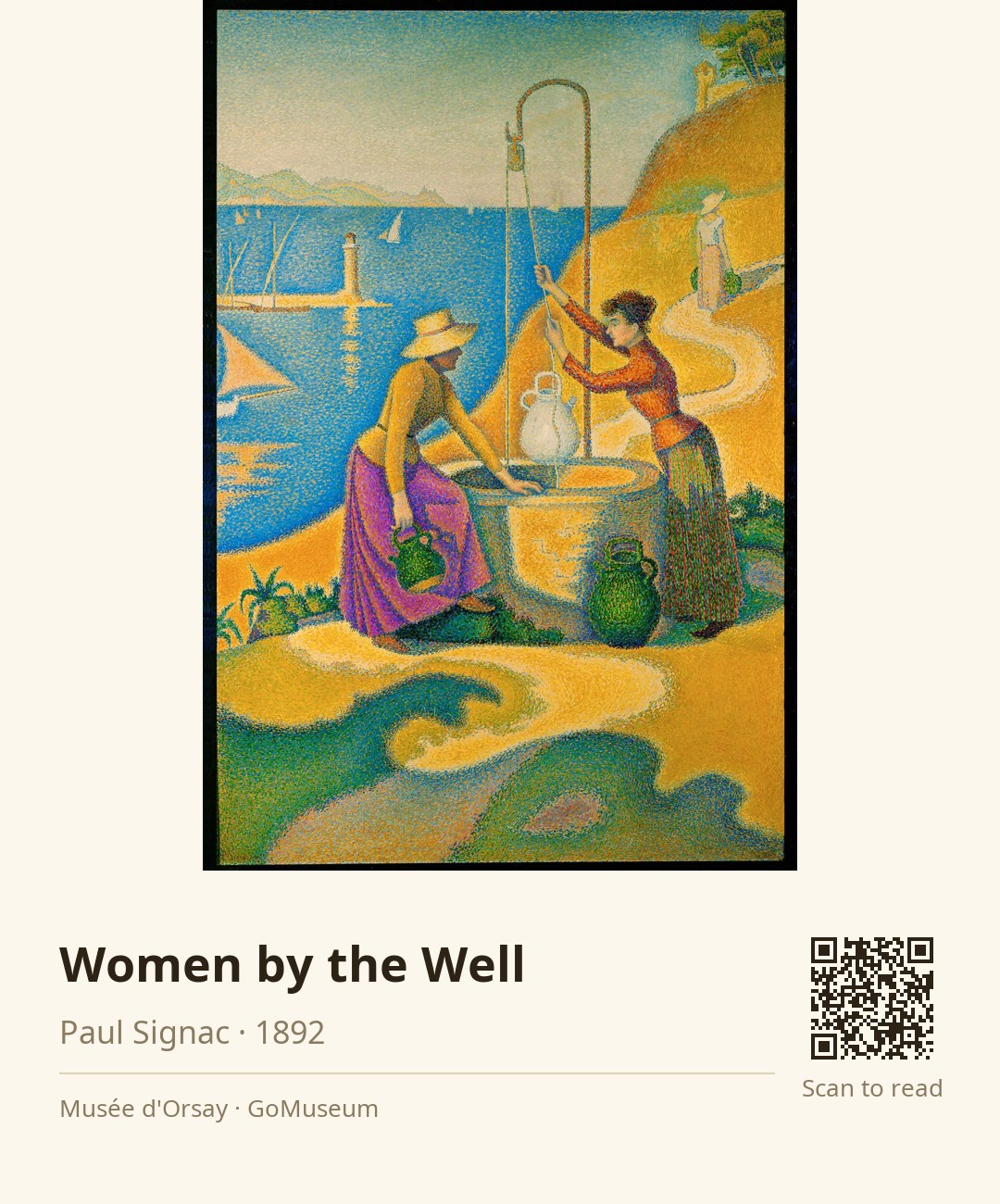
Women by the Well
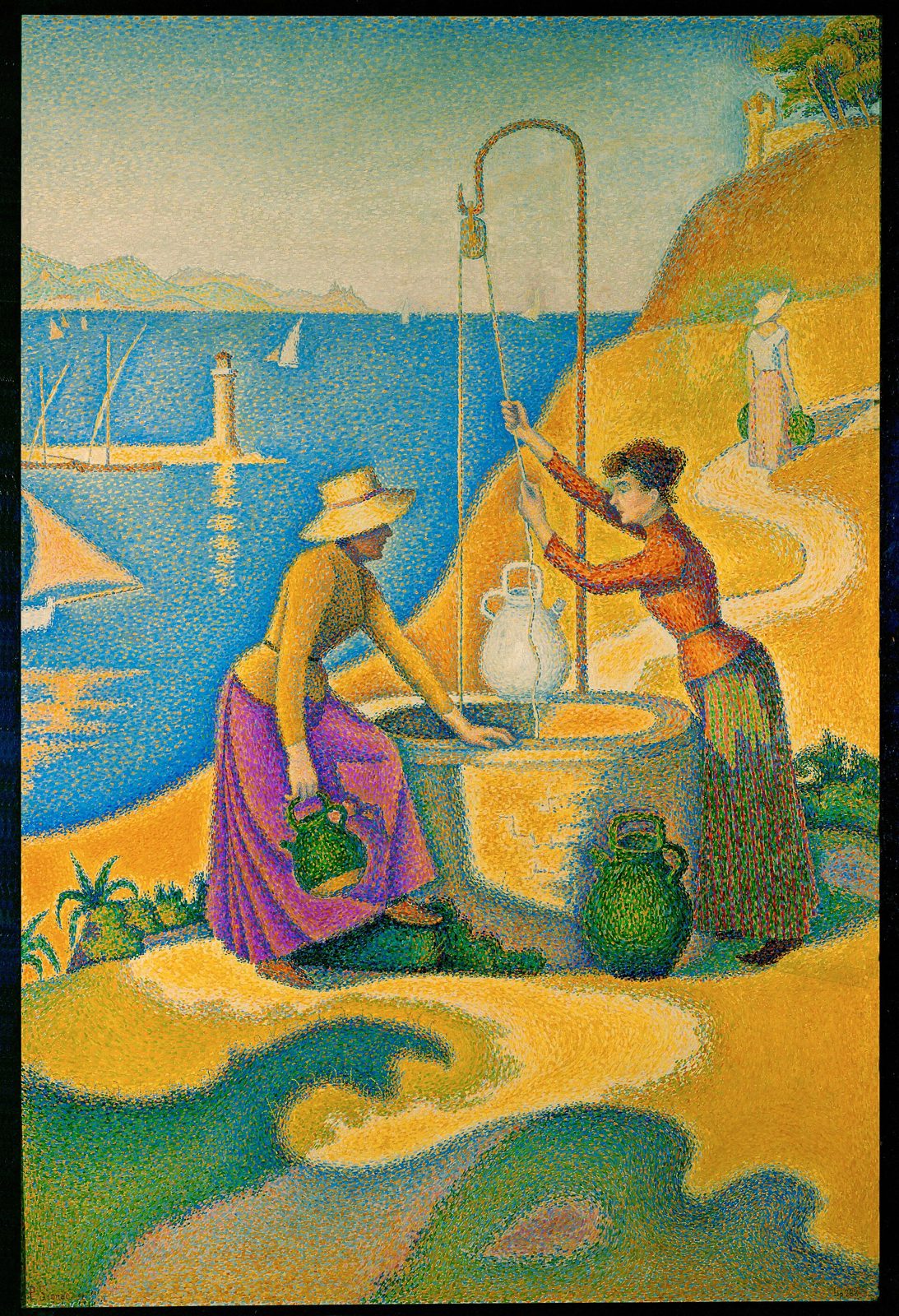
🎧 This work has audio narration — listen in the appTwo women gather at a well, one in a striking yellow hat and purple skirt, the other in a vibrant red blouse and striped skirt, engaged in the simple yet vital task of drawing water. The well, central to the scene, is flanked by a white jug, while a winding path leads to another figure in the background, all set against a lively coastal landscape dotted with sailboats and a distant lighthouse.
This depiction captures a moment of daily life in a vibrant Mediterranean setting, likely inspired by Signac’s own experiences in Saint-Tropez. The use of bright blues, yellows, and greens, combined with the pointillist technique, creates a textured surface that brings the scene to life, inviting viewers to feel the warmth of the sun and the gentle breeze of the sea. The harmonious arrangement of figures and landscape elements reflects Signac's mastery of color and composition, showcasing the beauty of ordinary moments.
Paul Signac was a French Neo-Impressionist painter born on November 11, 1863, in Paris. Initially encouraged to pursue architecture, he chose to follow his passion for painting, inspired by the Impressionists and particularly by Claude Monet's works. His encounter with Georges Seurat in 1884 profoundly influenced his artistic direction, leading him to develop the technique of Pointillism, where small dots of pure color blend in the viewer's eye rather than on the canvas.
A passionate sailor, Signac often painted seascapes and coastal scenes, spending summers in the south of France, where he envisioned an anarchist utopia. He co-founded the Société des Artistes Indépendants, promoting artistic freedom and innovation, serving as its president from 1908 until his death in 1935. His friendships with notable artists like Vincent van Gogh and Henri Matisse enriched his creative journey, while his writings on color theory and art further solidified his role as a key figure in the evolution of modern art.
Signac's legacy endures through his influence on subsequent movements, particularly Fauvism, and his commitment to artistic independence, making him a pivotal figure in the transition from Impressionism to modern art.
In 1892, Paul Signac painted 'Women by the Well,' a vibrant scene that captures the essence of daily life in a coastal Mediterranean setting. This work was first exhibited at the Salon des Indépendants in Paris in 1893, where it was titled 'Jeunes Provençales au puits.' The reception was warm, showcasing Signac's growing reputation as a leading figure in the Neo-Impressionist movement. Following its debut, the painting traveled to Brussels for the Libre Esthétique exhibition in 1894, further cementing its place in the art world. After Signac's passing, the painting remained in the family until it was acquired from his daughter, Ginette, in 1979. Today, it resides in the Musée d'Orsay, a testament to its enduring appeal and significance in Signac's oeuvre.
Signac's technique in 'Women by the Well' exemplifies the principles of Pointillism, where he meticulously applied small dots of pure color to create a vibrant, textured surface. The brushwork is deliberate yet spontaneous, allowing colors to blend optically rather than physically on the canvas. This method not only captures the shimmering light of the Mediterranean but also evokes the warmth of the sun and the gentle sea breeze. The composition is structured around the well, drawing the viewer's eye to the central action of the women drawing water. The bold color palette—dominated by bright blues, yellows, and greens—enhances the lively atmosphere, while the harmonious arrangement of figures and landscape elements reflects Signac's mastery of color theory and composition.
Interestingly, Signac's choice to depict women engaged in the simple act of drawing water reflects not just a moment in daily life but also his broader interest in the themes of labor and community. This focus on ordinary activities was somewhat revolutionary at the time, as many artists were preoccupied with grand historical or mythological subjects. Signac's work invites viewers to appreciate the beauty in the mundane, a perspective that resonates with audiences even today.
The painting stayed within Signac's family until it was sold by his daughter in 1979, eventually becoming part of the collection at the Musée d'Orsay.