Femme nue au chien
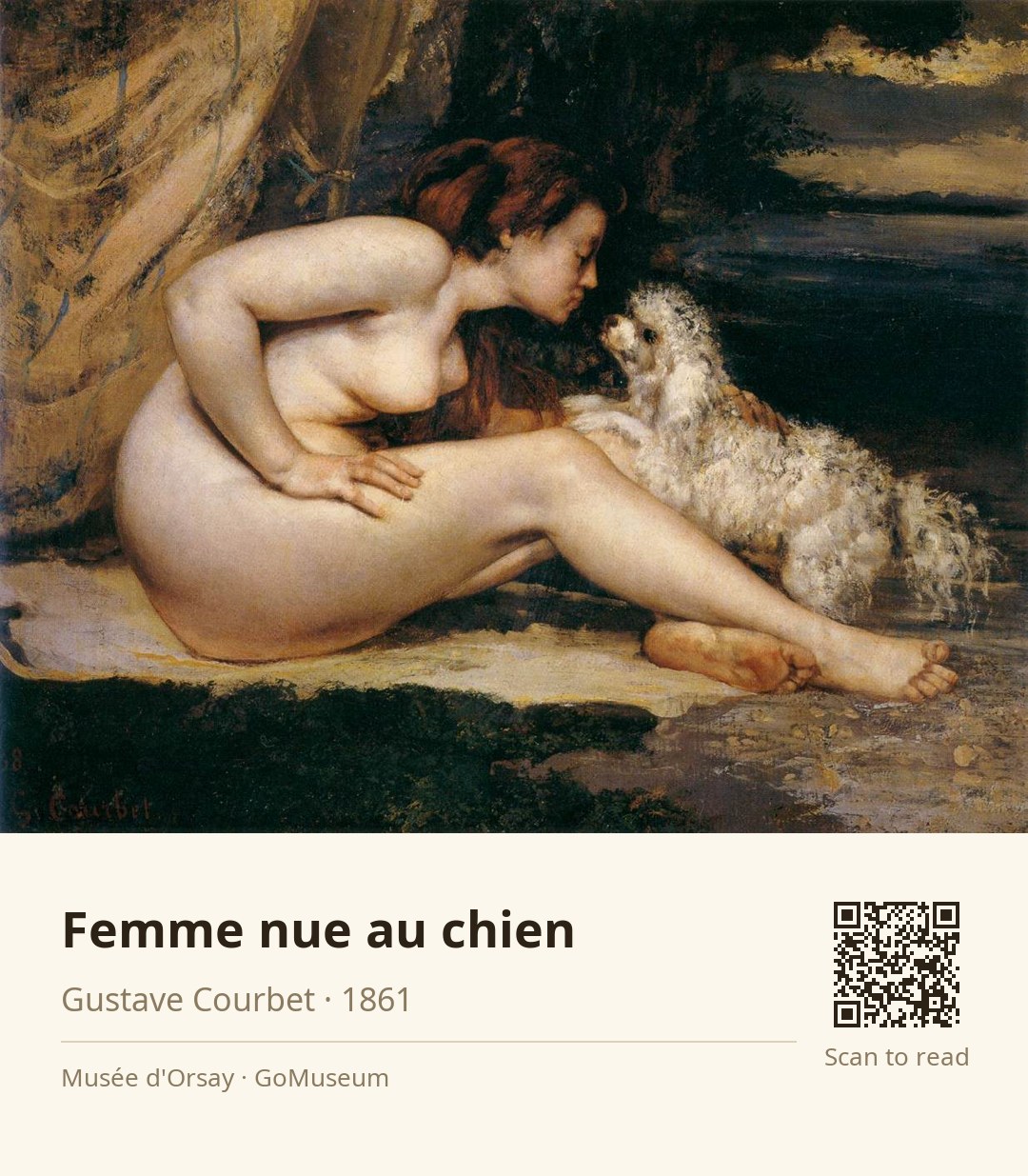
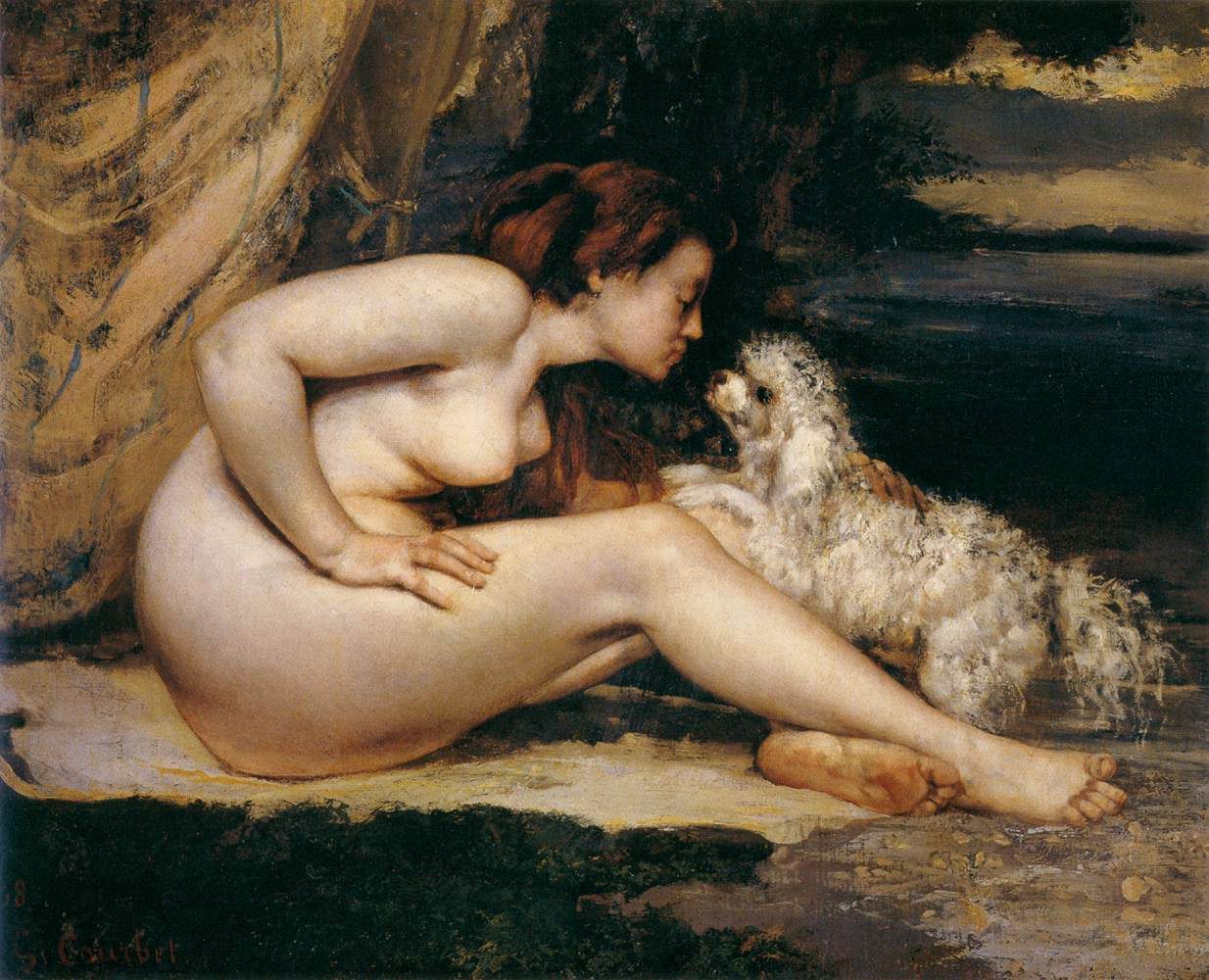
🎧 This work has audio narration — listen in the appTake a moment to really look at "Femme nue au chien" by Gustave Courbet. Notice how the young woman leans forward, her gaze tenderly fixed on the small white dog nestled in her lap. The way her body is positioned, slightly turned, creates a sense of intimacy, drawing you into this private moment shared between them.
This detail matters because it captures not just a figure, but a connection—an unguarded moment of affection that feels both timeless and deeply personal. Courbet’s choice to depict a nude figure in such a casual, affectionate scene was quite bold for his time, challenging the conventions of how women were typically portrayed in art. Instead of idealizing the female form, he presents a real woman, evoking a sense of warmth and humanity.
Created around 1861, this painting reflects Courbet's commitment to realism, a movement he championed by focusing on everyday life and genuine emotions rather than romanticized ideals. The model is believed to be Léontine Renaude, Courbet's mistress, which adds another layer of intimacy to the work.
As you stand here, think about the relationship between the woman and her dog. What does that connection say about companionship and vulnerability? How does it resonate with your own experiences of love and affection?
Gustave Courbet, born on June 10, 1819, in Ornans, France, was a pioneering painter who championed the Realism movement in 19th-century art. Rejecting the conventions of academic painting and the idealism of Romanticism, he focused on depicting the world as he observed it, often portraying unidealized peasants and workers in monumental compositions. His early works gained recognition, notably "After Dinner at Ornans," which won him a gold medal at the Salon of 1849, allowing him to exhibit without jury approval.
Courbet's commitment to realism was revolutionary; he believed that art should stem from personal experience rather than historical or mythological themes. His bold approach often sparked controversy, challenging societal norms and addressing social issues, which resonated with later movements like Impressionism and Cubism. Despite facing criticism and imprisonment for his political involvement during the Paris Commune, Courbet continued to create until his death on December 31, 1877, in Switzerland.
His legacy endures as a transformative figure in art history, whose unflinching depictions of everyday life laid the groundwork for modern artistic expression. Today, Courbet is celebrated for his vigorous and uncompromising work, which continues to engage audiences with its raw honesty and depth.
Femme nue au chien was painted by Gustave Courbet around 1861, a time when he was pushing the boundaries of traditional art. This piece was first shown to the public at the Salon in Ghent in 1868, where it sparked interest and conversation. It then passed through several hands, including Ernest Masurel's collection, before being accepted by the French state in 1979 as part of a payment for inheritance taxes. Since then, it has been housed at the Musée d'Orsay in Paris, after a brief stint at the Louvre. Over the years, Femme nue au chien has been featured in numerous exhibitions, including major retrospectives that highlight Courbet's significant impact on 19th-century art. Each showing has contributed to the painting's reputation, cementing its place in the canon of realist art.
As you gaze at 'Femme nue au chien,' take note of Courbet's masterful brushwork. The way he handles the oil paint creates a sense of texture and depth, particularly in the woman's skin, which feels almost alive under the light. The composition is intimate; the slight tilt of her body and the soft curves invite you into this private moment. Courbet's use of color is striking, with warm tones that enhance the warmth of the scene. The background, though less detailed, provides a natural setting that contrasts with the focus on the figures, emphasizing their connection. The scale of the painting, relatively small, adds to the feeling of closeness, making you feel like a participant in this tender exchange rather than just an observer. This technique of blending realism with emotional depth is what makes Courbet's work resonate so powerfully.
Interestingly, the model for 'Femme nue au chien' is believed to be Léontine Renaude, Courbet's mistress at the time. This personal connection adds an intimate layer to the painting, as it captures not just a moment of affection between a woman and her dog, but also a glimpse into Courbet's own life and relationships. It’s a reminder that art often intertwines with the artist's personal experiences, making the work even more poignant.
Since its creation, 'Femme nue au chien' has been featured in several significant exhibitions, including the 1986 showcase 'From Courbet to Cézanne' at the Musée d'Orsay, highlighting its enduring relevance and the evolution of Courbet's influence on later artists.