Woman with green scarf
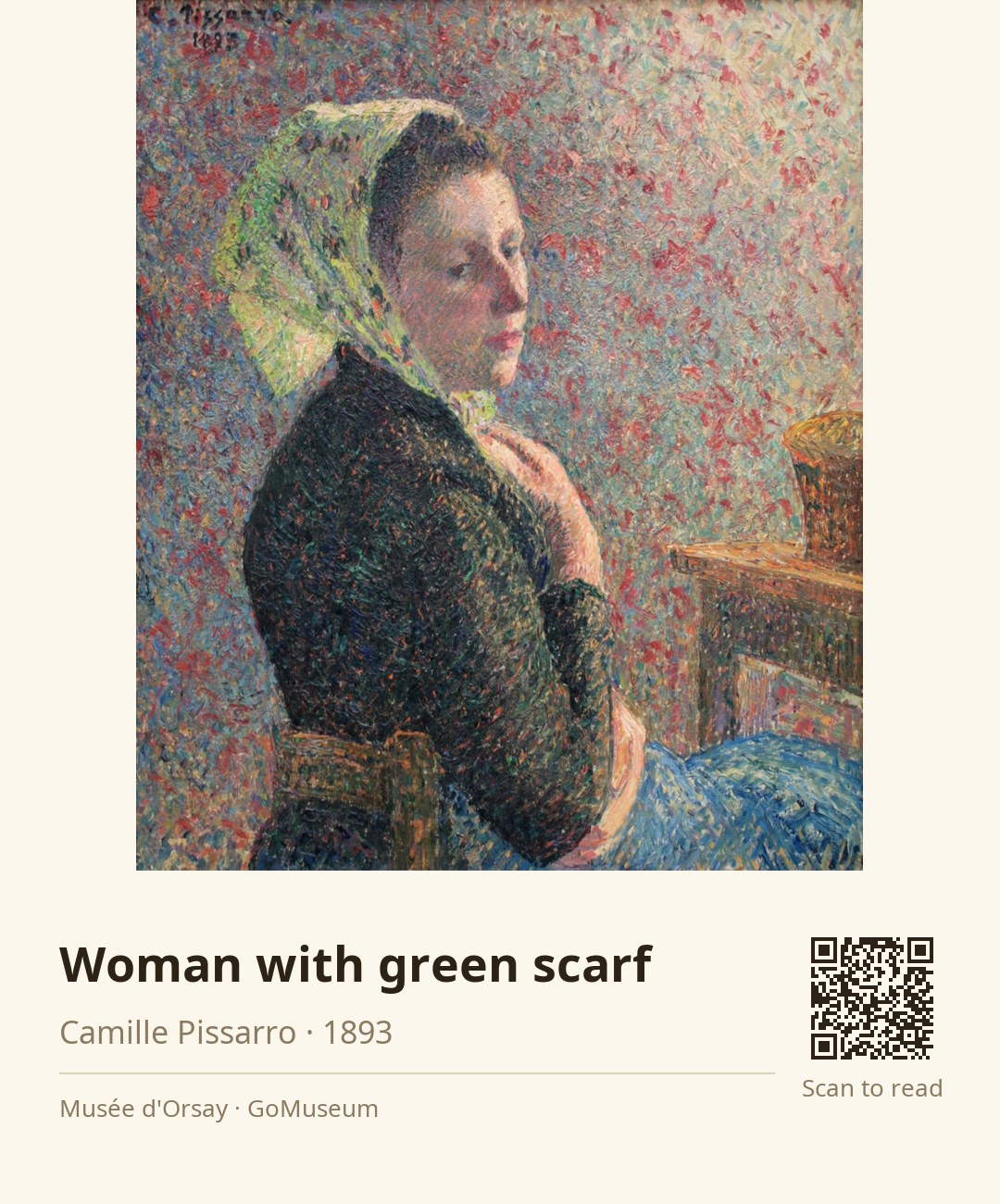
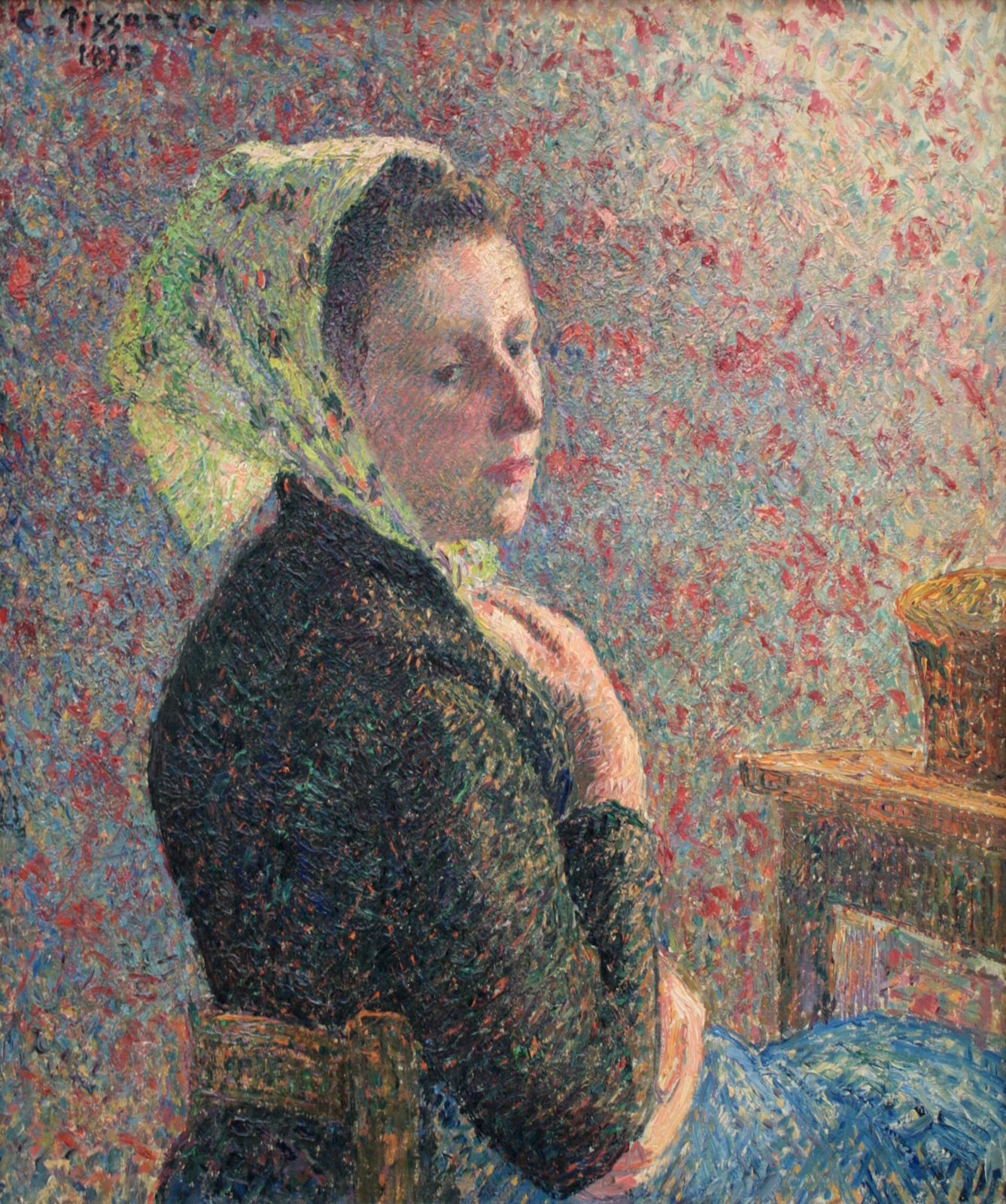
🎧 This work has audio narration — listen in the appThe woman in this painting, with her light-colored headscarf adorned in green and yellow, draws you into her quiet world. Her profile is delicately captured, with her hands resting gently on her chest, suggesting a moment of serene contemplation. The vibrant background, a tapestry of reds, blues, and greens, pulsates with life, contrasting beautifully with her dark garment and creating a sense of intimacy and warmth.
Pissarro’s use of pointillism here is particularly striking; the small, distinct dots of color blend seamlessly to form her likeness, showcasing his mastery of light and texture. This technique not only adds depth to the portrait but also reflects the artist's commitment to capturing the essence of everyday life, a hallmark of his Impressionist style. The woven basket on the table hints at domesticity, grounding the figure in a relatable context, while the lively brushstrokes evoke a sense of movement and vibrancy in the scene.
Created in 1893, "Woman with Green Scarf" stands as a testament to Pissarro's evolution as an artist, blending his Impressionist roots with the emerging Neo-Impressionist techniques he embraced later in his career. This painting was exhibited in Paris the same year it was completed, marking another significant moment in Pissarro's artistic journey.
Jacob Abraham Camille Pissarro, born on July 10, 1830, in Saint Thomas, was a Danish-French painter pivotal to the Impressionist and Neo-Impressionist movements. His artistic journey began under the influence of masters like Courbet and Corot, and he later collaborated with Seurat and Signac, embracing Neo-Impressionism at age 54. Pissarro's dedication to depicting rural life and the working class set him apart; he painted everyday scenes without grandeur, focusing on authenticity.
As a mentor, Pissarro played a crucial role in the development of fellow artists, including Cézanne, Gauguin, and Van Gogh, earning him the title "dean of the Impressionist painters." His warm personality and wisdom made him a father figure within the art community. Pissarro was the only artist to exhibit in all eight Paris Impressionist exhibitions from 1874 to 1886, solidifying his legacy. Despite facing criticism for his subjects, he remained committed to his vision, advocating for a personal approach to classicism. Pissarro passed away on November 13, 1903, leaving an indelible mark on art history.
Pissarro's 'Woman with Green Scarf' showcases his masterful use of pointillism, where tiny dots of color come together to create a vibrant whole. This technique demands a unique approach to brushwork; instead of broad strokes, Pissarro meticulously applies distinct dots, allowing the viewer's eye to blend the colors from a distance. The palette is rich and varied, with warm reds and cool blues dancing together, creating a dynamic background that contrasts beautifully with the dark garment of the woman. The composition is intimate, with the subject's profile drawing you in, while the woven basket on the table adds a touch of domesticity. The scale of the painting, at 65.5 by 54.5 centimeters, invites you to step closer, to appreciate the intricate details and the lively brushstrokes that evoke a sense of movement and life. This careful handling of paint not only captures the essence of the moment but also reflects Pissarro's commitment to portraying the everyday experiences of ordinary people.
Rewald referred to him as the 'dean of the Impressionist painters' due to his age and his wisdom, as well as his role in supporting and guiding other artists.