Wind Effect, Row of Poplars
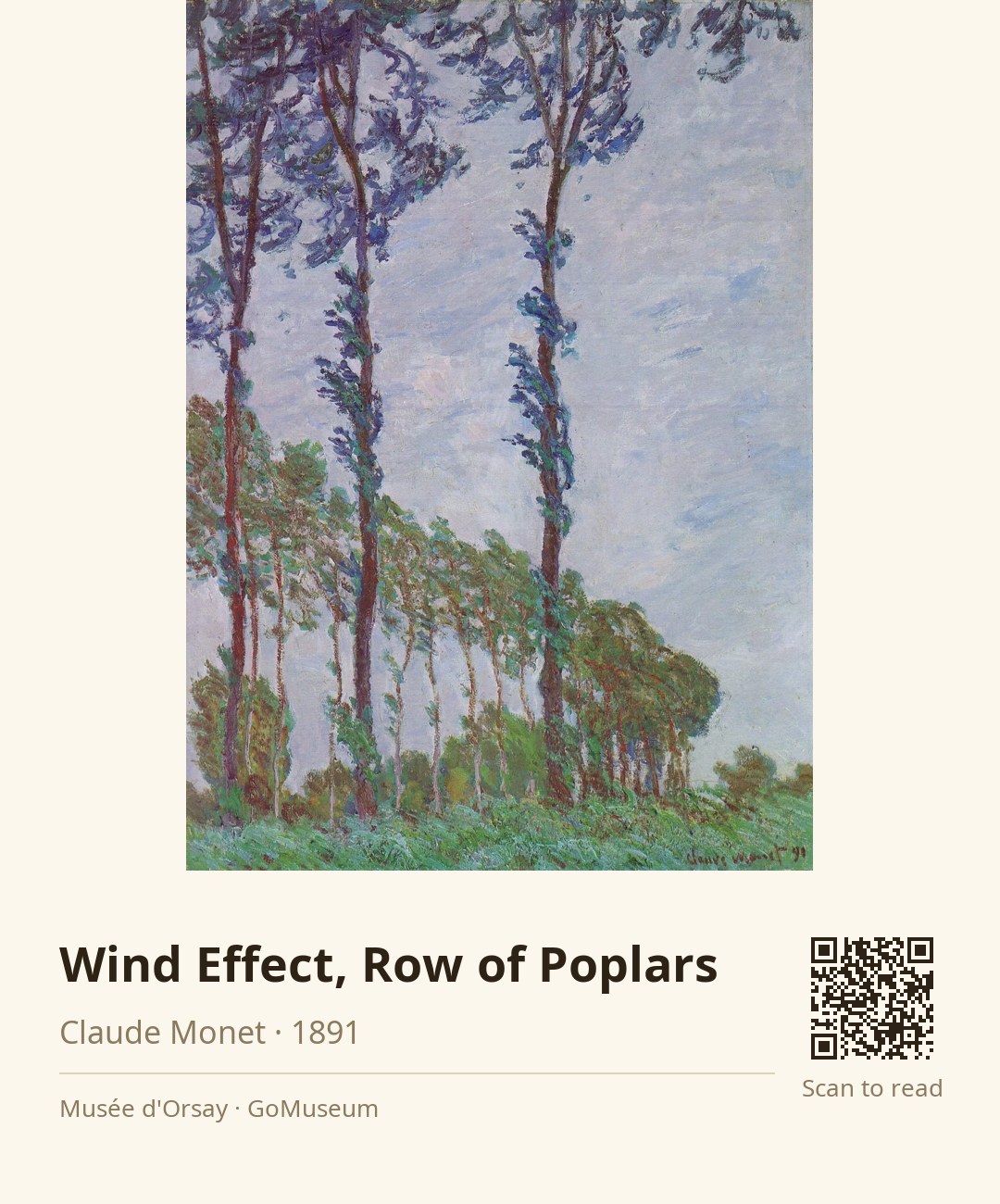
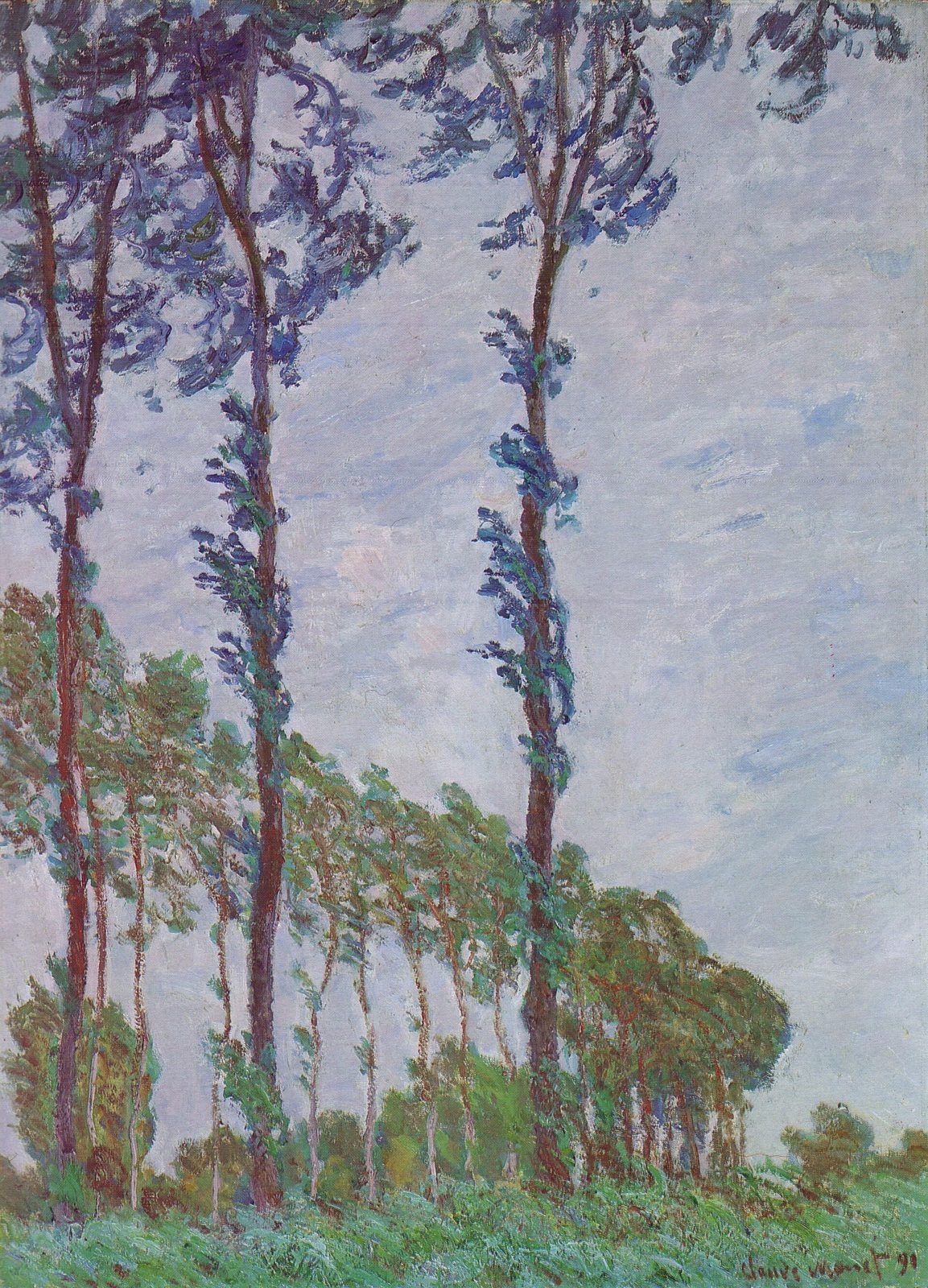
🎧 This work has audio narration — listen in the appA row of tall, slender poplars stretches diagonally across the canvas, their thin trunks and sparse green foliage swaying gently in the wind. The sky, painted in soft blues and grays, hints at an overcast day, while the expressive brushwork captures the dynamic movement of both the trees and the clouds. This scene, rich in texture and color, immerses you in the atmosphere of a tranquil landscape.
Monet's choice to depict these trees in such a manner reflects his fascination with the effects of light and weather on the natural world. The cool palette, dominated by greens and blues, evokes a sense of calm, while the loose brushstrokes convey the fleeting nature of the moment. This work is part of Monet's series on poplars, where he explored the same subject under varying conditions, emphasizing his commitment to capturing the essence of a scene as he perceived it.
Created in 1891, "Wind Effect, Row of Poplars" exemplifies Monet's innovative approach to landscape painting, showcasing his ability to merge observation with artistic expression.
Oscar-Claude Monet, born on November 14, 1840, in Paris, was a pioneering French painter and a founder of Impressionism, a movement that transformed the art world. Raised in Le Havre, he developed a passion for nature and painting early on, encouraged by his mother, while his father hoped he would pursue a business career. After his mother's death in 1857, Monet moved in with his aunt, who supported his artistic ambitions.
Monet's career began with caricatures, but he soon sought formal training, studying under Eugène Boudin, who introduced him to plein air painting. His breakthrough came in 1866 with "La Femme à la robe verte," which garnered attention at the Salon. The term "Impressionism" originated from his work "Impression, Sunrise," exhibited in 1874, marking a shift away from traditional art.
Throughout his life, Monet focused on capturing the essence of light and color in nature, creating series of paintings that depicted the same scenes under varying conditions, such as his famous haystacks and water lilies. He settled in Giverny in 1883, where he cultivated a beautiful garden that became his muse. Despite personal hardships, including the loss of loved ones and health issues, Monet's relentless dedication to his craft solidified his place in art history as a master of modernism, influencing countless artists and leaving a lasting legacy. He died on December 5, 1926, in Giverny, celebrated as one of the most significant figures in art.
In 1891, Claude Monet created 'Wind Effect, Row of Poplars,' a work that would soon become part of a significant series exploring the same subject. The painting was first exhibited in 1893 at a Knoedler sale in New York, where it was cataloged as number 188. By 1895, it was shown again in Boston, and over the years, it traveled to various exhibitions, including a notable retrospective in Paris in 1931. Its provenance reveals a journey through several collections, ultimately being accepted by the French state in 2002 as part of a payment for inheritance taxes, and finding its home in the Musée d'Orsay in Paris. Each exhibition contributed to the growing appreciation of Monet's work, showcasing his innovative approach to capturing landscapes.
The loose, expressive brushwork creates a sense of movement, allowing the viewer to feel the gentle sway of the trees and the shifting clouds above. Using oil paint on canvas, Monet layered colors to build depth and texture, particularly in the foliage, which appears almost alive. The cool palette of greens and blues not only evokes tranquility but also enhances the atmospheric quality of the scene. The diagonal arrangement of the poplars draws the eye across the canvas, creating a dynamic composition that feels both expansive and intimate. This approach reflects Monet's commitment to capturing the essence of a fleeting moment in nature, emphasizing the interplay between light, weather, and landscape.
Monet developed a technique of painting the same scene multiple times to capture variations in light and seasonal changes.
The death of Monet's mother at a young age had a profound impact on him, as she was a significant supporter of his artistic ambitions.