 Image: Sailko
Dancers Ascending a Staircase
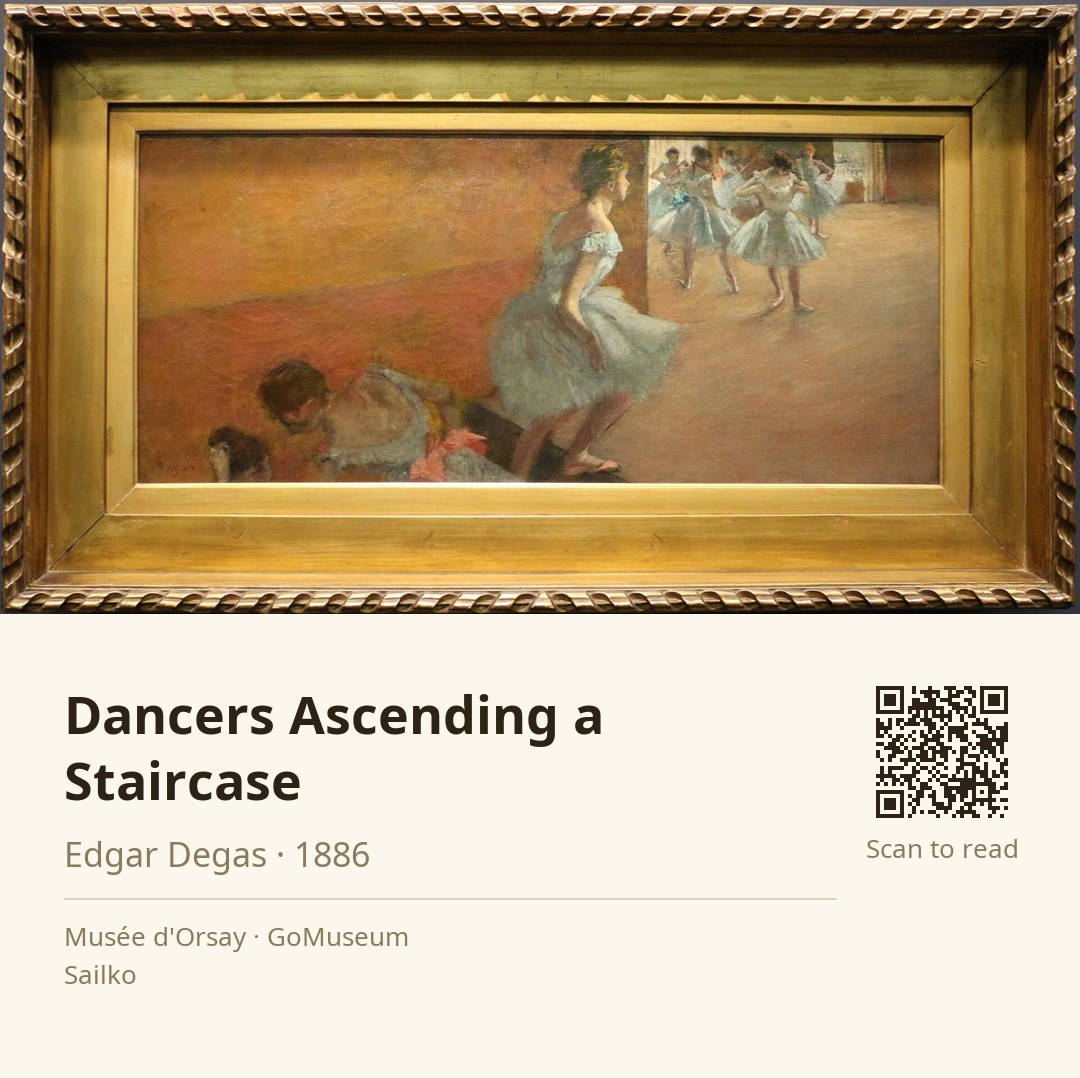
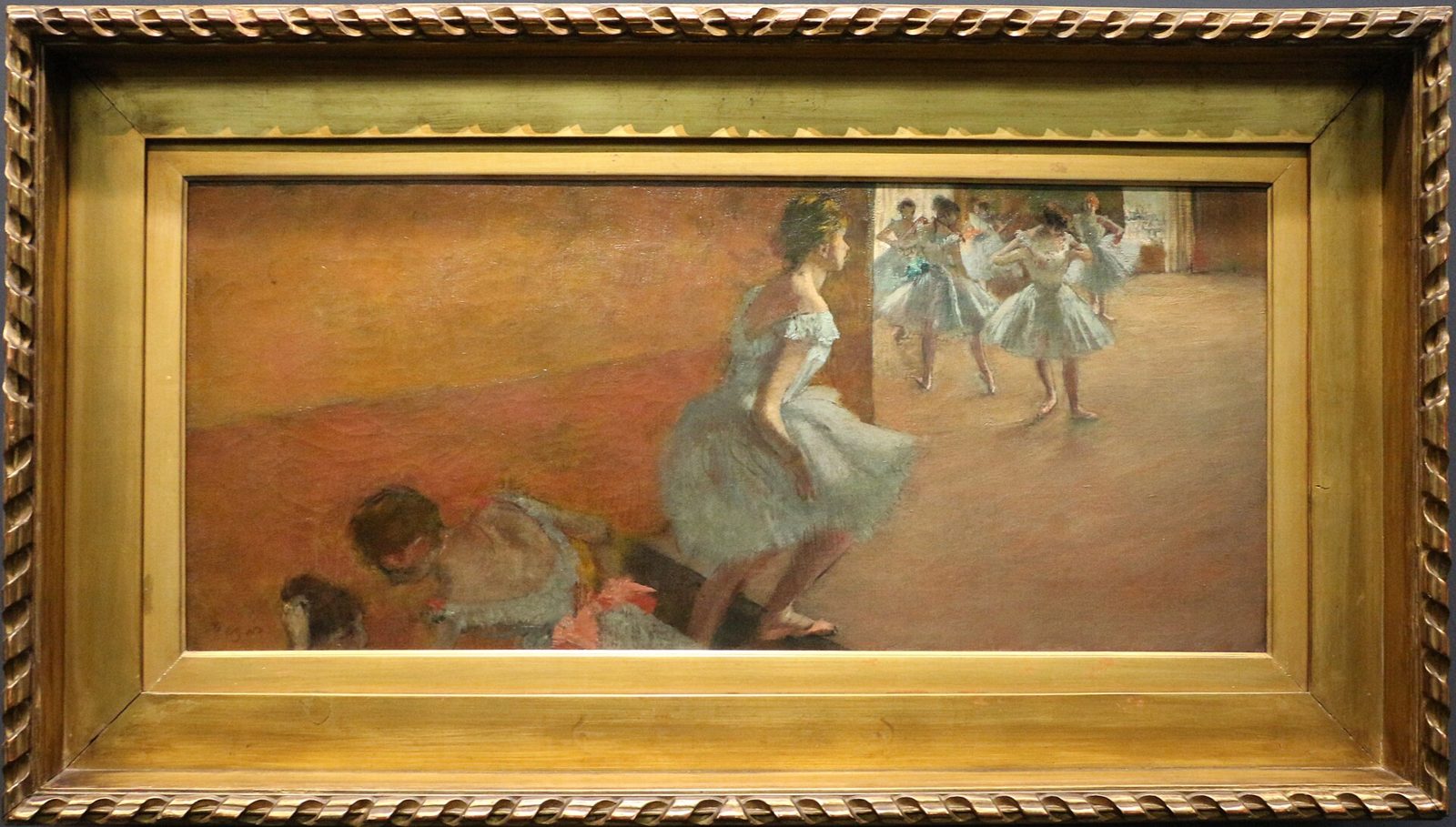
🎧 This work has audio narration — listen in the appA ballerina in a white tutu sits in the foreground of "Dancers Ascending a Staircase," adjusting her shoe, while another dancer leans slightly forward beside her. In the middle distance, several dancers are captured in mid-pose, their movements suggesting a vibrant rehearsal atmosphere, all set against a warm backdrop of browns and oranges that evokes the soft lighting of the studio.
This dynamic arrangement not only highlights the grace and discipline of ballet but also reflects Degas's fascination with movement and the human form. The contrasting delicate shades of the dancers' tutus against the earthy tones of the room create a visual rhythm that pulls the viewer into the scene, making it feel alive and in motion. Degas's ability to depict such fluidity stems from his rigorous training as a draftsman, allowing him to capture the essence of dance in a way that transcends mere representation.
Created in 1886, this painting exemplifies Degas's unique perspective on contemporary life, particularly his enduring interest in the world of dance, a subject he explored throughout his career.
Edgar Degas, born on July 19, 1834, in Paris, was a pivotal figure in the Impressionist movement, though he preferred to be labeled a realist. Known for his exceptional skill in drawing, Degas focused on capturing movement, particularly in his depictions of dancers, which constitute over half of his oeuvre. His works also include racehorses and portraits that reveal psychological depth and human isolation.
Degas came from a cultured, affluent family; his mother was a Creole from New Orleans, and his father was a banker. After his mother's death, he pursued art against his father's wishes, studying at the École des Beaux-Arts and drawing inspiration from classical masters during his time in Italy. His early ambition to be a history painter shifted as he embraced contemporary subjects, influenced by artists like Édouard Manet.
Despite being a founding member of the Impressionists, Degas's approach diverged from his peers, as he often worked in his studio rather than en plein air. His innovative techniques and themes sparked debate among critics and continue to influence art history today. Degas passed away on September 27, 1917, leaving behind a legacy that challenges traditional boundaries in art.
In 'Dancers Ascending a Staircase,' Degas employs a dynamic composition that captures the essence of movement. The diagonal arrangement of the dancers leads the viewer's eye into the depth of the painting, creating a sense of action and energy. The brushwork is both fluid and precise, allowing for a delicate rendering of the tutus in soft whites and blues that contrast beautifully with the warm, earthy tones of the studio. Degas's choice of a muted palette enhances the intimate atmosphere of the rehearsal space, while his mastery of oil paint allows for rich textures that evoke the fabric of the dancers' costumes and the warmth of the light filtering through the studio. This technique, combined with his keen observation of human movement, results in a work that feels alive and vibrant, drawing the viewer into the dancers' world.
Degas came from a moderately wealthy family in Paris, which influenced his access to education and the arts.
Degas's maternal grandfather was of French descent and was born in Haiti before settling in New Orleans.
Degas began painting at a young age and even converted a room in his home into a studio to pursue his art.