Blue Dancers
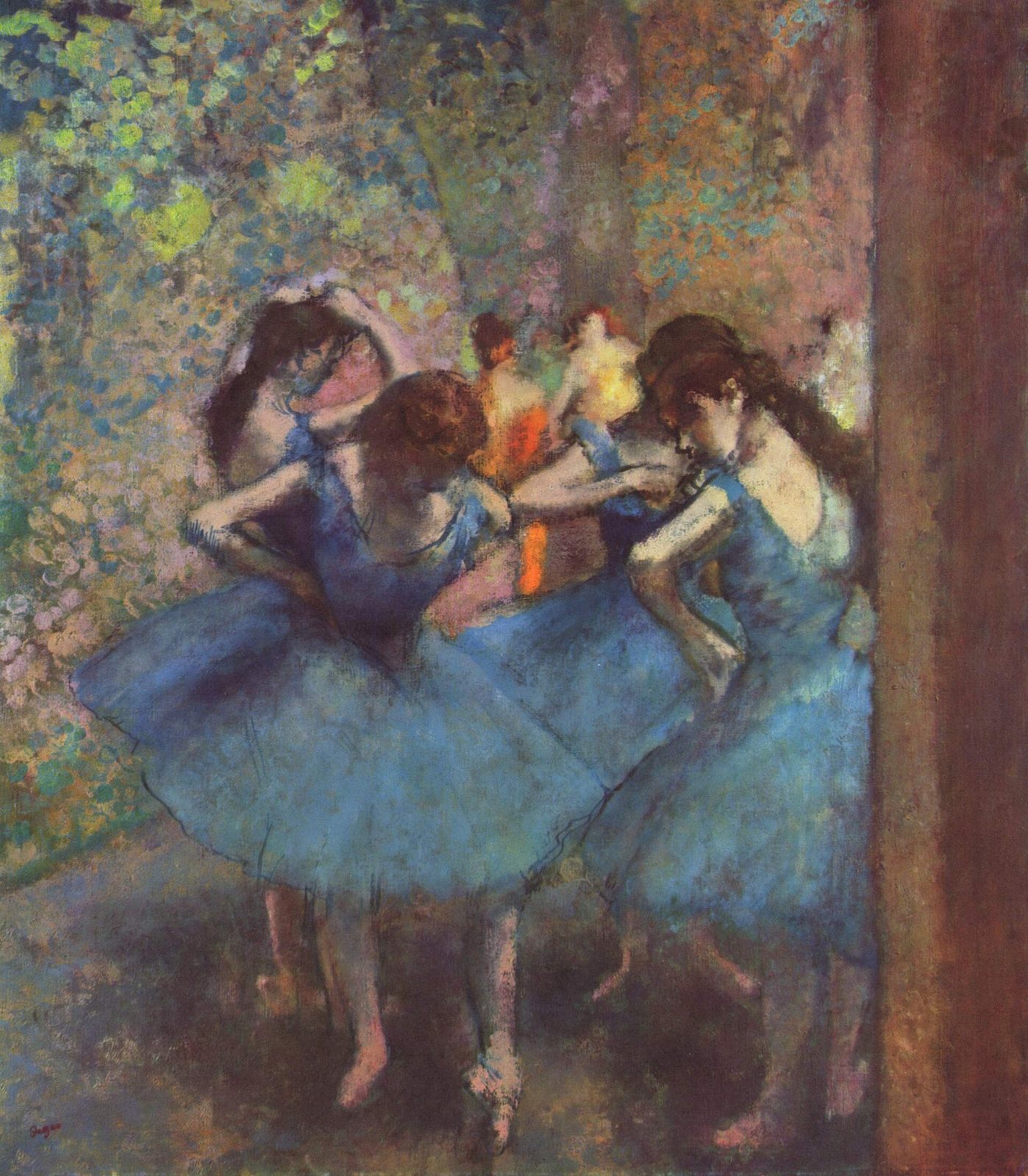
🎧 This work has audio narration — listen in the appTake a moment to really soak in the energy of "Blue Dancers" by Edgar Degas. Notice how the dancers seem to float, their bodies captured mid-movement, draped in soft hues of blue that almost shimmer. Look closely at the way Degas has layered the paint; you can see the brushstrokes that give life to their flowing skirts and delicate poses. These details matter because they reveal Degas's masterful ability to convey movement and emotion. He was fascinated by the world of ballet, and through these dancers, he invites us into a moment of grace and beauty. The blue tones not only enhance the ethereal quality of the scene but also reflect the melancholy often associated with the pursuit of perfection in art and dance. Created in 1890, this painting is a prime example of Degas's unique approach to Impressionism. While many of his contemporaries painted outdoors, Degas preferred the intimacy of the studio, where he could focus on the subtleties of his subjects. His dedication to capturing the human experience, particularly through dance, set him apart as a true innovator. As you stand here, think about the countless hours these dancers must have spent perfecting their craft. What emotions do you think they experienced in this moment? Let that question linger as you take in the beauty of Degas's work.
Edgar Degas, born on July 19, 1834, in Paris, was a pivotal figure in the Impressionist movement, though he preferred to be labeled a realist. Known for his exceptional skill in drawing, Degas focused on capturing movement, particularly in his depictions of dancers, which constitute over half of his oeuvre. His works also include racehorses and portraits that reveal psychological depth and human isolation.
Degas came from a cultured, affluent family; his mother was a Creole from New Orleans, and his father was a banker. After his mother's death, he pursued art against his father's wishes, studying at the École des Beaux-Arts and drawing inspiration from classical masters during his time in Italy. His early ambition to be a history painter shifted as he embraced contemporary subjects, influenced by artists like Édouard Manet.
Despite being a founding member of the Impressionists, Degas's approach diverged from his peers, as he often worked in his studio rather than en plein air. His innovative techniques and themes sparked debate among critics and continue to influence art history today. Degas passed away on September 27, 1917, leaving behind a legacy that challenges traditional boundaries in art.
Edgar Degas's 'Blue Dancers' was created in 1890 and quickly became a hallmark of his exploration into the world of ballet. The painting was first exhibited at the Galerie Durand-Ruel in Paris in 1934, and it was shown again in several prestigious exhibitions, including the Exposition Universelle in 1937 and a significant retrospective at the Grand Palais in 1988. The painting's journey through various galleries reflects its growing recognition and the evolving appreciation of Degas's unique perspective on dance. After Degas's passing in 1917, 'Blue Dancers' changed hands several times, with notable provenance including a sale at the Georges Petit Gallery in 1918. Each exhibition brought new audiences, allowing them to witness the delicate interplay of movement and color that defines this work.
As you gaze at 'Blue Dancers', pay attention to the way Degas employs color and light to create an almost dreamlike atmosphere. The soft blue hues envelop the dancers, suggesting both fluidity and a sense of melancholy. Notice how the brushwork feels restless, with quick, sweeping strokes that capture the momentary poses of the dancers. This technique not only conveys movement but also evokes the energy of a performance. The composition is structured to draw your eye across the canvas, leading you from one dancer to another, creating a rhythm that mimics the dance itself. The scale of the painting, larger than life, immerses you in the scene, making you feel as if you’re part of the audience, witnessing this ephemeral beauty firsthand.
This painting not only captures the grace and dynamism of ballet dancers but also reflects Degas's mastery in depicting movement and human emotion. His focus on dancers influenced countless artists, pushing them to explore the intersection of realism and abstraction. Degas's work laid the groundwork for future explorations in figure painting, making him a key figure in the transition from 19th-century art to the modern era. Remember, it’s not just about the dancers; it’s about how Degas transformed the way we see movement and emotion in art.
Throughout his life, he faced significant eye problems, which affected his ability to see detail. This challenge may have contributed to his unique approach to capturing movement and form, as he often relied on memory and imagination rather than direct observation. It's fascinating to think that his personal limitations led to such innovative and dynamic representations of dancers.
Coming from a moderately wealthy family with Creole roots, Degas had access to a rich cultural heritage and education, which likely shaped his appreciation for the arts and his unique approach to subjects like ballet.
Degas struggled with significant eye problems throughout his life, which forced him to rely on memory and imagination rather than direct observation, leading to his distinctive representations of movement and form.