Tulip Field in Holland
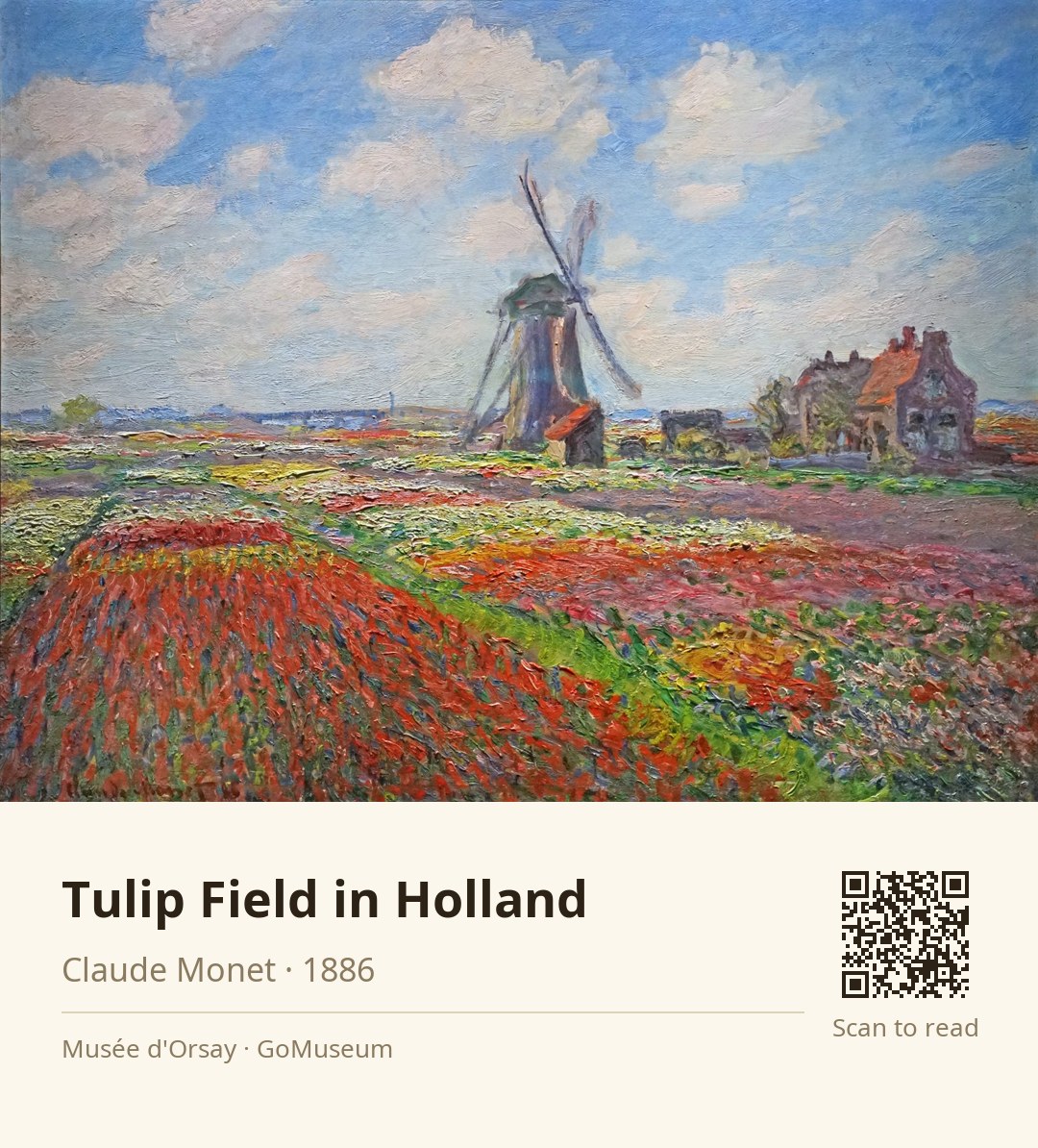
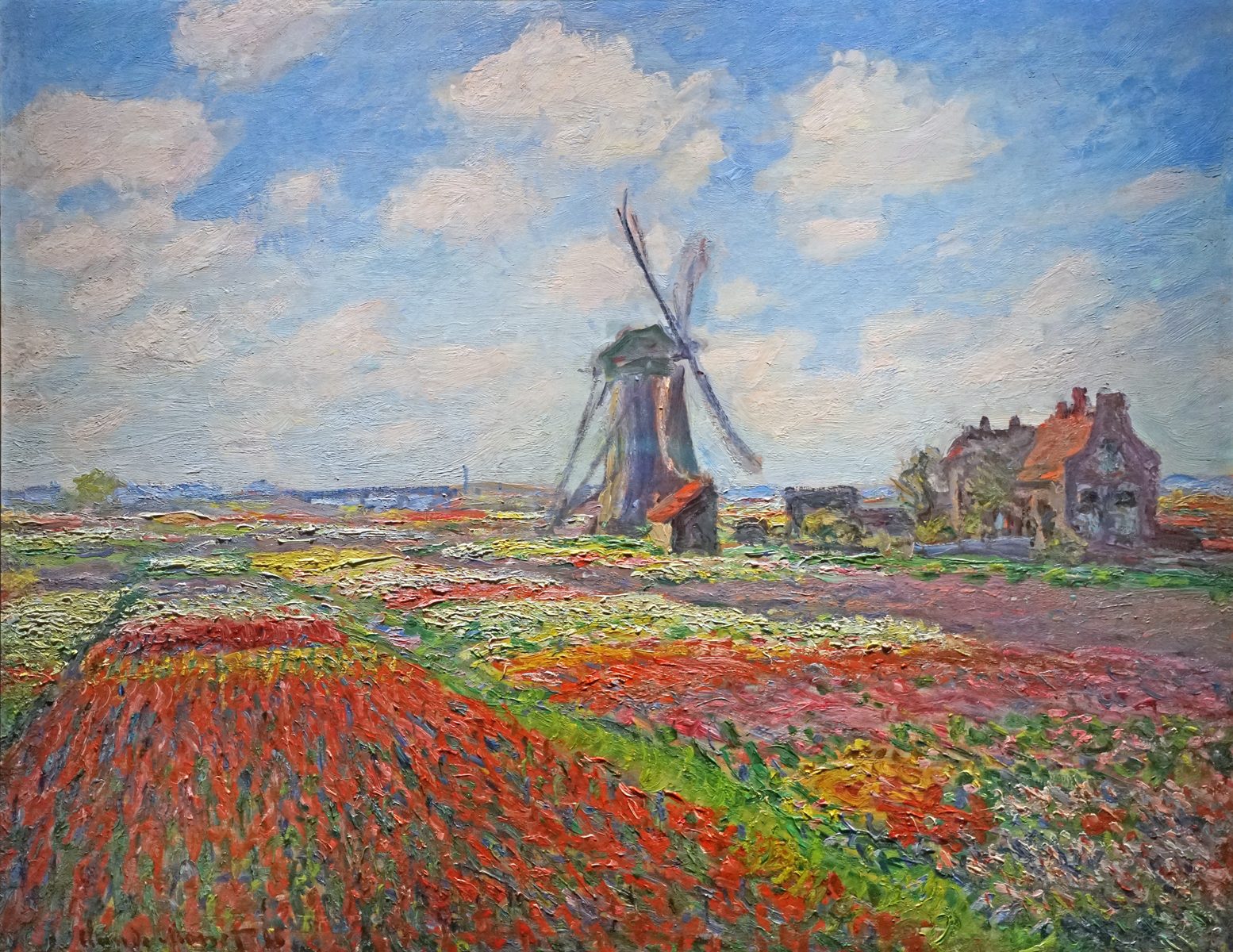
🎧 This work has audio narration — listen in the appTake a moment to really soak in the vibrant colors of Monet's "Tulip Field in Holland." Notice how the tulips burst forth in a riot of reds, yellows, and purples, almost dancing across the canvas. And look closely at the way the brushstrokes seem to flutter, capturing the gentle breeze that sweeps through the field.
He wasn't just depicting a scene; he was capturing a fleeting moment in time, the essence of the flowers as they swayed under the sun. This technique of using quick, loose brushwork was a hallmark of Impressionism, a movement Monet helped to pioneer.
Painted during his third visit to the Netherlands in 1886, this work showcases his fascination with the play of light and color in nature. Monet had only a week to create five paintings, and you can feel the urgency and excitement in this piece, as he wrestled with the vibrant hues that seemed almost impossible to replicate.
As you stand here, think about what it must have been like for Monet, standing in that field, surrounded by the beauty of blooming tulips. What do you think he felt as he painted this scene? Let that question linger as you take in the beauty before you.
Oscar-Claude Monet, born on November 14, 1840, in Paris, was a pioneering French painter and a founder of Impressionism, a movement that transformed the art world. Raised in Le Havre, he developed a passion for nature and painting early on, encouraged by his mother, while his father hoped he would pursue a business career. After his mother's death in 1857, Monet moved in with his aunt, who supported his artistic ambitions.
Monet's career began with caricatures, but he soon sought formal training, studying under Eugène Boudin, who introduced him to plein air painting. His breakthrough came in 1866 with "La Femme à la robe verte," which garnered attention at the Salon. The term "Impressionism" originated from his work "Impression, Sunrise," exhibited in 1874, marking a shift away from traditional art.
Throughout his life, Monet focused on capturing the essence of light and color in nature, creating series of paintings that depicted the same scenes under varying conditions, such as his famous haystacks and water lilies. He settled in Giverny in 1883, where he cultivated a beautiful garden that became his muse. Despite personal hardships, including the loss of loved ones and health issues, Monet's relentless dedication to his craft solidified his place in art history as a master of modernism, influencing countless artists and leaving a lasting legacy. He died on December 5, 1926, in Giverny, celebrated as one of the most significant figures in art.
This trip was brief but incredibly productive; within just a week, he managed to create five paintings, including this vibrant piece. It was first showcased at the 5th International Exhibition of Painting and Sculpture at the Galerie Georges Petit in Paris, where it garnered attention. Shortly after, a collector acquired it, and it remained in private hands until it was bequeathed to the French state in 1943. Since then, it has been exhibited in various prestigious locations, including the Louvre and the Musée d'Orsay, where it now resides, captivating audiences with its vivid colors and lively brushwork.
Notice how he employs quick, loose brushstrokes that create a sense of movement, almost as if the flowers are swaying in the breeze. The composition is structured with a gradient of colors that draws your eye from the detailed foreground to the more suggested background. The massive windmill anchors the scene, linking the vibrant tulips to the expansive sky. The play of light is crucial here; Monet captures the essence of the moment, using color to convey the warmth of the sun and the freshness of the air. This dynamic interplay of color and light not only highlights the tulips but also evokes the fleeting nature of beauty itself.
One intriguing tidbit about 'Tulip Field in Holland' is that Monet initially found the colors of the tulips nearly impossible to replicate. This challenge pushed him to experiment with his palette and brushwork, leading to the vibrant and dynamic representation you see today. It's a testament to his relentless pursuit of capturing nature's beauty, even when it seemed daunting.
Monet found the colors of the tulips nearly impossible to replicate at first, which pushed him to experiment with his palette and brushwork, ultimately leading to the vibrant representation seen in this painting.
During his brief stay in the Netherlands, Monet's fascination with the play of light and color in nature intensified, which is reflected in the dynamic brushwork and vivid hues of 'Tulip Field in Holland,' showcasing his evolving Impressionist style.