What is Called Vagrancy
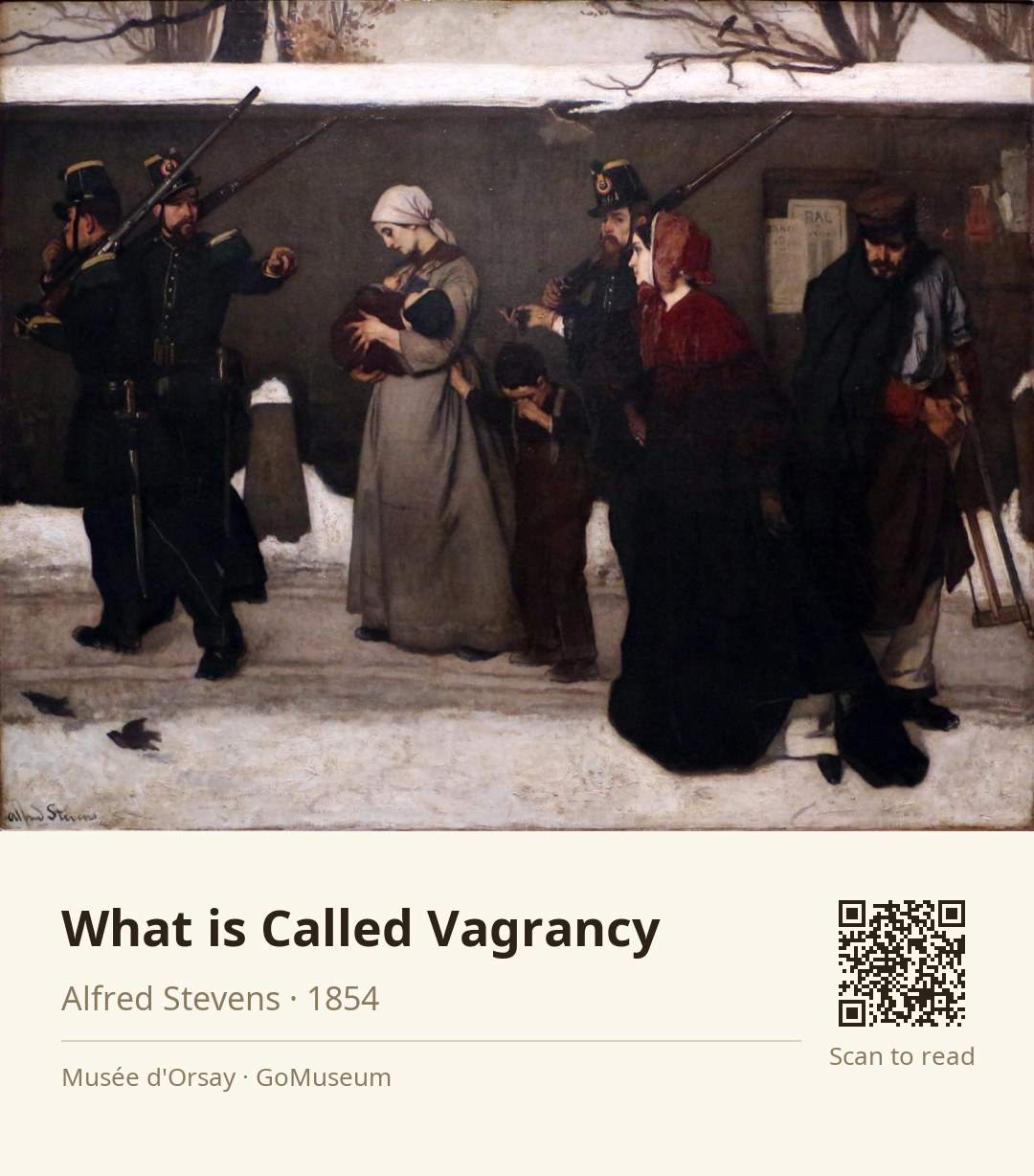
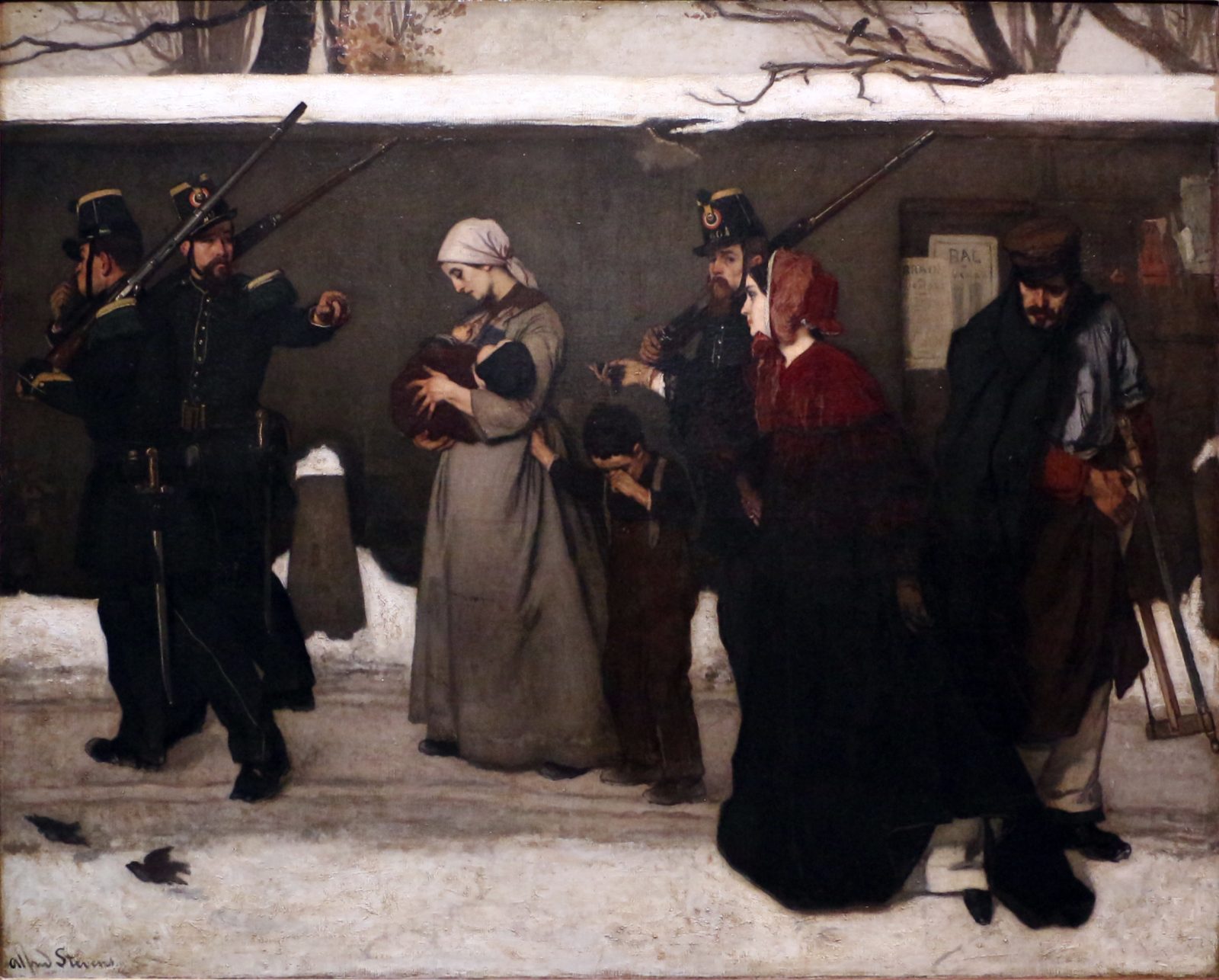
🎧 This work has audio narration — listen in the appTake a moment to really look at this painting, "What is Called Vagrancy" by Alfred Stevens. Notice the way the elegant woman reaches out, her hand almost pleading, against the backdrop of a stark, snowy street. Now, focus on the soldiers—can you see the refusal in their stance? Their rigid bodies and dismissive gestures tell a powerful story of authority clashing with compassion.
These details matter because they encapsulate a moment of desperation and societal critique. Stevens isn’t just painting a scene; he’s highlighting the harsh realities of vagrancy in 19th-century France, where the law treated the impoverished with suspicion and brutality. The elegant woman’s futile attempt to help the mother and her children reveals the tension between individual kindness and systemic oppression.
Created in 1854 and showcased at the Exposition Universelle the following year, this work reflects Stevens' commitment to social realism, capturing the struggles of everyday life. It’s a poignant reminder of how art can confront uncomfortable truths.
As you stand here, think about the stories behind those faces. What would you do in that moment? Would you intervene, or would you stand by?
Alfred Émile Léopold Stevens, born on May 11, 1823, in Brussels, was a prominent Belgian painter celebrated for his depictions of elegant modern women. Coming from a family steeped in the arts, he was influenced by his father's passion for painting and his brothers' artistic pursuits. After studying at the Académie Royale des Beaux-Arts and later the École des Beaux-Arts in Paris, Stevens quickly gained recognition for his social realist works, notably addressing urban poverty. His painting "What is called vagrancy" garnered attention from Napoleon III, leading to significant social change.
By the 1860s, Stevens had established himself as a leading figure in the Parisian art scene, known for his refined portrayals of upper-middle-class life. His works, characterized by a realistic style and meticulous detail, often featured fashionable women in intimate settings, reflecting the era's fascination with modernity and Japonisme. Despite initial reservations about Impressionism, he later embraced aspects of the movement, evolving his style.
Stevens was well-connected, mingling with notable figures like Édouard Manet and Alexandre Dumas. His legacy lies in his ability to blend genre painting with contemporary themes, securing his place in art history as a master of capturing the elegance and complexities of 19th-century Parisian life. He passed away on August 24, 1906, leaving behind a rich body of work that continues to resonate.
Alfred Stevens painted 'What is Called Vagrancy' in 1854, and it was first shown at the Exposition Universelle in Paris in 1855. This was a pivotal moment for Stevens, marking his breakthrough into the art world. The painting stirred quite a reaction, especially from Emperor Napoleon III, who found its portrayal of a woman trying to help a vagrant mother and her children to be shocking. He even requested its removal from the exhibition, highlighting the tension between art and authority. The work eventually became part of the French public collections through a bequest from Léon Lhermitte in 1926, and it has since found its home at the Musée d'Orsay, after passing through the Jeu de Paume and the Château de Compiègne.
Notice the way he captures the cold, stark environment with a palette dominated by whites and grays, evoking the chill of a snowy street. The brushwork is meticulous, especially in the rendering of fabrics, which reflects his admiration for the Old Flemish Masters. The elegant woman's outstretched hand, almost pleading, contrasts with the rigid postures of the soldiers, creating a palpable tension. The composition is carefully structured, leading your eye from the woman to the soldiers and then to the vulnerable family, emphasizing the drama of the moment. This layering of figures not only tells a story but also invites you to feel the weight of societal judgment and compassion.
One surprising twist in the story of 'What is Called Vagrancy' is how it caught the attention of Emperor Napoleon III himself. The painting depicts a poignant scene of a mother and her children being arrested for vagrancy, a topic that was quite controversial at the time. The emperor found the content so shocking that he ordered it to be removed from the exhibition! This reaction highlights not only the painting's emotional impact but also the tense social climate surrounding issues of poverty and state control during the mid-19th century in France.
Some critics pointed out that the left foot of the elegant woman appears strangely distant from her body, which sparked discussions about the painting's technical execution and composition.
Born in Brussels and later moving to Paris, Stevens was heavily influenced by the Old Flemish Masters, particularly in his meticulous attention to detail and fabric representation, which became a hallmark of his work.
The painting elicited a strong response, particularly from Emperor Napoleon III, who found its portrayal of a woman aiding a vagrant mother shocking enough to request its removal from the exhibition.