Bathers with Red Cow
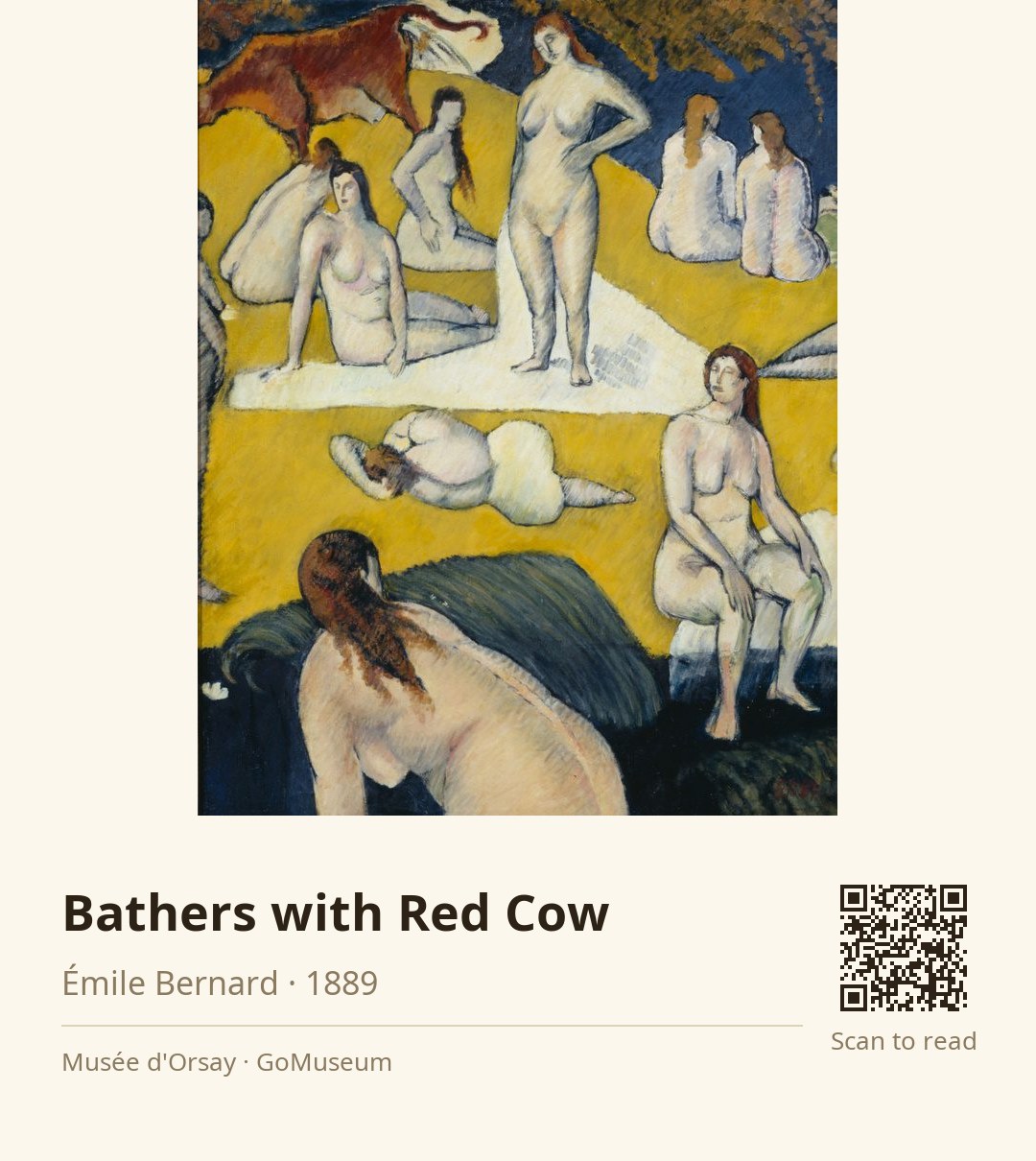
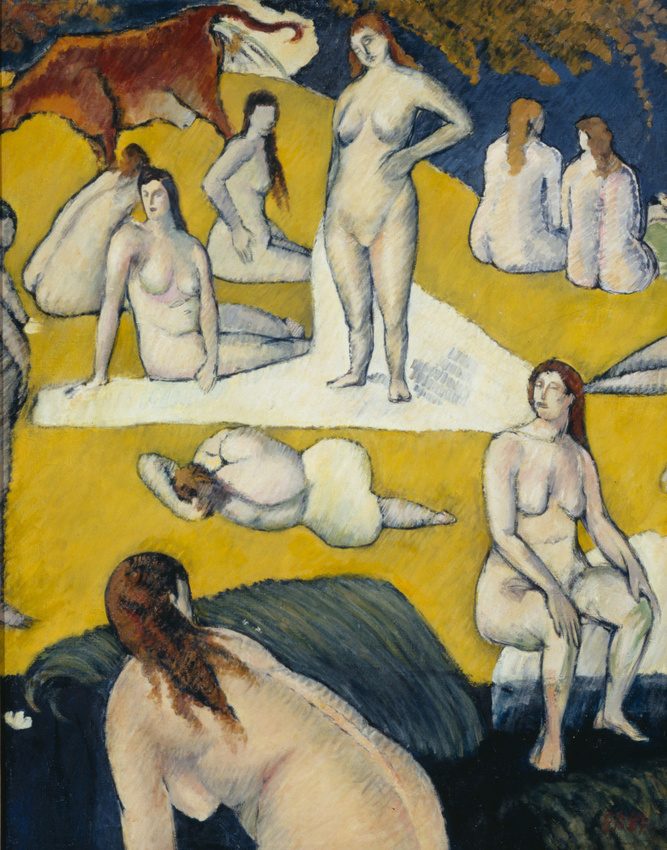
🎧 This work has audio narration — listen in the appTake a moment to soak in the vibrant scene before you in Émile Bernard's "Bathers with Red Cow." Notice how the ten women, all in various poses of leisure, seem to dance with the light of the sun reflecting off the water. Look closely at the striking red cow that stands proudly in the background—its bold color contrasts beautifully with the soft, natural hues of the women and the lush greenery surrounding them. This cow isn't just a whimsical addition; it symbolizes the pastoral life that Bernard was so enamored with, echoing the harmony between humanity and nature. The juxtaposition of the nude figures and the cow invites you to consider the simplicity and purity of rural life, a theme that resonates deeply in the Post-Impressionist movement. Created in 1889, this painting reflects Bernard's exploration of Cloisonnism, a style that emphasizes bold outlines and flat areas of color, influenced by his friendships with artists like Gauguin and Van Gogh. It’s a moment frozen in time, capturing the essence of leisure and the beauty of the natural world. As you stand here, think about the stories these figures might tell. What do you imagine their conversations are about? What feelings does this idyllic scene evoke in you?
Émile Henri Bernard was a French Post-Impressionist painter and writer born on April 28, 1868, in Lille. His early life was marked by familial challenges, as he often sought solace in art while living with his supportive grandmother. Moving to Paris in 1878, he pursued formal art education, eventually studying under Fernand Cormon, where he befriended notable artists like Toulouse-Lautrec and Anquetin.
Bernard's artistic journey flourished between 1886 and 1897, during which he became associated with Cloisonnism and Synthetism, movements characterized by bold colors and simplified forms. His friendship with Vincent van Gogh and Paul Gauguin significantly influenced his work, with Bernard's theories on art contributing to Gauguin's development. He sought to create art that was simple and accessible, emphasizing collective expression over individuality.
In 1891, he joined Symbolist painters, and his travels to Egypt and Italy further diversified his style. Despite his early radical contributions to modern art, Bernard's later years saw a shift towards classicism. He returned to Paris in 1904, teaching at the École des Beaux-Arts until his death in 1941. While his literary work remains lesser-known, it provides valuable insights into the evolution of modern art. Bernard's legacy endures as a pivotal figure in the transition from Impressionism to more abstract forms of expression.
Émile Bernard's 'Bathers with Red Cow' was created in 1889, during a vibrant period of artistic exploration. The work was first showcased at the Volpini exhibition in Paris, held alongside the 1889 Exposition Universelle, where Bernard displayed 25 pieces. His artistic journey was deeply intertwined with his friendships with figures like Gauguin and Van Gogh, who were pivotal in shaping his style. The reception of his work during this time was mixed, as the Post-Impressionist movement was still gaining traction, but Bernard's unique approach to color and form began to attract attention, marking him as a significant figure in the art world.
As you gaze at 'Bathers with Red Cow,' notice the bold brushwork that defines the figures and landscape. Bernard employs a technique reminiscent of Cloisonnism, where distinct outlines separate vibrant areas of color, creating a flat yet dynamic composition. The women, rendered in soft, natural hues, contrast sharply with the striking red of the cow, which draws your eye and anchors the scene. The light dances across the water, captured through quick, expressive strokes that evoke a sense of movement and leisure. The composition is structured yet playful, with the figures arranged in a way that feels both intimate and expansive, inviting you to ponder their interactions. This careful orchestration of color and form not only enhances the visual impact but also conveys a deeper narrative of harmony between humanity and nature.
One intriguing aspect of 'Bathers with Red Cow' is that Bernard created a self-portrait in which he depicted himself in front of this very painting. This self-referential approach not only highlights his connection to the work but also reflects the introspective nature of artists during this period, as they navigated their identities within the rapidly changing landscape of modern art.