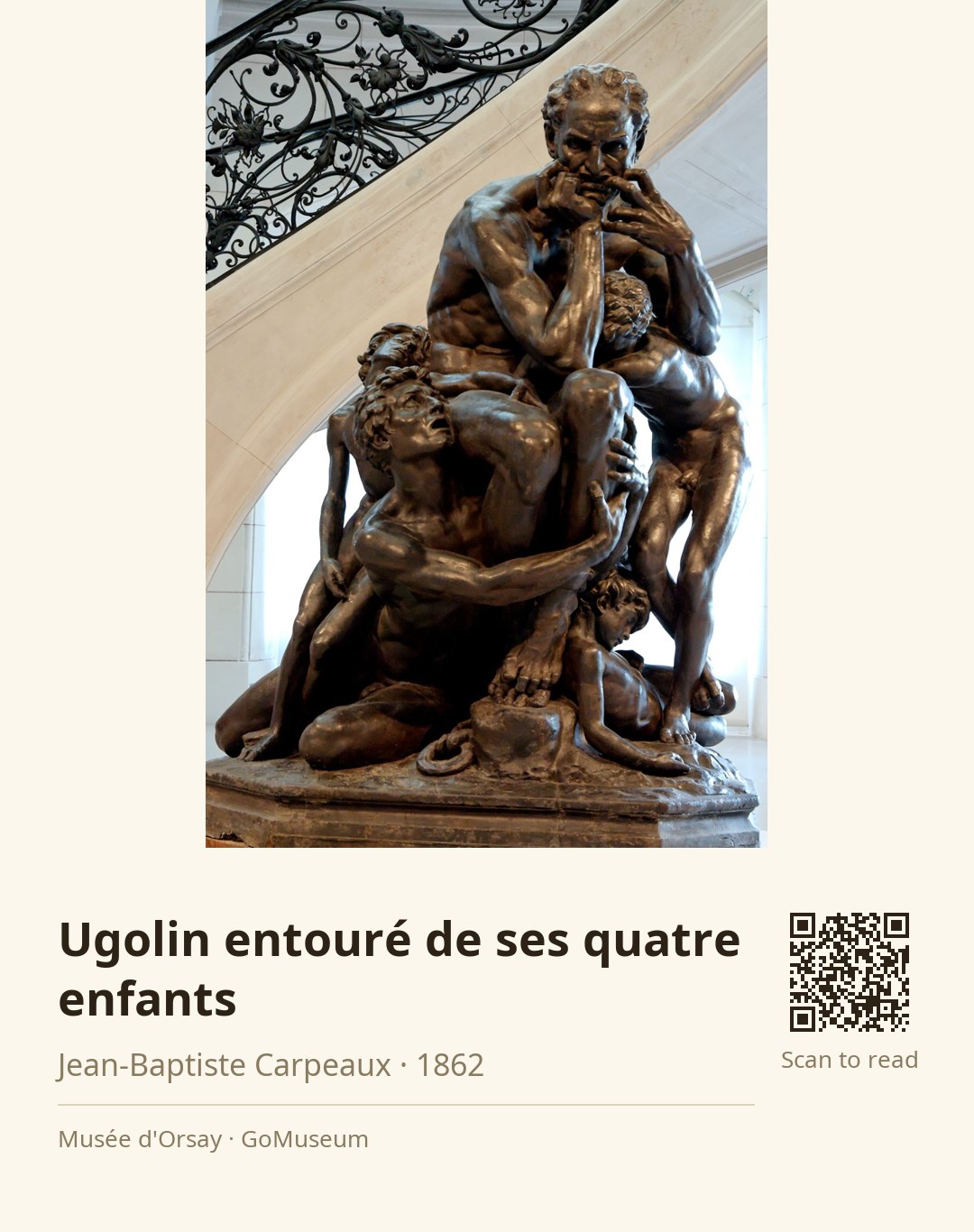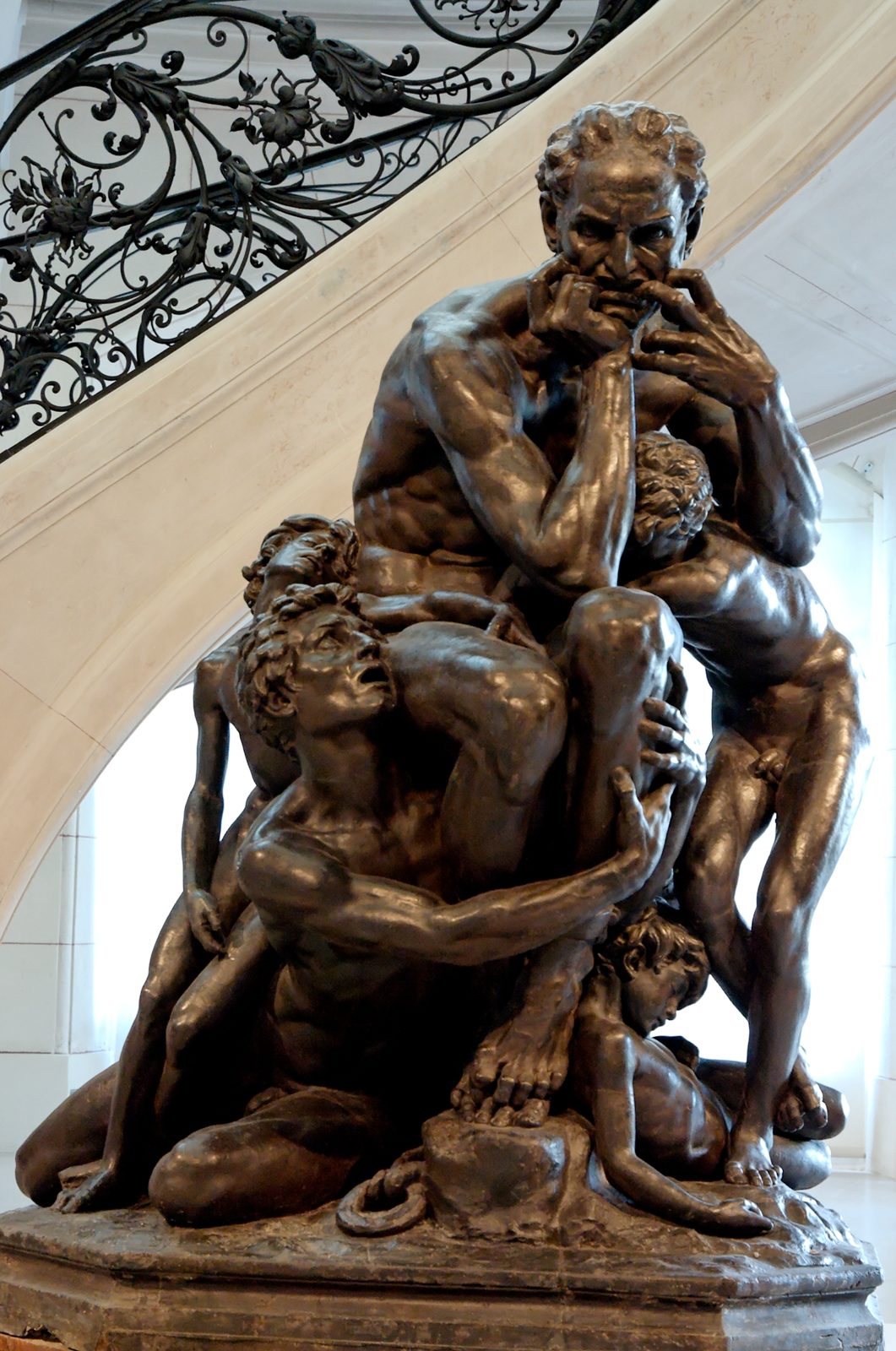
Ugolin entouré de ses quatre enfants
🎧 This work has audio narration — listen in the appTake a moment to really look at "Ugolin entouré de ses quatre enfants." Can you feel the weight of despair in this sculpture? Notice how Ugolin's face is twisted in anguish, while his children cling to him, their expressions a mix of fear and innocence. These details matter because they capture a profound moment of human suffering and love, frozen in time. Carpeaux wanted to express the rawest emotions, and he does so brilliantly here. Each child represents a stage of impending doom, a heartbreaking reminder of their fate. This piece, created in 1862, draws inspiration from Dante's "Divine Comedy," specifically the harrowing tale of Ugolin della Gherardesca, a tyrant condemned to starve with his children. Carpeaux's choice to depict this medieval story was bold, especially in a time when classical themes were favored. As you stand here, think about the emotions this sculpture evokes. What does it say about the bonds of family in the face of tragedy? How does it challenge your understanding of love and sacrifice? Let that linger as you take in the full impact of this powerful work.
Jean-Baptiste Carpeaux was a prominent French sculptor and painter born on May 11, 1827, in Valenciennes. Coming from a humble background as the son of a mason, he pursued his passion for art against his father's wishes, studying under François Rude at the École des Beaux-Arts. His artistic journey took him to Rome after winning the Prix de Rome in 1854, where he drew inspiration from the works of Michelangelo and Donatello, embracing a style that celebrated movement and spontaneity over classical tradition.
Carpeaux's career flourished during the Second Empire, where he became known for his dynamic sculptures, including the famous "Neapolitan Fisherboy" and the allegorical group "Ugolino and His Sons." His work often reflected a blend of realism and emotional depth, which resonated with the public and earned him numerous commissions, including from Emperor Napoleon III. He was not only a celebrated artist but also a savvy entrepreneur, producing variations of his works to reach a broader audience.
Despite his success, Carpeaux struggled with the constraints of academicism and sought to break free from traditional norms. His innovative spirit and dedication to capturing the essence of life left a lasting impact on the art world. He passed away on October 12, 1875, but his legacy endures through his influential works and the artists he mentored, securing his place in art history as a key figure of the 19th century.
As you gaze at 'Ugolin entouré de ses quatre enfants,' pay attention to the intricate details of the sculpture. Carpeaux worked primarily in marble, a material that allows for both fine detail and a sense of solidity. The way he carved Ugolin's anguished face and the delicate features of the children showcases his mastery over the medium. Notice the texture of the clothing, the way it drapes and folds, almost as if it’s alive. The contrast between the smoothness of the skin and the rougher textures of the hair and fabric adds depth to the emotional weight of the piece. This wasn’t just a simple carving; it was a labor of love and pain, reflecting the intense emotions Carpeaux aimed to capture.
The creation of 'Ugolin entouré de ses quatre enfants' spanned several years, from 1857 to 1861, during Carpeaux's time at the Villa Medici in Rome. Initially, he faced challenges from the Academy, which preferred singular figures over groups. However, his passion for the subject matter led to a special exemption, allowing him to pursue this ambitious work. The sculpture was first unveiled in plaster in 1862 and later cast in bronze in 1863. It was displayed in prominent locations, including the Tuileries Garden, where it stood in stark contrast to classical works. The piece stirred significant interest and debate, as it challenged the artistic norms of its time by focusing on a medieval narrative rather than classical themes. Its reception was mixed, but it undeniably marked a pivotal moment in Carpeaux's career, solidifying his reputation as a bold and innovative artist.
By daring to depict a complex emotional narrative—one of despair, familial love, and tragic fate—Carpeaux broke away from the rigid classical traditions that dominated his time. This work, inspired by Dante's 'Divine Comedy', not only showcases the raw intensity of human emotion but also paved the way for future artists to explore realism and psychological depth in their own work. Its influence can be seen in the way subsequent generations approached storytelling in sculpture, emphasizing the importance of narrative and emotional resonance over mere aesthetic perfection. Remember, it's not just a sculpture; it's a poignant exploration of the human condition that resonates through the ages.
Did you know that the legend surrounding Ugolin's fate includes a chilling twist? While Dante's text hints at the extreme desperation of Ugolin, the notion that he resorted to cannibalism is debated among scholars. This interpretation likely arose from a misreading of Dante's lines, which emphasize the overwhelming nature of hunger over pain. Carpeaux's choice to depict this moment of despair captures the ambiguity and horror of the story, inviting viewers to grapple with the moral complexities of survival and sacrifice.
Carpeaux faced resistance from the Academy, which preferred singular figures over groups, making his ambitious multi-figure composition a bold departure from the artistic norms of his time.
Carpeaux was deeply inspired by the intense emotions and moral complexities of Ugolin's tale, which drove him to depict not just the anguish of the father but also the innocence of his children, capturing a moment of profound human suffering.