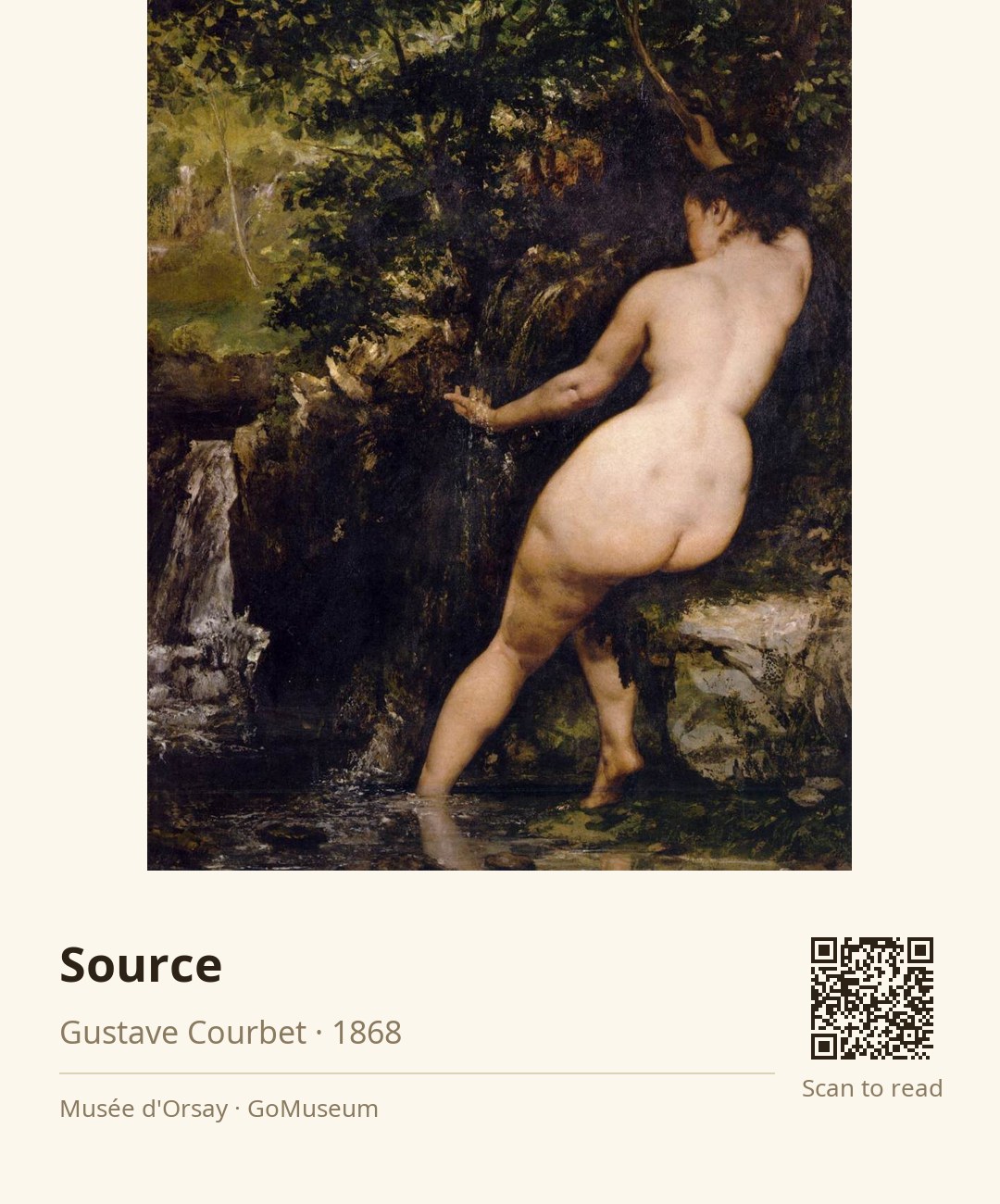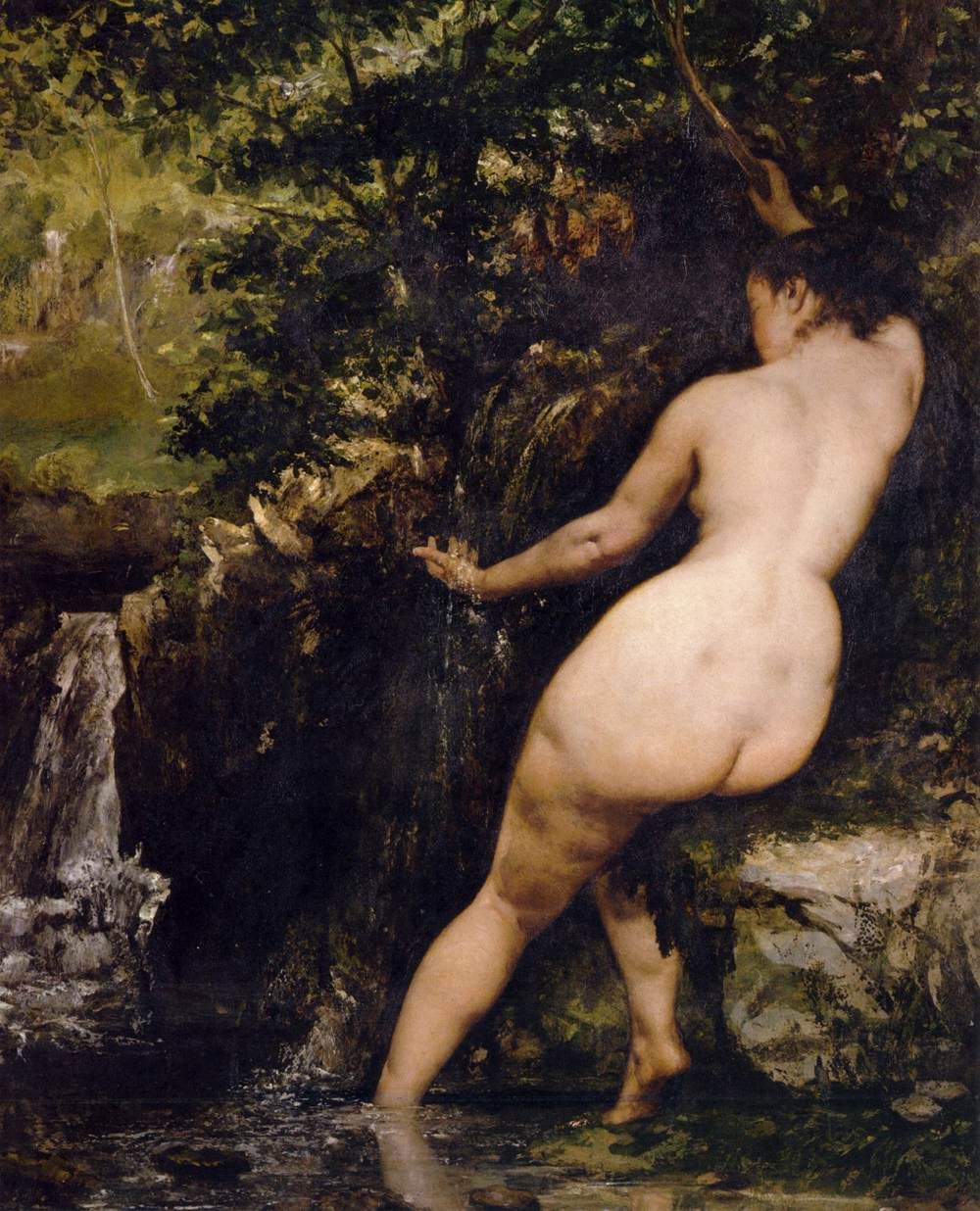
Take a moment to really absorb the scene before you. Gustave Courbet’s “Source” captures a moment of serene intimacy, where a woman stands in a gentle stream, her back turned to us. Notice how the light dances on the water, highlighting the curves of her body and the soft texture of her hair. The way Courbet paints the ripples around her feet feels almost alive, doesn’t it?
These details matter because they invite you into a world that feels both real and dreamlike. Courbet was a pioneer of Realism, and here, he’s not just depicting a nude; he’s celebrating the beauty of nature and the human form in a way that challenges the idealized representations of his time. This painting is a bold statement about the authenticity of everyday life, a theme that Courbet championed throughout his career.
Created in 1868, “Source” reflects Courbet's commitment to painting what he observed in the world around him, breaking away from the romanticized styles of previous generations. He believed that art should be grounded in reality, and this piece exemplifies that philosophy beautifully.
As you stand here, think about the connection between the woman and the nature surrounding her. What emotions does this scene evoke in you? How does it challenge your perception of beauty in art? Let those questions linger as you take in this remarkable work.
Gustave Courbet, born on June 10, 1819, in Ornans, France, was a pioneering painter who championed the Realism movement in 19th-century art. Rejecting the conventions of academic painting and the idealism of Romanticism, he focused on depicting the world as he observed it, often portraying unidealized peasants and workers in monumental compositions. His early works gained recognition, notably "After Dinner at Ornans," which won him a gold medal at the Salon of 1849, allowing him to exhibit without jury approval.
Courbet's commitment to realism was revolutionary; he believed that art should stem from personal experience rather than historical or mythological themes. His bold approach often sparked controversy, challenging societal norms and addressing social issues, which resonated with later movements like Impressionism and Cubism. Despite facing criticism and imprisonment for his political involvement during the Paris Commune, Courbet continued to create until his death on December 31, 1877, in Switzerland.
His legacy endures as a transformative figure in art history, whose unflinching depictions of everyday life laid the groundwork for modern artistic expression. Today, Courbet is celebrated for his vigorous and uncompromising work, which continues to engage audiences with its raw honesty and depth.
Created in 1868, Gustave Courbet's painting 'La Source'—also known as 'Baigneuse à la source'—was a bold exploration of the female form, showcasing a nude woman seen from behind in a stream. This work was part of Courbet's larger commitment to realism, a movement he championed, rejecting the idealized forms of previous artistic traditions. Initially, it was exhibited at the Salon in Brussels in 1869, where it likely stirred conversations among critics and patrons alike. Later, it made its way to the Exposition Universelle in Paris in 1900, further cementing its place in the art world. The painting has a rich provenance, having been part of Courbet's own collection before passing through the hands of his family and various collectors, including notable sales at the Drouot auction house in 1882 and the Petit gallery in 1919. Today, it resides in the Musée d'Orsay, a testament to Courbet's lasting impact on the art of the 19th century.
As you gaze at "Source," pay attention to Courbet's masterful brushwork. The way he layers the oil paint creates a texture that feels almost tactile, inviting you to reach out and touch the surface. The light in the painting is striking; it dances across the water, capturing the fleeting moments of sunlight filtering through the trees. Notice how the composition draws your eye to the figure in the stream, her back turned, which adds an air of mystery. The scale of the painting, quite large at nearly 128 by 97 centimeters, immerses you in the scene, making you feel as if you could step right into that serene moment.
When it was first exhibited, it stirred quite a controversy. Courbet was known for his commitment to realism, and he often faced backlash for depicting subjects that were considered too raw or unrefined. In fact, this painting, which features a nude woman in a stream, was part of a larger movement that challenged the traditional ideals of beauty and representation in art. Courbet was unapologetic about his choices, and this piece was a testament to his belief that art should reflect the world as it is, not as society wished it to be.
Yes, Courbet often returned to his hometown of Ornans for inspiration, and the natural settings in his works, including 'Source', are influenced by the landscapes of his youth, showcasing his deep connection to the region.