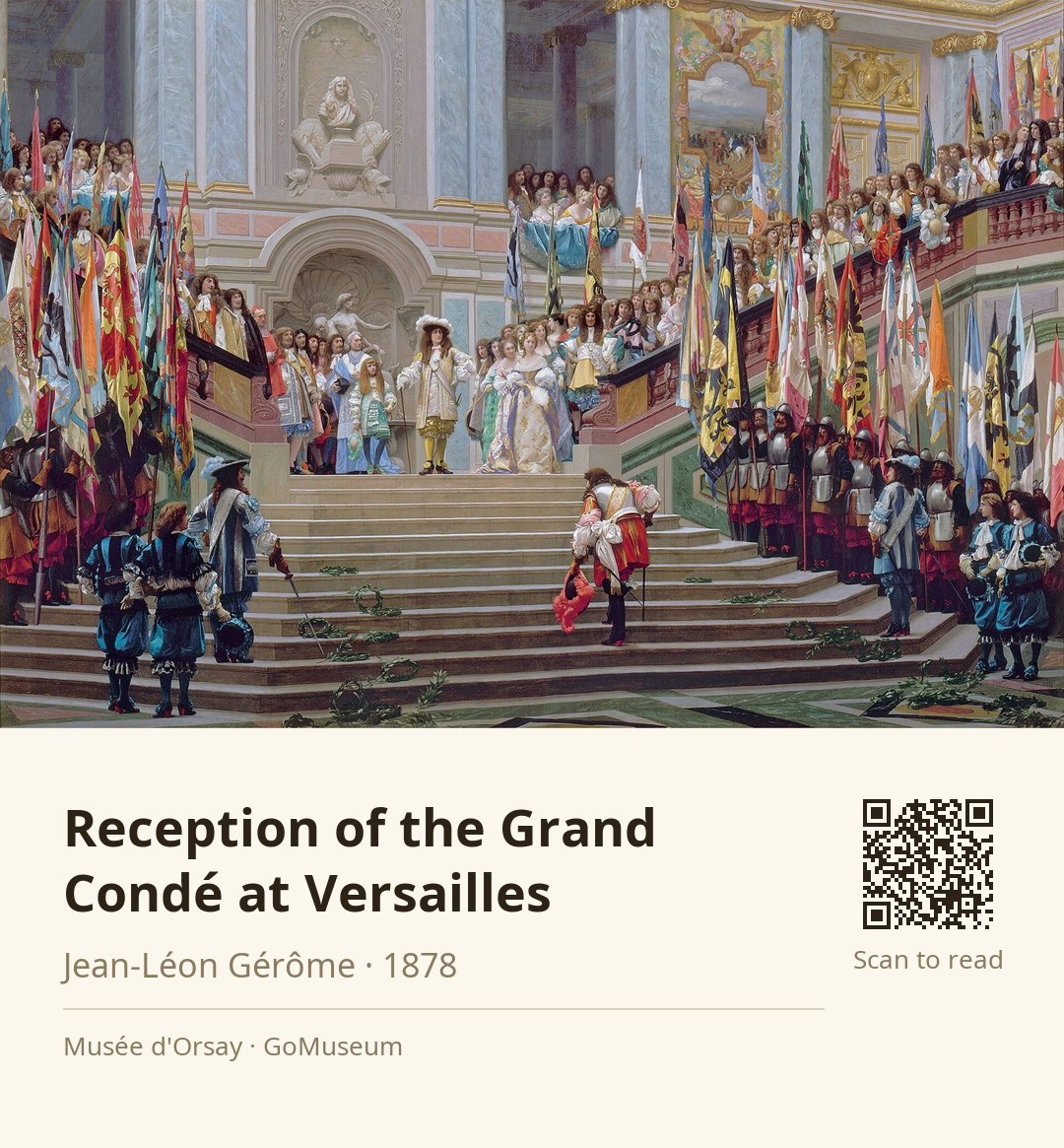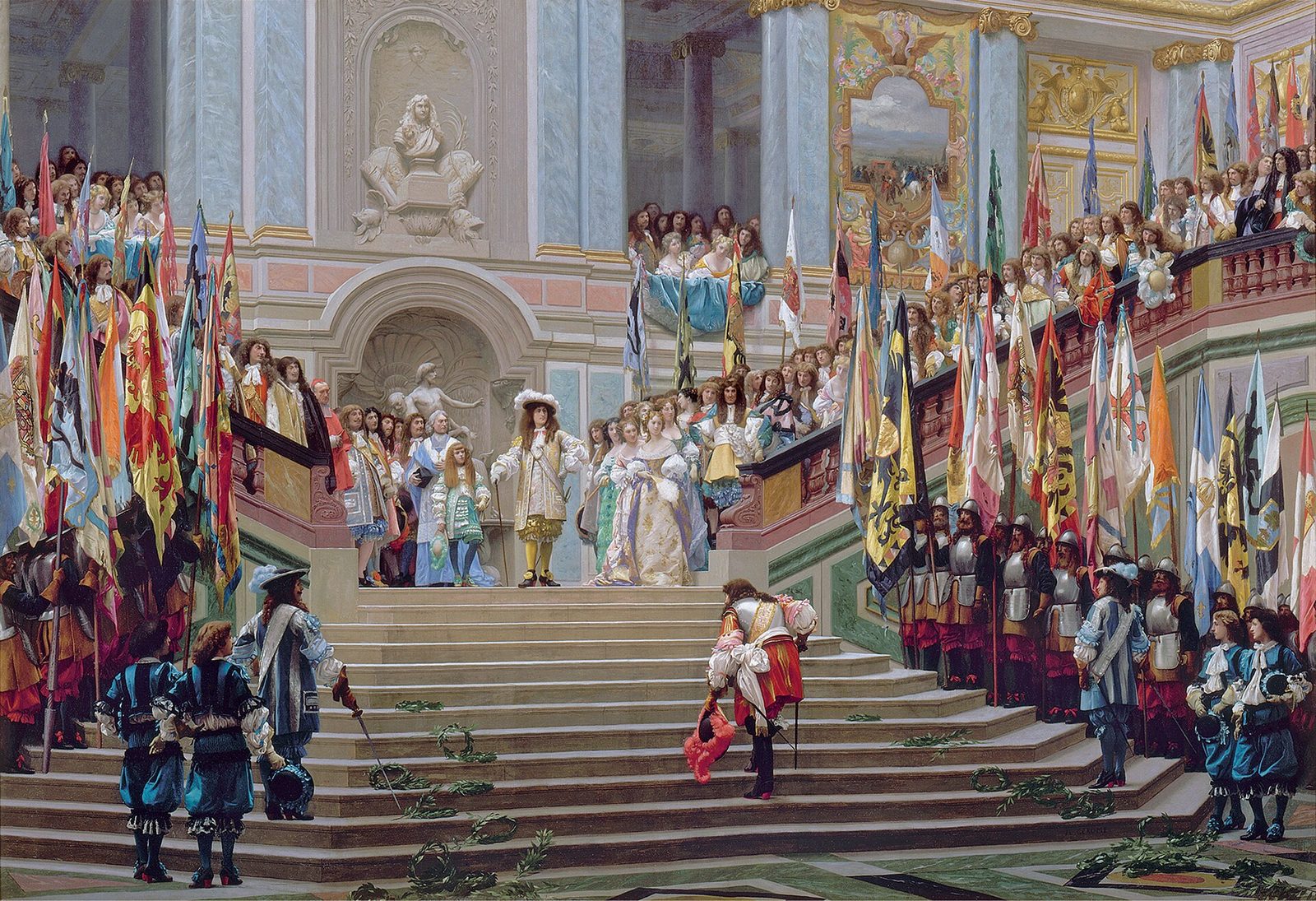
Reception of the Grand Condé at Versailles
🎧 This work has audio narration — listen in the appTake a moment to really soak in the scene before you. This painting, "Reception of the Grand Condé at Versailles," by Jean-Léon Gérôme, captures a pivotal moment in French history, where power dynamics are laid bare. Notice the opulent costumes worn by the courtiers—each thread and embellishment meticulously painted to reflect the grandeur of Versailles.
Now, look closely at the expressions on the faces of the figures. The Grand Condé, standing before Louis XIV, seems to embody a mix of pride and reluctance, a visual cue to the complex relationship between loyalty and ambition. This moment, set in 1674, is not just a greeting; it’s a dramatic play of allegiance and authority, showcasing how the grandiosity of the court often masked deeper tensions.
Gérôme, a master of historical detail, painted this in 1878, years after the actual event, yet he sought to reconstruct the past with precision. The monumental staircase, the Escalier des Ambassadeurs, depicted here, was destroyed long before Gérôme’s brush touched canvas, making his work a fascinating blend of imagination and historical homage.
As you step back, think about the layers of history and human emotion captured in this moment. What do you think the Grand Condé was feeling as he faced the king? How does this painting reflect the timeless dance of power and loyalty that still resonates today?
Jean-Léon Gérôme, born on May 11, 1824, in Vesoul, France, was a prominent painter and sculptor known for his academic style. He gained fame in the mid-19th century, becoming arguably the most celebrated artist of his time. Gérôme's work spanned various genres, including historical, mythological, and Orientalist themes, showcasing his meticulous attention to detail and vibrant compositions. His early education in drawing laid the foundation for his artistic journey, which included studies under notable mentors in Paris.
Gérôme's career flourished after his debut at the Paris Salon in 1847, where his painting "The Cock Fight" garnered critical acclaim. He became a leading figure in the Neo-Grec movement and later embraced Orientalism after travels to Egypt and the Ottoman Empire. His works often depicted exotic scenes, blending accurate architectural details with idealized figures. As a teacher at the École des Beaux-Arts, he influenced a generation of artists, including Mary Cassatt and Thomas Eakins.
Despite his initial success, Gérôme's resistance to modern movements like Impressionism led to a decline in his reputation after his death on January 10, 1904. However, his art experienced a revival in the late 20th century, inspiring filmmakers and continuing to be celebrated for its technical prowess and historical significance. With around 600 paintings and numerous sculptures, Gérôme remains a key figure in the academic art tradition of the Second Empire.
Jean-Léon Gérôme's painting, 'Reception of the Grand Condé at Versailles,' was completed in 1878, but it captures a moment from 1674, when Louis II de Bourbon-Condé was received by Louis XIV at the grand Palace of Versailles. This painting was acquired by the Musée d'Orsay in 2004, and just a decade later, in 2014, it was loaned to the Museum of Fine Arts of Lyon for an exhibition titled 'L'invention du Passé.' Gérôme's meticulous attention to historical detail reflects his desire to reconstruct the past, even depicting the Escalier des Ambassadeurs, which had been destroyed long before he painted it.
Gérôme's technique in 'Reception of the Grand Condé at Versailles' is a masterclass in precision and detail. The brushwork is both meticulous and dynamic, capturing the rich textures of the courtiers' costumes, from the glint of gold embroidery to the deep hues of velvet. Notice how the light plays across the figures, creating a sense of depth and dimension that draws your eye into the scene. The composition is structured around the monumental staircase, leading your gaze upward, emphasizing the grandeur of the setting. Gérôme's choice to depict this historical moment with such vivid realism not only highlights the opulence of the court but also the underlying tension between the figures, particularly the Grand Condé's complex expression of pride and reluctance. This careful balance of detail and emotional nuance is what gives the painting its lasting impact.
Interestingly, Gérôme's painting was part of a shift in his career after the mixed reception of his earlier work, 'Siècle d'Auguste.' This prompted him to focus on what he termed 'small' history, emphasizing intimate moments of power and allegiance rather than grand historical narratives. This pivot not only marked a change in his artistic direction but also reflected a broader trend in 19th-century art towards capturing the nuances of human experience.
The monumental staircase, the Escalier des Ambassadeurs, depicted in the painting was actually destroyed long before Gérôme painted this scene, showcasing his imaginative reconstruction of historical architecture.
Following the mixed reception of his earlier painting, 'Siècle d'Auguste,' Gérôme shifted his focus to 'small' history, emphasizing intimate moments like the reception of the Grand Condé, which reflects a broader trend in 19th-century art.
As a long-time professor at the École des Beaux-Arts, Gérôme taught over two thousand students, including notable artists like Mary Cassatt and Thomas Eakins, influencing generations of painters with his academic approach.