Portrait of Miss L. L.
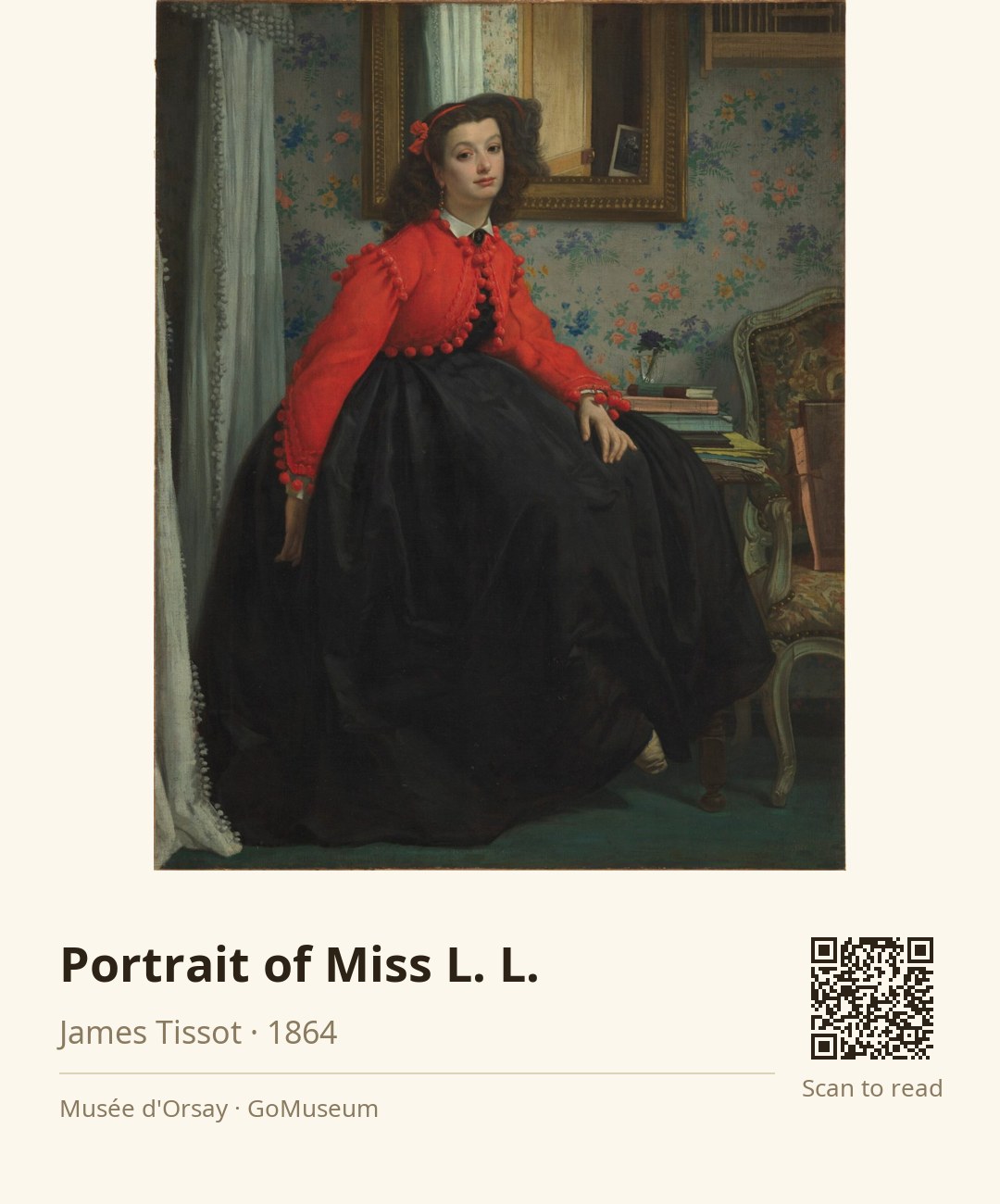
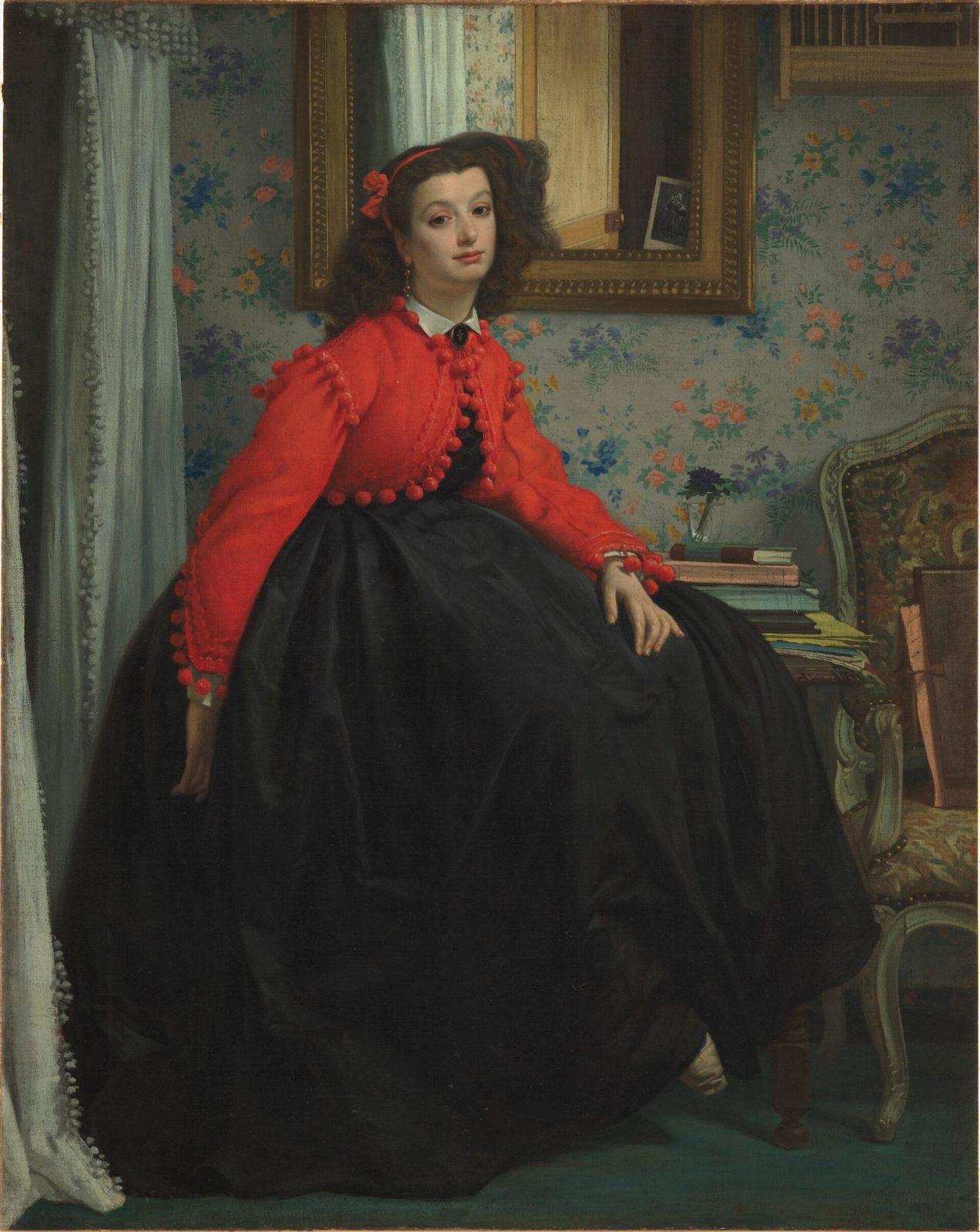
🎧 This work has audio narration — listen in the appTake a moment to really look at the "Portrait of Miss L. L." by James Tissot. Notice how the young woman, dressed in that striking red bolero jacket, seems to almost leap off the canvas. Her expression carries a hint of melancholy, which draws you in, doesn’t it?
Now, pay attention to the details surrounding her—the luxurious black dress that takes up nearly half the painting, the intricate floral wallpaper, and that golden-framed mirror reflecting an open door. These elements aren’t just decoration; they tell us about her world. The books and the delicate flowers suggest a life filled with curiosity and perhaps a touch of solitude, while the open door hints at possibilities or perhaps a longing for freedom.
Created in 1864, this piece marked a turning point for Tissot, moving away from historical themes to focus on the contemporary life of women, a subject he would explore throughout his career. It was a bold shift that surprised many at the time, as critics noted he had finally entered the modern age.
So, as you stand here, think about the story this young woman might tell. Who was she? What dreams did she hold? Let your imagination wander—what do you think she was waiting for?
James Tissot, born Jacques Joseph Tissot in Nantes in 1836, was a French painter and illustrator renowned for his depictions of Victorian high society and women's fashion during the Belle Époque. Initially trained at the École des Beaux-Arts in Paris, he embraced realism and impressionistic techniques, capturing the nuances of contemporary life. Tissot's early works focused on medieval themes, but after moving to London in 1871, he shifted to genre paintings that resonated with British audiences, earning acclaim for his photorealistic style.
His tumultuous life included service in the Franco-Prussian War and a close relationship with Kathleen Newton, who inspired many of his works until her untimely death. Tissot's social circle included notable figures like Edgar Degas and James Whistler, reflecting his integration into the artistic elite. Later in life, he experienced a religious awakening, leading him to create biblical subjects that garnered significant recognition. Tissot's legacy endures as a pivotal figure in 19th-century art, bridging traditional techniques with modern themes, ultimately earning him a place in art history. He passed away in 1902, leaving behind a rich tapestry of works that continue to captivate audiences.
In 1864, James Tissot unveiled the 'Portrait of Miss L. L.' at the Salon des Artistes français in Paris, a pivotal moment in his career. This painting, alongside 'The Two Sisters,' marked a significant departure from his earlier historical themes, surprising both supporters and critics. One critic famously remarked that Tissot had finally 'entered our century.' The painting's model, whose identity remains a mystery, had posed for Tissot before, adding a layer of intrigue to the work. The painting was acquired by the French state in 1907 and is now housed in the Musée d'Orsay, having been part of the Thiébaut-Sisson sale at the Hôtel Drouot in Paris. This shift in Tissot's focus to contemporary life and women's experiences would define much of his future work, reflecting the changing social landscape of the time.
As you gaze at 'Portrait of Miss L. L.,' notice Tissot's meticulous brushwork, which creates a sense of texture and depth. The luxurious black dress enveloping the figure is painted with such care that it almost feels tangible, while the vibrant red of the bolero jacket pops against the more subdued background. Tissot's use of light is masterful; it dances across the fabric, highlighting the contours and folds, drawing your eye to the model's poised yet melancholic expression. The composition is carefully structured, with the mirror reflecting an open door, suggesting a world beyond the canvas. This interplay of reflection and reality invites you to ponder the model's inner life. The floral wallpaper and the carefully arranged books and flowers add layers of meaning, hinting at her intellectual curiosity and perhaps a longing for something more. Tissot's attention to detail transforms the painting into a narrative, inviting you to step into her world.
L.' marked a pivotal shift in his artistic journey, steering him away from historical themes towards a vibrant exploration of contemporary life. This 1864 painting, with its striking depiction of a young woman in a red bolero, not only captivated audiences at the Salon but also showcased Tissot's unique blend of realism and modernity. Critics noted this transformation, suggesting he had finally entered 'our century.' Tissot's focus on fashionable women and their environments influenced a generation of artists, bridging the gap between traditional portraiture and the emerging Impressionist movement. His work laid the groundwork for future explorations of gender and society in art, making him a key figure in the evolution of modern portraiture.
The identity of the model, referred to as Miss L. L., remains a mystery, which adds an intriguing layer to the painting and invites speculation about her life and relationship with Tissot. This anonymity has led to much discussion among art historians, as she had posed for Tissot before, suggesting a deeper connection.
Growing up in a family involved in the fashion industry likely influenced Tissot's meticulous attention to detail in clothing and textiles, which is evident in his portrayal of women's fashion. His mother's background as a milliner also instilled a sense of aesthetic appreciation that permeated his work.
Edgar Degas, a contemporary and friend of Tissot, significantly influenced his shift towards modern themes, as both artists shared an admiration for classical techniques and an interest in capturing contemporary life. Their friendship and mutual respect for each other's work helped shape Tissot's evolving style.