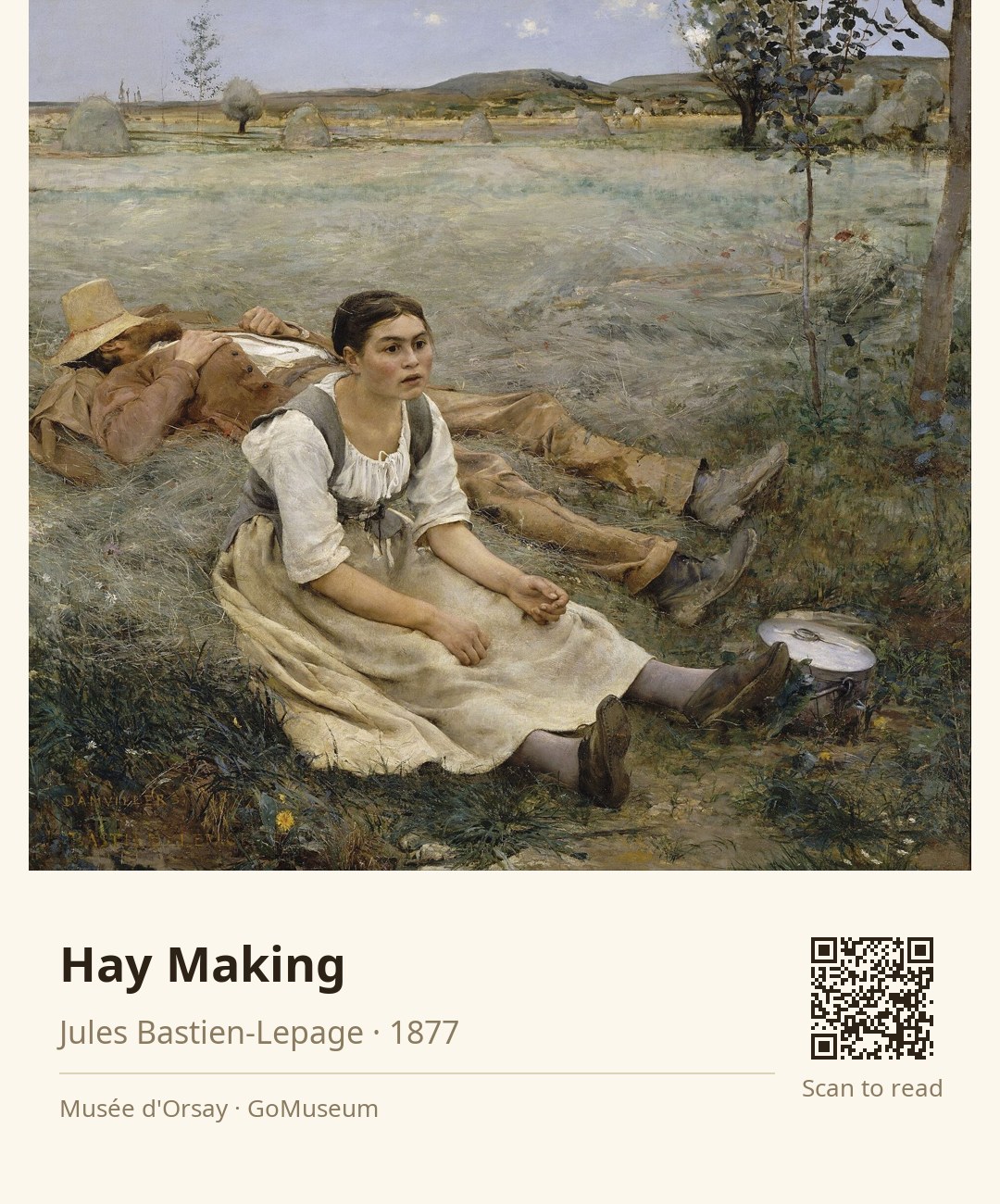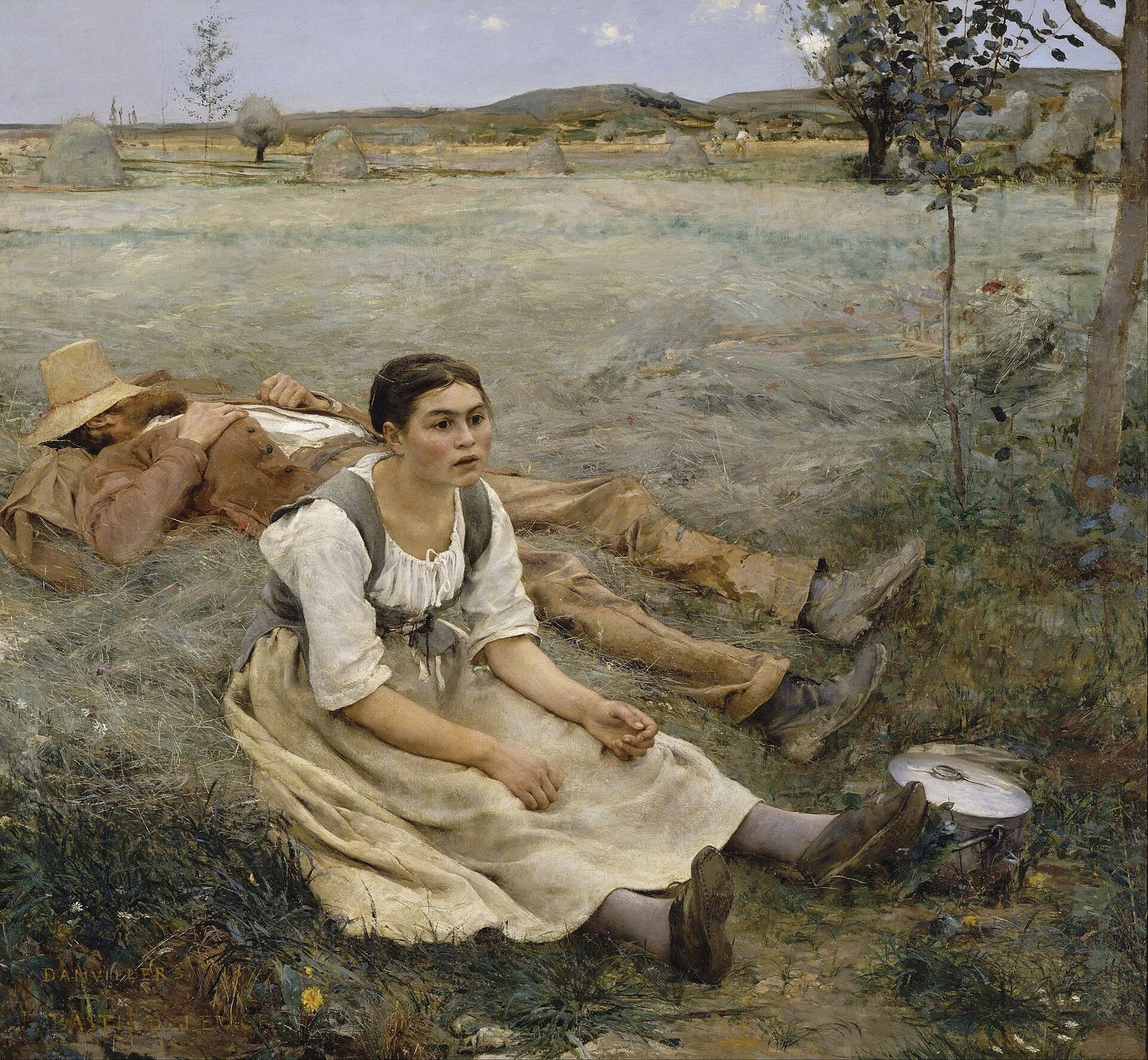
Take a moment to really look at "Hay Making" by Jules Bastien-Lepage. Notice the way the sunlight dances across the mown grass, illuminating the weary faces of the two peasants. The man is sprawled out, his straw hat casting a shadow that hides his expression, while the young woman sits beside him, her body language screaming exhaustion.
These details matter because they capture a raw, unfiltered moment of rural life, far removed from the romanticized depictions of peasants that were common in the art of the time. Instead of idealizing their toil, Bastien-Lepage lays bare the reality of their labor, inviting you to feel the weight of their fatigue and the heat of the sun on their skin.
Created in 1877 and first shown at the Salon of 1878, this painting is a hallmark of Naturalism, a movement that sought to depict life as it truly is. Critics like Émile Zola praised Bastien-Lepage for his ability to convey deep emotion through simple scenes, making this work a significant piece in the evolution of modern art.
As you stand here, think about the lives of these two figures. What stories do you imagine they carry with them, and how does this moment of rest reflect the struggles of their daily lives?
Jules Bastien-Lepage was a pivotal figure in the transition from Realism to Naturalism in 19th-century French art. Born on November 1, 1848, in the rural village of Damvillers, he was nurtured in a modest, artistic family that encouraged his early passion for drawing. His formal education began under his father's guidance and later at the École des Beaux-Arts in Paris, where he studied under Alexandre Cabanel. Despite initial struggles, his breakthrough came with the acclaimed "Portrait of my Grandfather" in 1874, establishing him as a leading voice in Naturalism.
Bastien-Lepage's works, characterized by their en plein air depictions of peasant life, resonated with audiences and influenced artists worldwide, including George Clausen and Tom Roberts. His notable pieces, such as "Joan of Arc" and "Haymaking," showcased his ability to blend realism with a touch of Impressionism, earning him accolades like the Legion of Honour.
Tragically, his life was cut short by illness at the age of 36, but his legacy endures through his innovative approach and the emotional depth of his subjects, marking him as a significant contributor to the evolution of modern art. His influence is felt in the works of many artists who followed, solidifying his place in art history.
Jules Bastien-Lepage's 'Hay Making' was first unveiled at the Salon of 1878 in Paris, where it quickly garnered attention. This painting was a pivotal moment in the artist's career, showcasing his commitment to Naturalism, a movement that aimed to depict life with authenticity. The work was acquired by the Musée du Luxembourg in 1885 during a posthumous sale of Bastien-Lepage's works, a testament to its immediate impact. It later transitioned to the Louvre in 1929 before finding its permanent home in the Musée d'Orsay in 1980. Critics like Émile Zola hailed it as a masterpiece, praising its raw emotional depth and departure from idealized representations of peasant life. The painting's journey reflects not just its artistic merit but also the evolving appreciation for realism in art during the late 19th century.
As you gaze at 'Hay Making,' take note of the striking composition. The horizon line is positioned unusually high, allowing the lush mown grass to dominate the canvas. This choice draws your eye downward, emphasizing the peasants' exhaustion against the vastness of their labor. The brushwork is both meticulous and expressive, capturing the textures of the grass and the weariness etched on their faces. The light plays a crucial role, with sunlight filtering through the scene, creating a warm yet harsh atmosphere that mirrors the peasants' toil. The color palette is earthy and subdued, enhancing the sense of realism. Bastien-Lepage's technique, blending detailed realism with an almost photographic quality, invites you to feel the weight of the moment, making their fatigue palpable.
He positioned the horizon line unusually high, allowing the mown grass to dominate the canvas, which emphasizes the peasants' exhaustion against the vastness of their labor.
Growing up in a modest rural environment, he developed a deep connection to peasant life, which became a central theme in his work, allowing him to authentically portray the struggles and realities of rural labor.