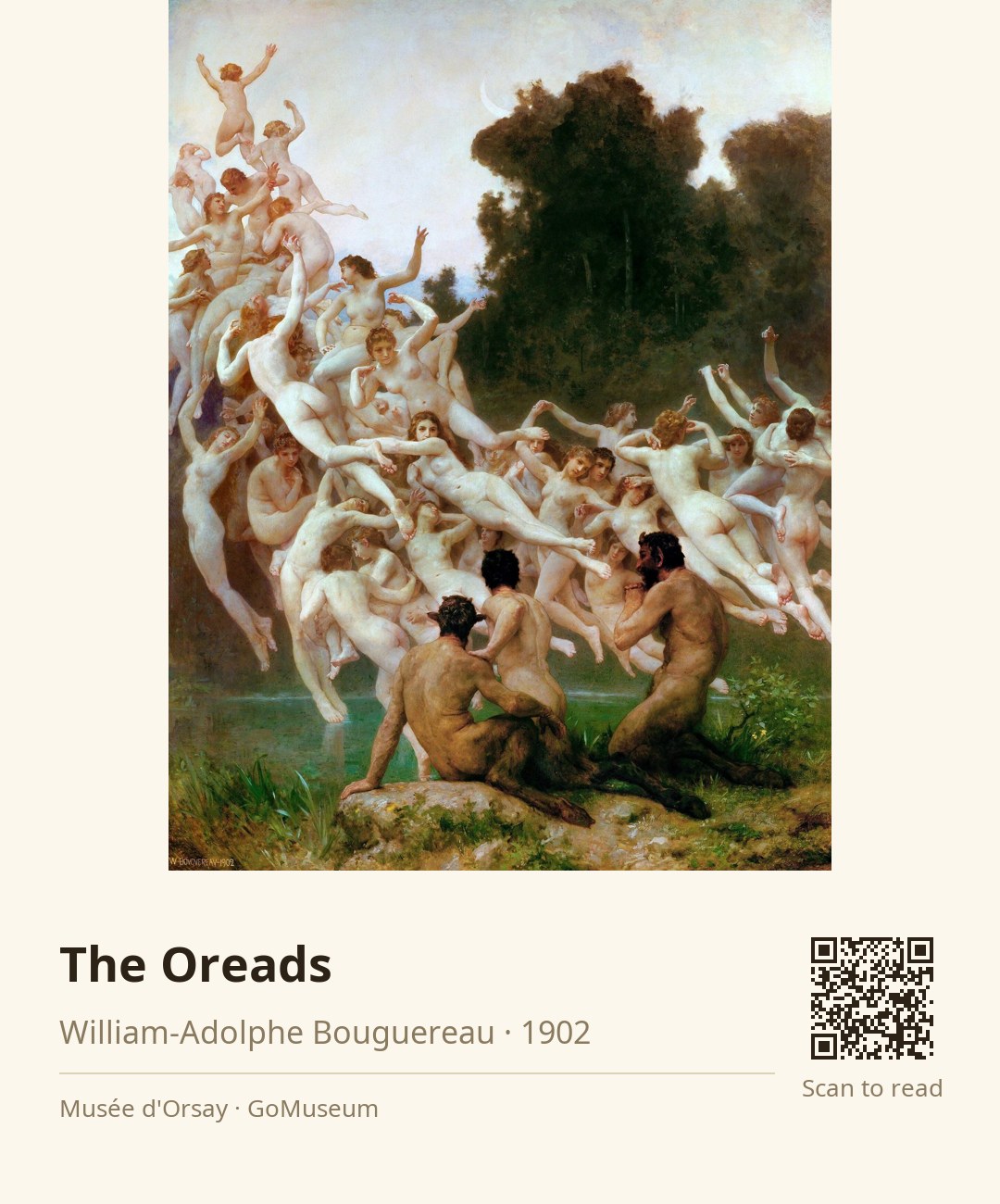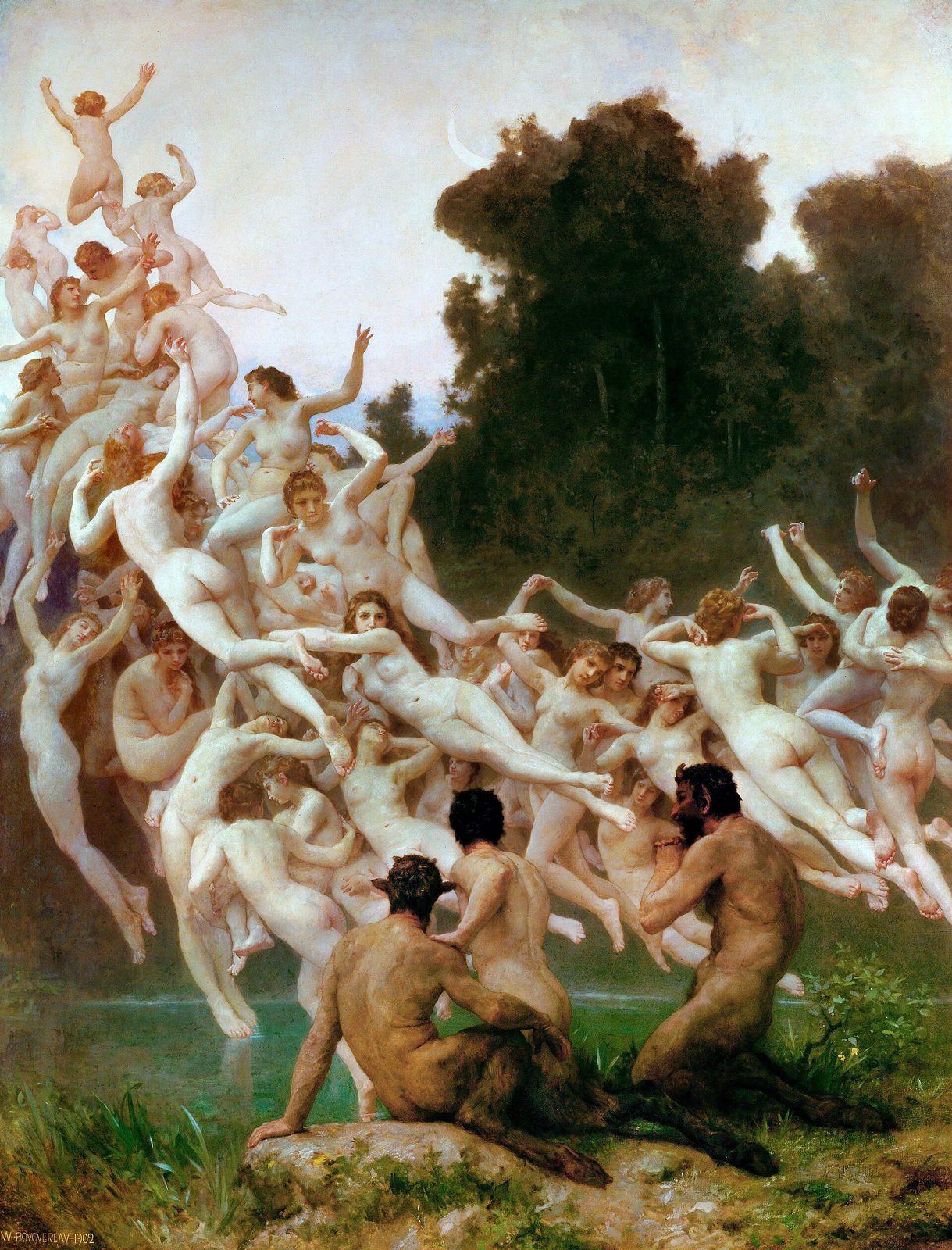
Take a moment to really soak in the ethereal beauty of "The Oreads." As you gaze at this stunning painting, notice how the nymphs seem to almost float into the dawn-lit sky, their bodies glowing with a soft, radiant light. Look closely at the delicate way their hair cascades down their backs, and how the gentle curves of their forms blend seamlessly with the natural landscape around them.
These details matter because they capture the essence of Bouguereau's mastery over the human figure and his ability to evoke a sense of otherworldliness. The Oreads, in Greek mythology, are mountain nymphs, and here they are depicted at the break of day, symbolizing a transition from the earthly to the divine. The three satyrs watching in awe remind us of the playful yet mysterious relationship between nature and the divine, a theme that resonates deeply throughout art history.
Bouguereau painted this piece in 1902, a time when he was at the height of his career, celebrated for his academic style that emphasized beauty and realism. His works often faced criticism from the avant-garde, yet this painting remains a testament to his skill and vision.
As you take in this captivating scene, consider what it might feel like to be one of those nymphs, ascending into the sky, leaving the earthly realm behind. What dreams or adventures might await you in that ethereal world?
William-Adolphe Bouguereau was a prominent French academic painter born on November 30, 1825, in La Rochelle. He grew up in a family of merchants and developed a passion for art at a young age. Bouguereau studied at the École des Beaux-Arts and won the prestigious Prix de Rome in 1850, which allowed him to immerse himself in the classical art of Italy. His work, characterized by realistic depictions of mythological themes and the female form, gained immense popularity in France and the United States during his lifetime.
Despite his success, he faced criticism from the Impressionist movement, which deemed his style overly traditional. By the early 20th century, changing tastes led to a decline in his popularity, but a revival in the 1980s rekindled interest in his work. Bouguereau completed 822 known paintings, many of which remain lost. His legacy as a master of academic painting endures, particularly for his sensitive portrayals of women and children, marking him as a significant figure in art history. He passed away on August 19, 1905, leaving behind a complex legacy that continues to provoke discussion and admiration.
This painting quickly captured attention, not just for its ethereal beauty but also for its embodiment of Bouguereau's academic style, which was both celebrated and critiqued. The work depicts the Oreads, mountain nymphs from Greek mythology, ascending into the dawn, watched by three satyrs. The painting was later donated by Bouguereau's descendants to the Musée d'Orsay in Paris in 2009, where it resides today, continuing to draw admiration from visitors and art lovers alike. Its journey reflects the artist's legacy, moving from the heights of acclaim to a period of obscurity, and now enjoying a revival in appreciation for its technical mastery and mythological themes.
The brushwork is meticulous, creating a smooth texture that enhances the lifelike quality of the nymphs' skin, making them appear almost luminous against the soft pinks and blues of the dawn sky. Notice how Bouguereau plays with light; the nymphs are illuminated as if kissed by the first rays of sunlight, their forms glowing with an ethereal quality. The composition draws your eye upward, following the ascending figures, which creates a sense of movement and transcendence. The way the nymphs' hair flows and intertwines with the landscape adds to this dynamic, almost as if they are part of the very air around them. This careful orchestration of elements not only showcases Bouguereau's technical prowess but also evokes a dreamlike quality, inviting you to lose yourself in this mythical ascent.
Did you know that Bouguereau's 'The Oreads' was actually exhibited at the Salon des artistes français in 1902? This was a big deal back then! The Salon was the premier art exhibition in France, and getting a piece shown there was a mark of prestige. But here's the twist: while Bouguereau was celebrated for his technical skill, he was also a polarizing figure. The Impressionists, who were just starting to make waves, viewed his polished style as outdated. So, while the Oreads were soaring into the sky in his painting, Bouguereau was facing a storm of criticism in the real world. It's a fascinating contrast, isn't it?
Bouguereau's meticulous brushwork creates a smooth texture that enhances the lifelike quality of the nymphs' skin, making them appear almost luminous against the dawn sky.