 Image: Sailko
Homage to Delacroix
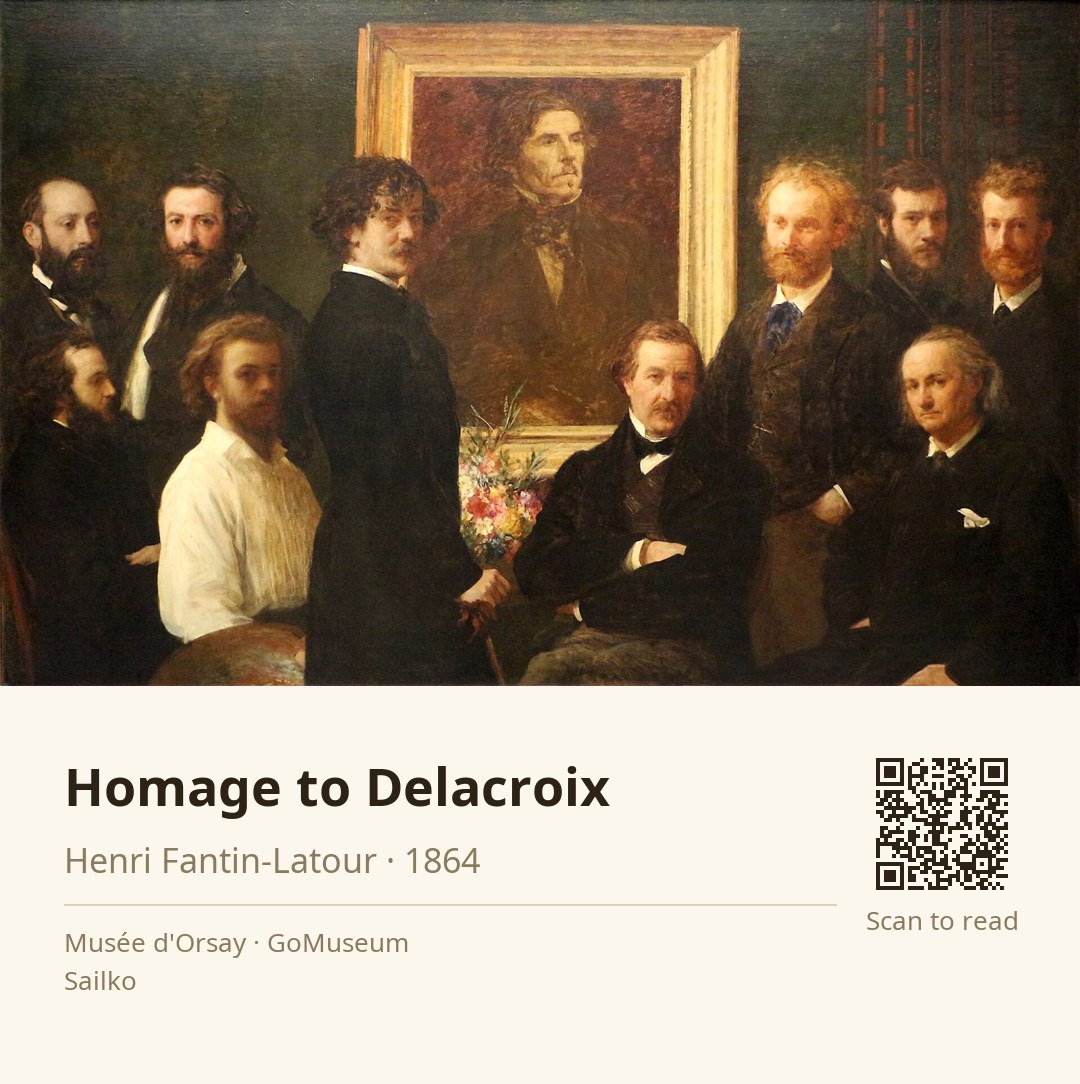
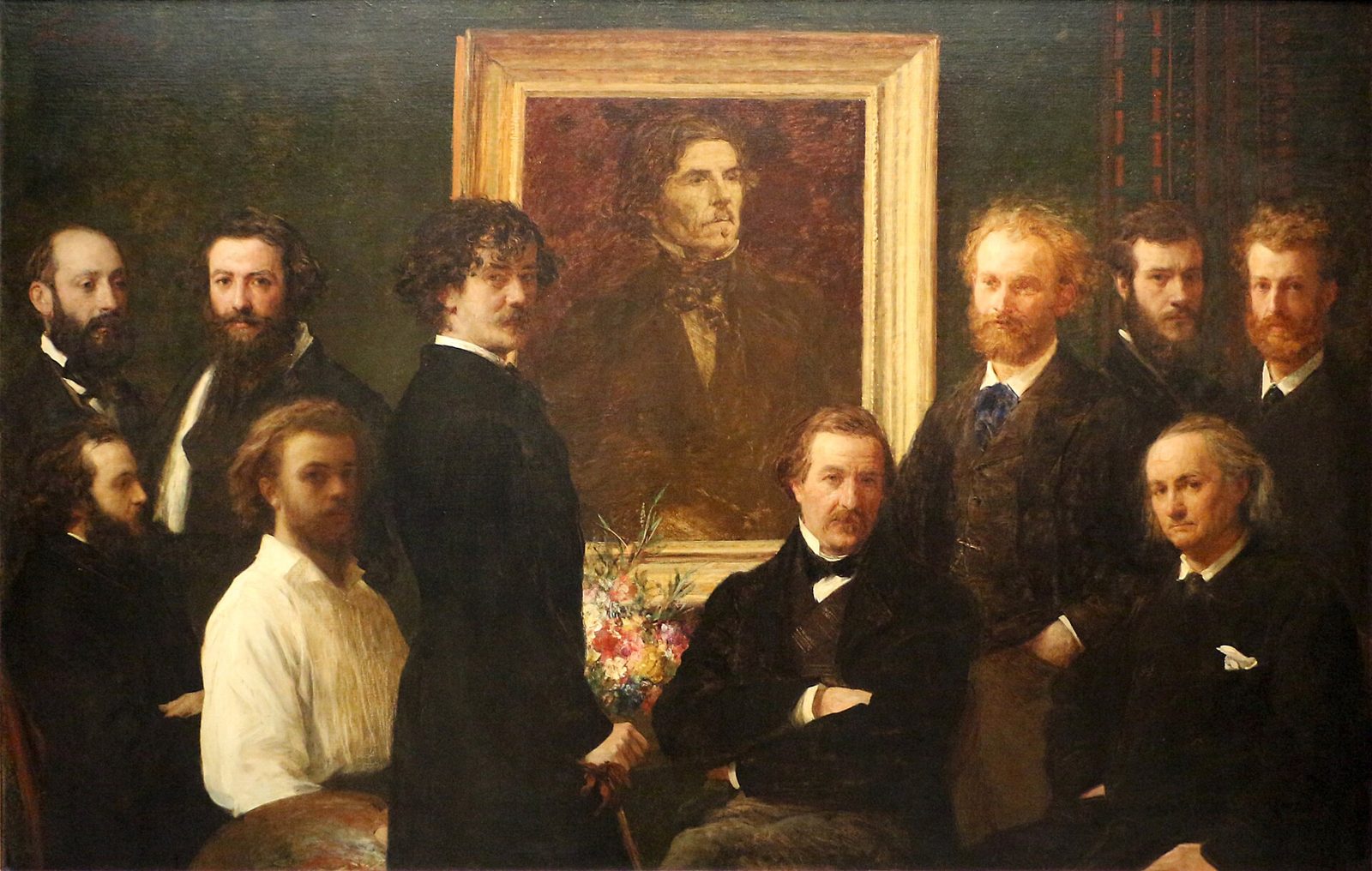
🎧 This work has audio narration — listen in the appTake a moment to really look at "Homage to Delacroix" by Henri Fantin-Latour. Notice how the figures are gathered around the portrait of Eugène Delacroix, almost as if they’re in a hushed reverence. See the way the light subtly highlights the faces of the artists and writers, each one a notable figure in their own right, yet all united in their admiration for the Romantic master.
These details matter because they capture a moment of collective mourning and respect in the art world. Fantin-Latour was deeply moved by the sparse attendance at Delacroix's funeral, and this painting serves as a powerful tribute, immortalizing not just Delacroix but also the community of artists who revered him. The somber tones and the arrangement of the figures create a sense of stillness, inviting you to ponder the weight of legacy and influence.
Created in 1864, just a year after Delacroix's death, this work was part of a series where Fantin-Latour explored group portraits of artistic personalities. Despite receiving mixed reviews at its debut at the Paris Salon, it has since been recognized as a significant piece that reflects the spirit of its time.
As you stand here, think about the relationships between these artists. What do you imagine they might have discussed in front of Delacroix’s portrait?
Ignace Henri Jean Théodore Fantin-Latour, born on January 14, 1836, in Grenoble, was a notable French painter and lithographer renowned for his exquisite flower paintings and group portraits of contemporary artists and writers. His artistic journey began under the guidance of his father, a painter, and continued in Paris, where he studied at the École des Beaux-Arts alongside future Impressionists like Edgar Degas and Alphonse Legros. Despite his connections to the avant-garde, Fantin-Latour's style remained rooted in realism and tradition.
In the 1860s, he gained acclaim for his still lifes, particularly in England, where his works were celebrated for their vibrant colors and textures. Encouraged by James McNeill Whistler, he embraced this genre, which was often undervalued in the hierarchy of art. His still lifes, characterized by their simplicity and focus on form, defied academic conventions and showcased his mastery of color.
Fantin-Latour's contributions to collective portraiture, such as "A Studio at Les Batignolles," positioned him as a bridge between Romanticism and Impressionism. Despite being overshadowed by his contemporaries, his legacy endures, with his works held in prestigious museums and a lasting influence on subsequent generations of artists. He passed away on August 25, 1904, leaving behind a rich artistic heritage that continues to be appreciated today.
Henri Fantin-Latour's 'Homage to Delacroix' was painted in 1864, just a year after the death of the renowned Romantic painter Eugène Delacroix. This poignant piece was born out of Fantin-Latour's deep sorrow at the sparse attendance at Delacroix's funeral, an event he attended alongside notable figures like Charles Baudelaire and Édouard Manet. Fantin-Latour felt compelled to create a public tribute, gathering ten prominent personalities from the arts and letters around Delacroix's portrait. The painting debuted at the Paris Salon of 1864, where it received mixed reviews, criticized for its static composition and dark tones. However, within artistic circles, it was appreciated for its heartfelt homage. Over the years, it has been exhibited in various prestigious venues, including the Exposition Universelle in 1889 and a dedicated exhibition in 1906. Today, it resides in the permanent collection of the Musée d'Orsay in Paris, a testament to its enduring legacy.
As you gaze at 'Homage to Delacroix,' take a moment to appreciate Fantin-Latour's masterful technique. The composition is structured with a careful arrangement of figures, each artist positioned to create a sense of unity and reverence. The use of light is particularly striking; it gently illuminates the faces of the gathered figures, drawing your eye to their expressions of admiration and melancholy. Notice the brushwork — it feels almost restless, capturing the emotional weight of the moment. The palette is dominated by somber tones, which enhances the atmosphere of mourning while still allowing for subtle highlights that bring the figures to life. The scale of the painting is grand, measuring 160 by 250 centimeters, which invites viewers to step closer and engage with the intimate yet collective experience of loss and tribute.
Created in 1864, this painting brought together a who's who of 19th-century French artists and writers, all gathered in reverence of Eugène Delacroix, a titan of Romanticism. By uniting these figures, Fantin-Latour not only honored Delacroix but also established a new genre of artistic manifesto, setting the stage for future movements. This work influenced generations of artists, emphasizing the importance of community and shared admiration in the creative process. Remember, this painting isn't just about the individuals depicted; it's a celebration of artistic legacy and the bonds that tie creators together.
One surprising detail about 'Homage to Delacroix' is that it was inspired by a rather somber event: the funeral of Eugène Delacroix. Henri Fantin-Latour was deeply affected by the sparse turnout at the procession, which he attended alongside notable figures like Charles Baudelaire and Édouard Manet. This experience ignited a spark in him to create a public tribute that would gather the artistic elite of his time, showcasing their admiration for Delacroix in a single, powerful composition.
The painting features ten prominent personalities from the arts and letters, including Charles Baudelaire, Édouard Manet, and James Whistler, each of whom played a significant role in the artistic community of the time.
Fantin-Latour was deeply affected by the sparse attendance at Delacroix's funeral, which motivated him to create this tribute as a way to honor the legacy of Delacroix and the community of artists who admired him.
At its debut in the Paris Salon of 1864, the painting received mixed reviews, with critics pointing out its static composition and dark tones, although it was appreciated in artistic circles for its emotional depth.