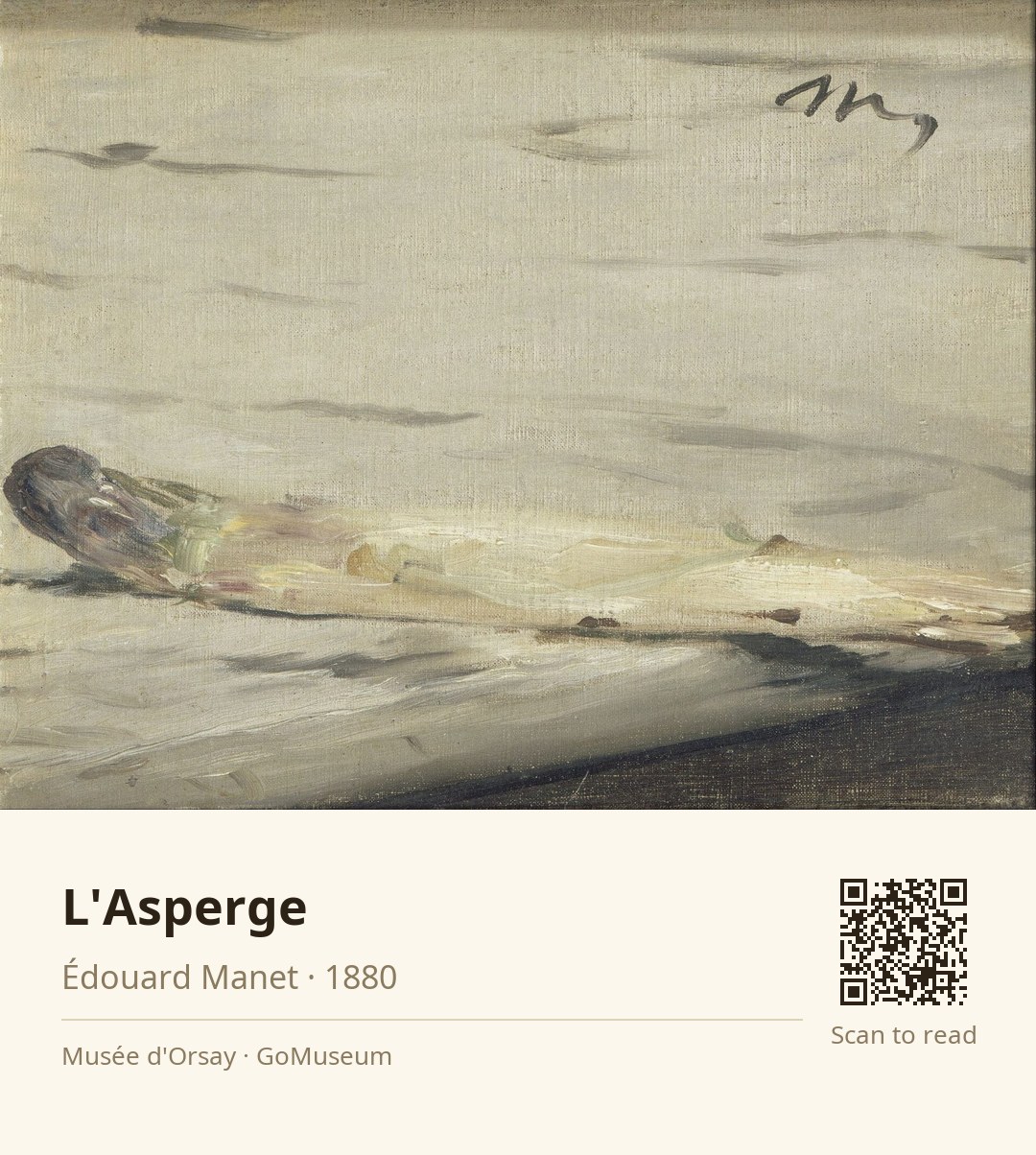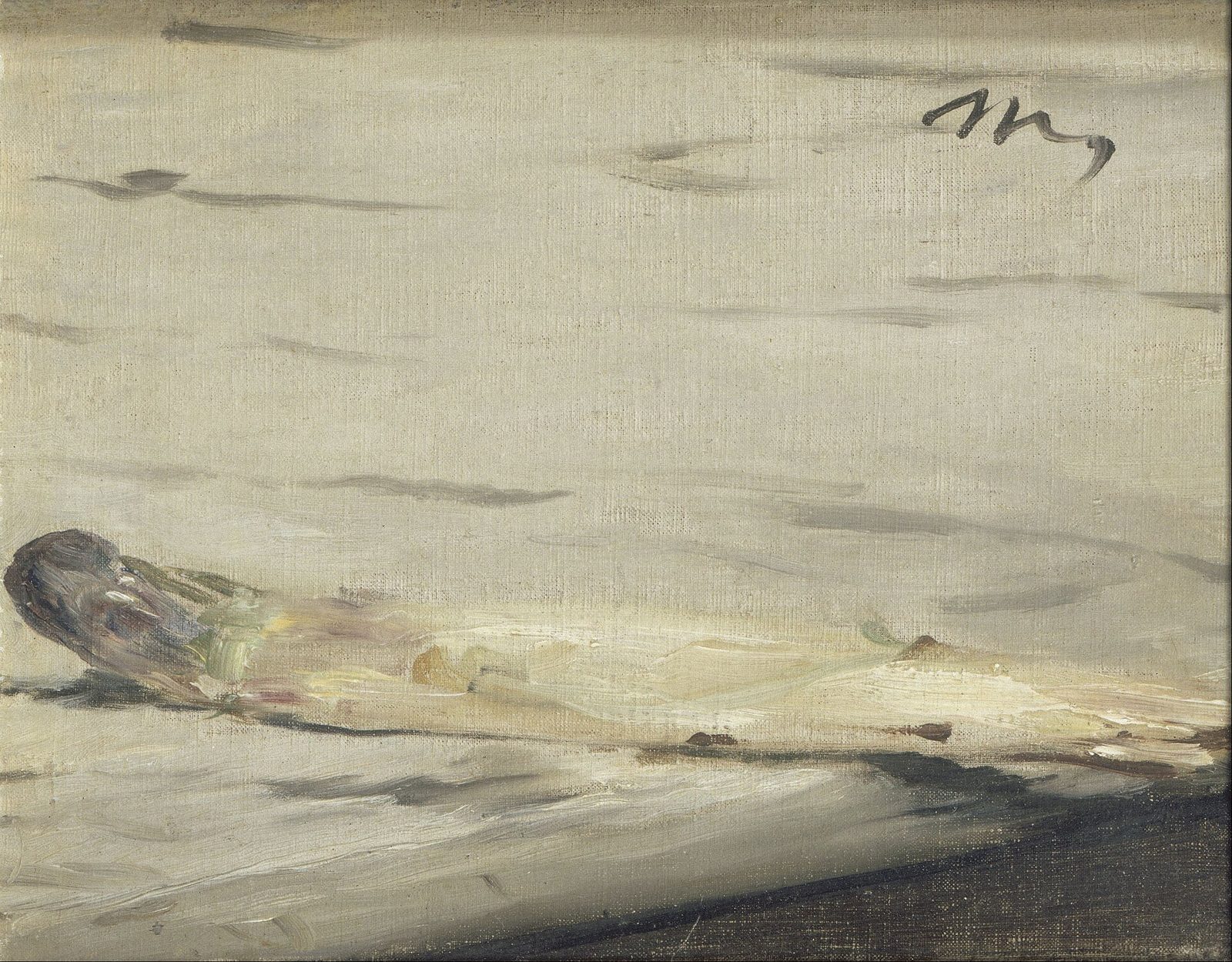
Take a moment to really look at this painting, "L'Asperge" by Édouard Manet. Notice how the single sprig of asparagus rests casually on that light marble surface, its violet tip almost reaching out to you. The way the light dances across the surface, highlighting the subtle greens and purples, draws you in, doesn’t it?
This isn’t just a simple still life; it’s a playful commentary on value and perception. Manet painted this in response to an overpayment from his patron, Charles Ephrussi, and humorously noted that one sprig was missing from the original order. By creating this smaller piece, he transformed a mundane transaction into a witty artistic gesture, showcasing his ability to blend humor with sophistication.
Manet, a key figure in the transition from realism to impressionism, often challenged traditional norms in art. This painting, created in 1880, reflects his late style, where he focused on the essence of objects rather than their mere representation. It’s a reminder that even the simplest subjects can carry deep meaning and provoke thought.
As you stand here, consider this: what does it mean to you when a single asparagus stalk can evoke such a rich narrative? How does this blend of humor and artistry resonate with your own experiences?
Édouard Manet, born on January 23, 1832, in Paris, emerged as a pivotal figure in 19th-century art, bridging Realism and Impressionism. From an affluent family, he initially faced pressure to pursue a naval career but instead dedicated himself to painting, influenced by his uncle and the Old Masters. His early works, including "The Luncheon on the Grass" and "Olympia," sparked controversy and challenged traditional artistic norms, marking him as a revolutionary force.
Manet's style, characterized by loose brushwork and a focus on contemporary life, diverged from the meticulous techniques of his predecessors. He often depicted modern Parisian scenes, capturing the essence of leisure and social dynamics. Despite initial rejection from the art establishment, he gained recognition among progressive artists and became a mentor to the Impressionists.
Throughout his life, Manet formed connections with influential figures like Baudelaire and Zola, who defended him against critics. His later works, such as "A Bar at the Folies-Bergère," showcased his evolving style and mastery of color. Manet's contributions to art history are profound; he is celebrated not only for his innovative techniques but also for elevating still life and modern subjects to the forefront of artistic expression. He passed away on April 30, 1883, leaving behind a legacy that continues to inspire artists today.
In 1880, Édouard Manet was commissioned by Charles Ephrussi, a prominent art collector, to create a still life titled A Bundle of Asparagus for 800 francs. However, Ephrussi mistakenly sent 1,000 francs, prompting Manet to respond with a smaller, playful piece: A Sprig of Asparagus. He humorously noted in a letter to Ephrussi that one sprig was missing from the original order. This act transformed a simple commercial transaction into a witty artistic gesture, showcasing Manet's unique blend of humor and sophistication. The painting was later exhibited in notable locations, including the Musée d'Orsay, and has been part of various exhibitions, such as the 1983 Manet retrospective at the Grand Palais in Paris. The work has been well-received, with art historians recognizing its clever commentary on value and perception in art.
The painting features a single asparagus stalk resting on a light marble surface, with the tip angled toward the viewer. This composition creates a striking focal point, drawing your eye directly to the subtle interplay of colors—muted greens and purples—that highlight the asparagus's delicate features. The brushwork is precise yet fluid, allowing the textures of both the asparagus and the marble to come alive. Armstrong noted that the painting 'declares its own paintedness,' emphasizing the relationship between the object and its representation. Manet's choice of a neutral background enhances the asparagus's vibrant colors, while the overall composition balances restraint with a lively essence, challenging traditional still-life conventions and inviting viewers to reconsider the value of both the object and the artwork itself.
A Sprig of Asparagus has left a lasting impact on the art world, often cited as a pivotal example of Manet's ability to blend humor with artistic expression. This painting not only showcases his innovative approach to still life but also challenges conventional notions of value and representation in art. Its playful commentary on the commodification of art has influenced countless artists and writers, including contemporary figures like Sheila Heti, who references it in her novels. Manet's work continues to resonate, reminding us that even the simplest subjects can carry profound meaning and provoke thoughtful reflection.
One intriguing aspect of A Sprig of Asparagus is that it serves as a companion piece to Manet's earlier work, A Bundle of Asparagus. While the latter features multiple stalks against a dark background, this smaller painting adopts a lighter palette and a more intimate composition, highlighting Manet's evolving approach to still life.
A Sprig of Asparagus serves as a companion piece to A Bundle of Asparagus, showcasing Manet's evolving style by shifting from a dramatic, multi-stalk composition to a more intimate and singular focus on one asparagus stalk.
The contemporary author Sheila Heti has referenced A Sprig of Asparagus in her novels, particularly highlighting it as a significant and moving piece of art that resonates with her own experiences.