Bazille's Studio
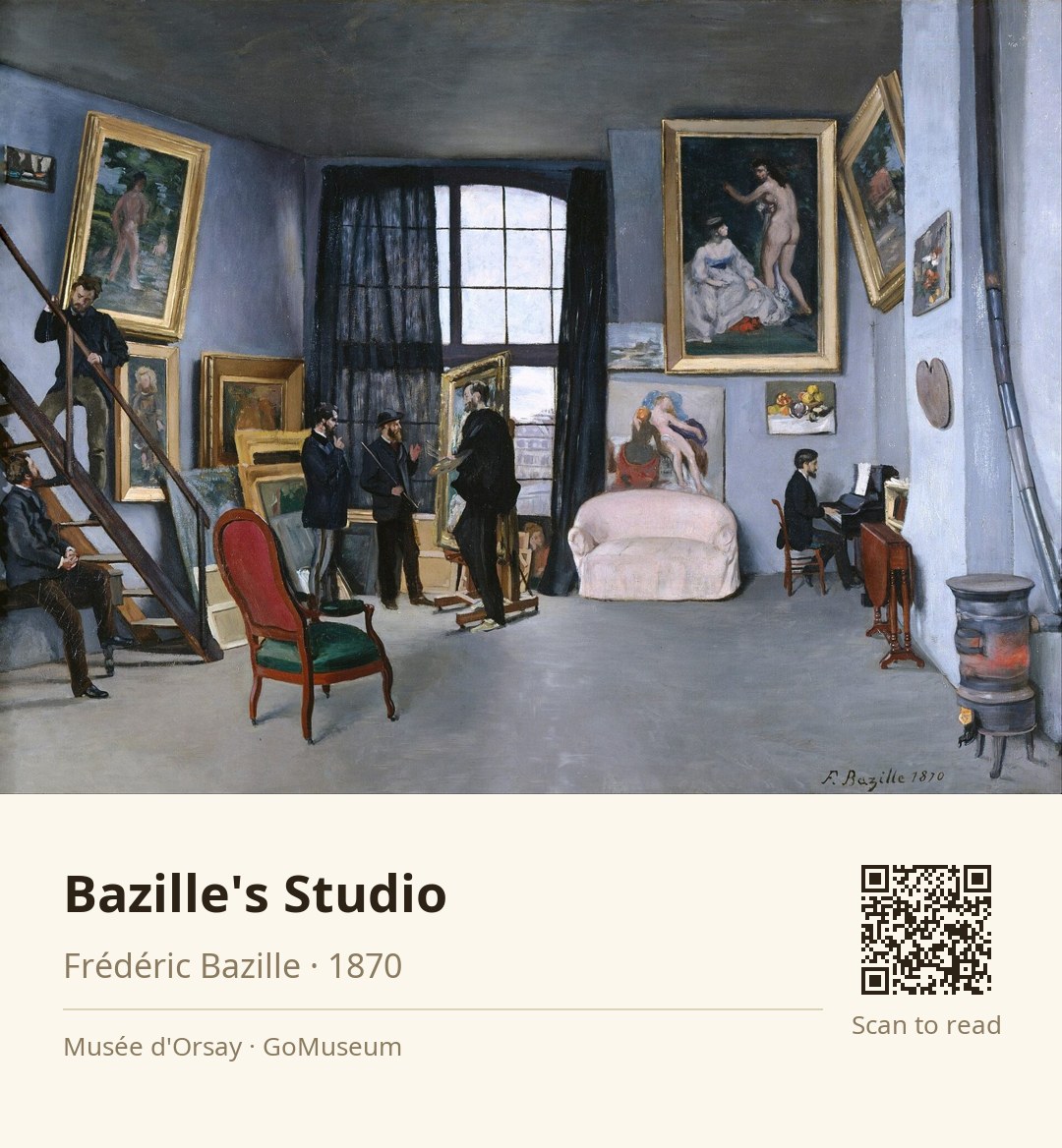
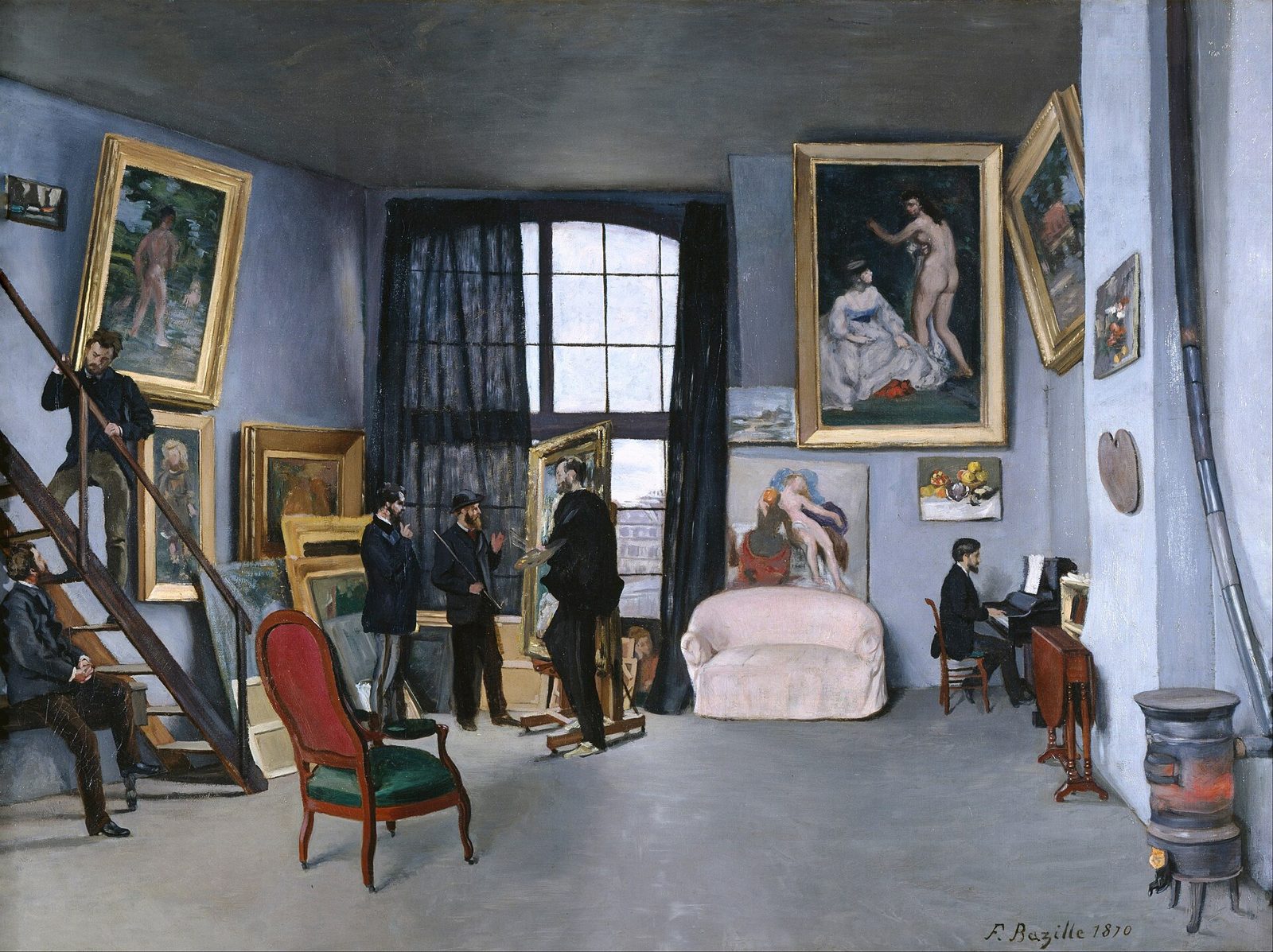
🎧 This work has audio narration — listen in the appTake a moment to really soak in the scene before you in Bazille's Studio. Look closely at the figure at the center—it's Bazille himself, palette in hand, surrounded by friends and fellow artists in a lively Parisian studio. Notice the way he’s positioned next to a framed painting on the easel, which is his own work, "View of the Village." This isn’t just a snapshot of a moment; it’s a vibrant declaration of artistic camaraderie and ambition.
These details matter because they reveal the heart of the Impressionist movement, still in its infancy in 1870. Bazille’s choice to showcase his unfinished works alongside those of his friends—like Manet and Renoir—speaks to a collective struggle against the rigid conventions of the art world. Each brushstroke and unfinished canvas is a testament to their shared journey, a rebellion against the Salon’s strict standards.
Frédéric Bazille, born into privilege, chose to pursue art over medicine, and this studio was a hub for innovation and creativity. Tragically, he would die young, just months after completing this painting, in the Franco-Prussian War. His legacy, however, is immortalized here, capturing a moment of hope and collaboration.
As you stand here, think about the friendships that shaped Bazille’s life and work. What stories do you imagine these artists shared in this very space?
Jean Frédéric Bazille was a French Impressionist painter born on December 6, 1841, in Montpellier. Coming from a wealthy Protestant family, he initially pursued medicine to satisfy his parents but soon shifted his focus to art after being inspired by Eugène Delacroix. Moving to Paris in 1862, he became part of the burgeoning Impressionist movement, befriending artists like Claude Monet and Pierre-Auguste Renoir. Bazille's works, characterized by their vibrant figures set against natural landscapes, include notable pieces such as "Family Reunion" and "The Pink Dress."
Despite his promising career, Bazille's life was tragically cut short when he died at the age of 28 during the Franco-Prussian War. His commitment to his friends and the arts was evident as he generously supported fellow artists. Although his work was largely forgotten after his death, a revival began in the 20th century, recognizing his contributions to Impressionism. Today, Bazille is celebrated for his unique perspective and remains an important figure in art history, embodying the spirit of youthful creativity and camaraderie among the Impressionists.
Frédéric Bazille painted 'Bazille's Studio' in early 1870, capturing a moment in time that would soon be lost. The studio was shared with fellow artists like Pierre-Auguste Renoir, and it became a gathering place for the likes of Édouard Manet and Émile Zola. After Bazille's untimely death in November 1870, the painting remained in the possession of his brother, Marc, until it was bequeathed to the French state in 1924. It has since been exhibited in various locations, finding a permanent home at the Musée d'Orsay in 1986. The reception of this work has evolved over time; initially, Bazille was overshadowed by his more famous contemporaries, but exhibitions in the late 20th century began to recognize his contributions to Impressionism.
As you gaze at 'Bazille's Studio,' take note of the dynamic brushwork that creates a sense of movement and life within the studio. Bazille employs a loose, expressive style, allowing the colors to blend and dance across the canvas. The light streams in through the window, illuminating the figures and the unfinished works, which adds a layer of intimacy and immediacy to the scene. The composition is carefully structured, with Bazille at the center, drawing your eye to him and then outward to his friends and their artworks. The scale of the painting, nearly a meter tall and over a meter wide, invites you to step into this lively space, making you feel like part of the gathering. The unfinished canvases hanging on the walls are not just background; they symbolize the artists' ongoing struggles and aspirations, making the entire piece a manifesto of creativity.
While Bazille was initially seen as a secondary figure compared to Monet and Renoir, his contributions have gained recognition over the years. His approach to depicting artists in their environment influenced later generations, emphasizing the importance of the artist's studio as a space of creation and community. This painting stands as a testament to the friendships and shared experiences that fueled the Impressionist revolution, marking a shift in how art was perceived and created.
One intriguing detail about 'Bazille's Studio' is that beneath its surface lies a hidden composition similar to Pierre-Auguste Renoir's 'Diana the Huntress.' This revelation came from X-radiographs, suggesting that Bazille may have used Renoir's work as a model for practice. This connection between the two artists adds another layer to the collaborative spirit of the studio, highlighting how they influenced one another's artistic journeys.
X-radiographs revealed that beneath Bazille's Studio is a hidden composition similar to Pierre-Auguste Renoir's Diana the Huntress, suggesting that Bazille may have practiced using Renoir's work as a model.
Bazille's close relationships with fellow artists like Renoir and Manet not only shaped his artistic style but also led him to support their works by displaying their rejected paintings in his studio, fostering a spirit of collaboration.
Bazille's studio was located in the Batignolles neighborhood of Paris, a vibrant area that became a hub for many Impressionist artists, reflecting the dynamic cultural environment that influenced their revolutionary approach to art.