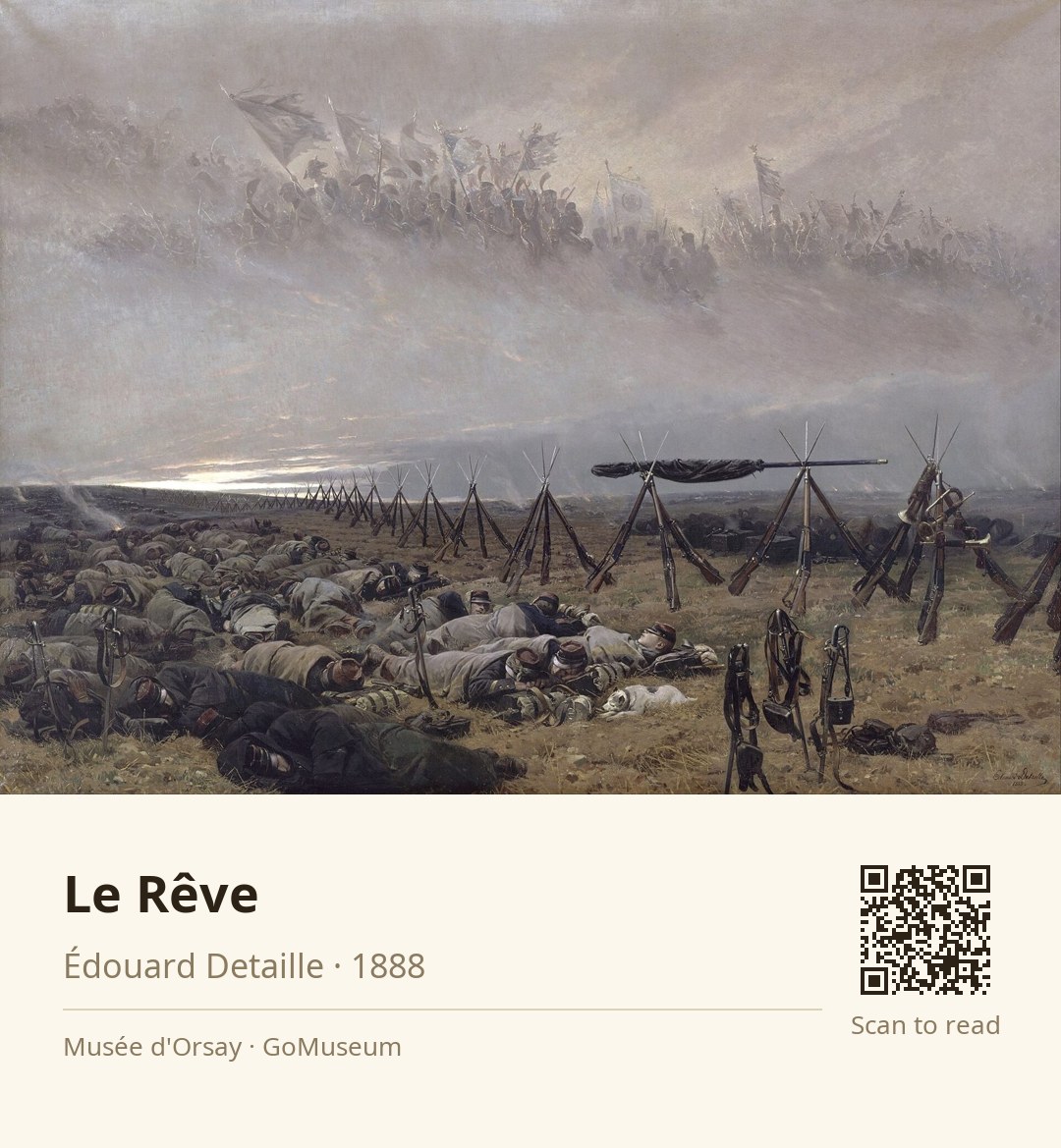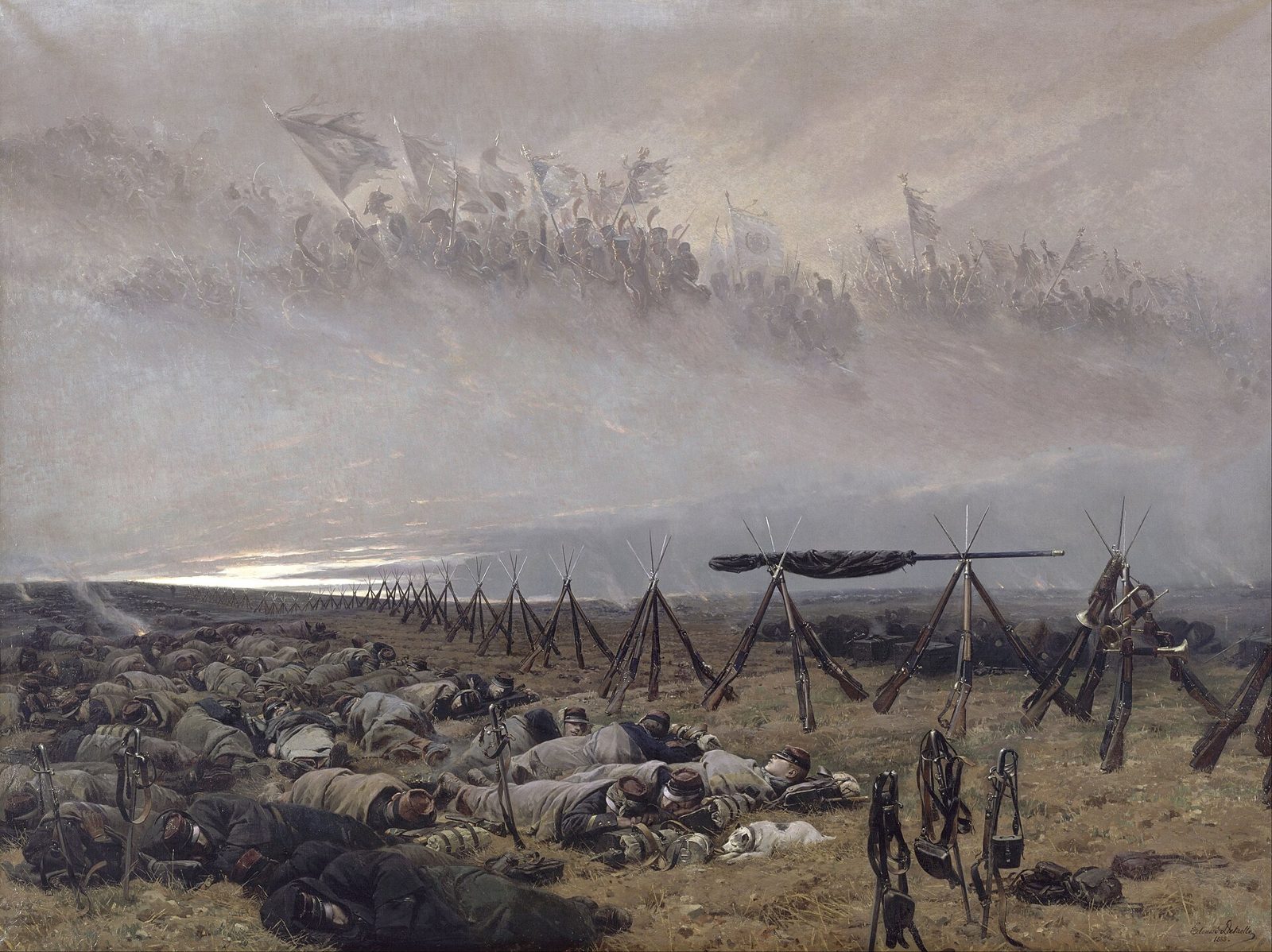
As you stand before Édouard Detaille's "Le Rêve," take a moment to let your eyes wander over the scene of slumbering soldiers. Notice how the young conscripts are nestled in their camp, their faces relaxed, lost in dreams of glory. Look closely at the ethereal figures of past heroes that float above them, their forms intentionally blurred, almost ghostly.
These details matter because they encapsulate a poignant longing—these soldiers are dreaming not just of personal valor but of a collective national pride, a yearning for the triumphs of their forebears after the humiliating defeat in the Franco-Prussian War. Detaille painted this in 1888, at a time when France was grappling with its identity and seeking to rekindle a sense of unity and strength.
Detaille, known for his meticulous attention to military life, was deeply influenced by his own experiences in the army. This painting isn't just a depiction; it's a political statement, a rallying cry for nationalistic fervor during a turbulent period in French history.
As you take in this powerful imagery, consider: what dreams do you think these soldiers are having? What does glory mean to them, and how does it resonate with our own aspirations today?
Jean-Baptiste Édouard Detaille was a prominent French academic painter and military artist, born on October 5, 1848, in Paris. Coming from a military family, he was encouraged by his father, an amateur artist, to pursue his artistic talents. Detaille studied under Jean-Louis-Ernest Meissonier, who instilled in him a passion for precision and realism. His early works, including his debut at the Salon in 1867, showcased his talent for military subjects, culminating in his acclaimed painting "The Drummers Halt."
Detaille's experiences during the Franco-Prussian War profoundly influenced his art, leading him to create detailed portraits of soldiers and accurate depictions of military life. He became the official painter of the French army and published "L'Armée Française," showcasing his dedication to historical accuracy. His later designs for military uniforms, though not adopted, influenced future French military attire.
Detaille's legacy is marked by his commitment to realism and historical detail, positioning him as a key figure in military art before its decline in the early 20th century. His notable work, "Le Rêve," reflects the glories of military pasts and remains a significant piece in art history. He passed away on December 23, 1912, leaving behind a rich collection of military artifacts to the Musée de l'Armée in Paris.
Édouard Detaille's "Le Rêve" was painted in 1888 and quickly became a significant piece in the art world. Commissioned by the French state, it was first showcased at the Salon des artistes français in the same year, where it won a gold medal, a testament to its immediate acclaim. The painting was later exhibited at the 1889 Exposition Universelle in Paris and the 1915 Panama-Pacific International Exposition in San Francisco, further solidifying its reputation. After its debut, it was acquired by the French government, reflecting the national pride and sentiments of the time. Over the years, it transitioned through various collections, including the Musée du Luxembourg and the Musée de l'Armée, before finding its home at the Musée d'Orsay, where it remains today. This journey through prominent exhibitions and collections highlights the painting's enduring significance in French art history, resonating with the collective memory of a nation recovering from defeat.
As you gaze at "Le Rêve," notice the way Detaille's brushwork creates a sense of tranquility amidst the chaos of military life. The soft, almost ethereal quality of the soldiers' forms contrasts sharply with the sharpness of the background, drawing your eye to the dream-like state of the sleeping figures. The use of light is particularly striking; it bathes the scene in a warm glow, suggesting a serene moment in the midst of a soldier's arduous life. Detaille's meticulous attention to detail is evident in the textures of the soldiers' uniforms and the subtle variations in color that bring depth to their faces. The composition is carefully structured, leading your gaze from the foreground of slumbering soldiers to the ghostly figures of past heroes hovering above, blurring the lines between reality and dreams. This layering of elements not only enhances the emotional impact but also invites you to ponder the soldiers' aspirations and the weight of history they carry with them.
Did you know that Édouard Detaille's painting 'Le Rêve' was not just a work of art but a political statement? When he created this piece in 1888, France was still reeling from the aftermath of the Franco-Prussian War. Detaille was a supporter of the nationalist general Georges Boulanger, and this painting served as a rallying cry for those yearning for a return to France's military glory. The soldiers depicted are not just sleeping; they are dreaming of revenge and honor, a reflection of a nation grappling with its identity and pride.
Coming from a prosperous military family, with a grandfather who supplied arms for Napoleon, Detaille was immersed in military culture from a young age, which significantly shaped his focus on military subjects in his artwork.