Portrait of Stéphane Mallarmé
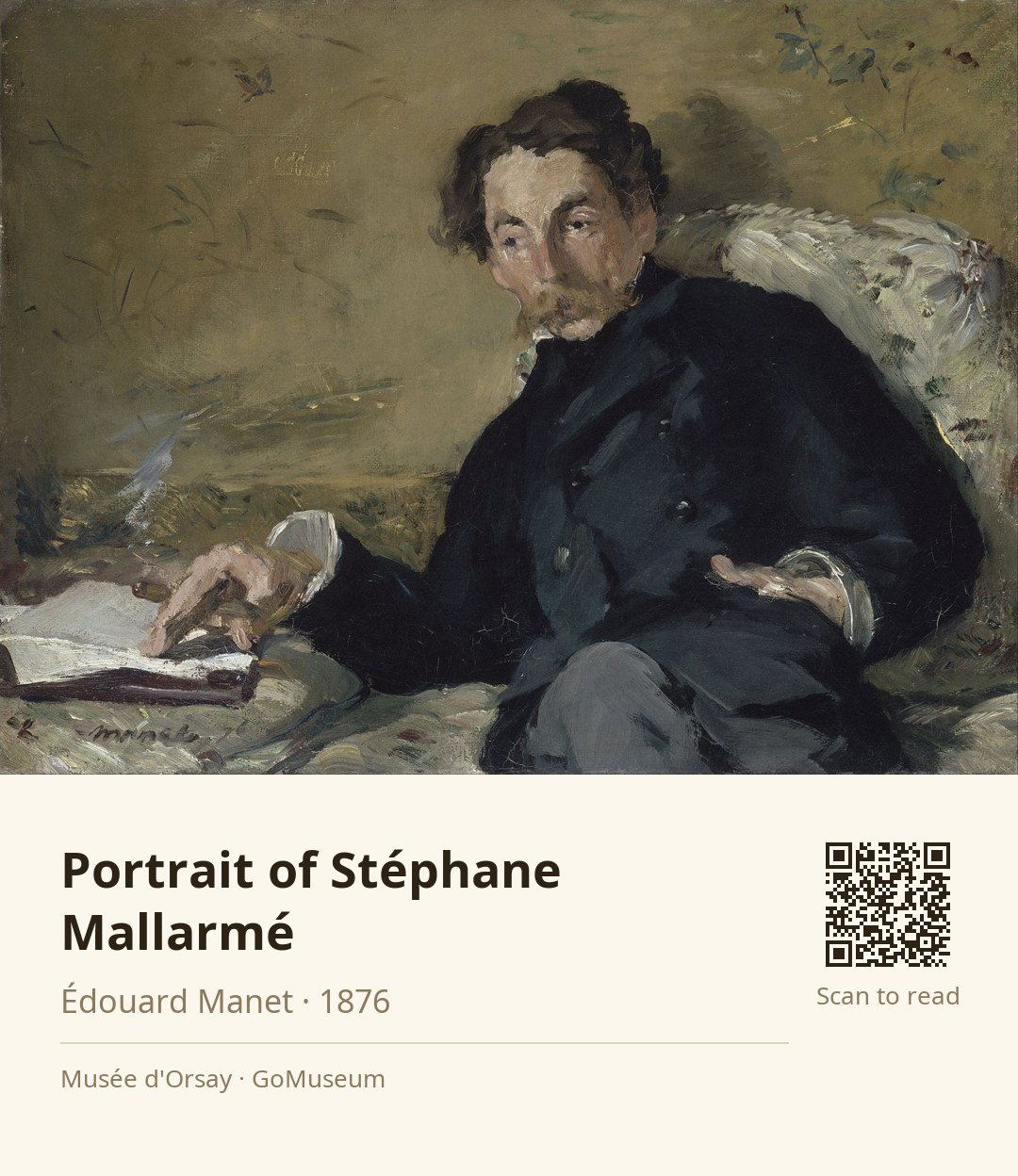
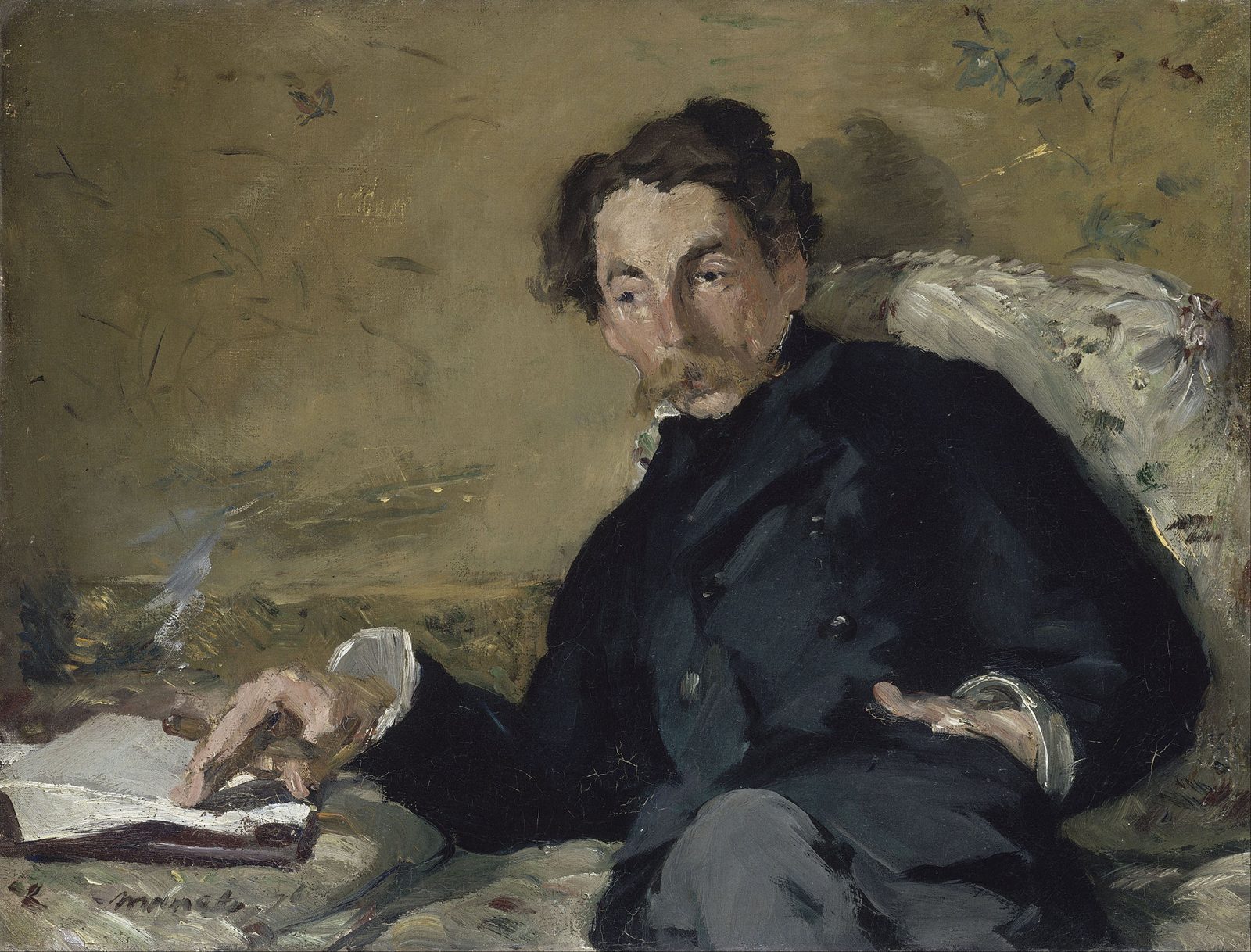
🎧 This work has audio narration — listen in the appTake a moment to really look at this portrait of Stéphane Mallarmé by Édouard Manet. Notice how Mallarmé is lounging on that plush couch, a cigar in hand, seemingly lost in thought. The way he leans back against the soft white cushions gives him an air of relaxed contemplation, doesn’t it?
Now, focus on the details of the wallpaper behind him. Those delicate floral patterns, possibly inspired by Japanese art, contrast beautifully with the boldness of his pose and the smoke curling from his cigar. This juxtaposition creates a rich atmosphere, blending sensuality with a sense of introspection. It’s as if Manet captured not just Mallarmé’s likeness, but the very essence of their friendship—two creative minds deeply engaged in the world of art and poetry.
Created in 1876, this painting is more than just a portrait; it symbolizes the bond between the artist and the poet, who collaborated closely during their time together in Paris. Mallarmé even defended Manet’s work in the press, helping to secure his legacy as a pioneer of modern art.
As you stand here, think about the conversations they must have shared, the ideas that flowed between them. What do you think they discussed while Manet painted this intimate moment?
Édouard Manet, born on January 23, 1832, in Paris, emerged as a pivotal figure in 19th-century art, bridging Realism and Impressionism. From an affluent family, he initially faced pressure to pursue a naval career but instead dedicated himself to painting, influenced by his uncle and the Old Masters. His early works, including "The Luncheon on the Grass" and "Olympia," sparked controversy and challenged traditional artistic norms, marking him as a revolutionary force.
Manet's style, characterized by loose brushwork and a focus on contemporary life, diverged from the meticulous techniques of his predecessors. He often depicted modern Parisian scenes, capturing the essence of leisure and social dynamics. Despite initial rejection from the art establishment, he gained recognition among progressive artists and became a mentor to the Impressionists.
Throughout his life, Manet formed connections with influential figures like Baudelaire and Zola, who defended him against critics. His later works, such as "A Bar at the Folies-Bergère," showcased his evolving style and mastery of color. Manet's contributions to art history are profound; he is celebrated not only for his innovative techniques but also for elevating still life and modern subjects to the forefront of artistic expression. He passed away on April 30, 1883, leaving behind a legacy that continues to inspire artists today.
Édouard Manet's 'Portrait of Stéphane Mallarmé' was painted in 1876, during a vibrant period in Paris where the worlds of art and literature intertwined. This portrait was not just a personal endeavor; it was a testament to the friendship between Manet and Mallarmé, who met in 1873 and quickly became inseparable. Mallarmé, a rising star in the literary scene, often defended Manet's work in public forums, helping to elevate the artist's reputation. The painting was first exhibited in 1884 at a show dedicated to Manet in Paris, and later at various galleries, including the prestigious Galerie Bernheim-Jeune in 1928. By then, it had already been acquired by the Louvre from Mallarmé's family, later finding its home in the Musée d'Orsay. The painting's journey reflects not just its artistic merit but also the deep bond shared between the two men, a friendship that resonated through their collaborative works, including illustrations for Mallarmé's translation of Edgar Allan Poe’s 'The Raven.'
As you gaze at this portrait, notice how Manet's brushwork creates a sense of intimacy and spontaneity. The way he applies paint with 'virtuoso freeness' gives Mallarmé a relaxed, almost casual presence, contrasting sharply with the more rigid poses typical of portraiture at the time. The soft white cushions enveloping Mallarmé invite you into his world, while the delicate floral wallpaper—possibly inspired by Japanese art—adds a layer of complexity. This juxtaposition of boldness and delicacy is key; the smoke from Mallarmé's cigar curls upward, creating a dynamic interplay with the serene background. The composition, with Mallarmé leaning back, suggests a moment of deep thought, perhaps reflecting on the very poetry he was known for. The stack of papers by his side hints at his literary endeavors, making this not just a portrait but a narrative of friendship and creativity.
Interestingly, Manet and Mallarmé's collaboration extended beyond this portrait. They worked closely on illustrations for Mallarmé's translation of Edgar Allan Poe’s 'The Raven,' where Manet created four lithographic plates that visually interpreted the poem's haunting themes. This partnership highlights how their artistic dialogues influenced not only their individual works but also the broader cultural landscape of their time.
Some art historians speculate that the couch depicted in the portrait may be the same one from Manet's studio on rue de Saint-Pétersbourg, adding a personal touch to the setting and suggesting a shared space of creativity between the artist and Mallarmé.
Mallarmé actively defended Manet's work in the press, writing essays that helped secure Manet's reputation as a pioneer of modern art, illustrating the profound impact their friendship had on the perception of Manet's contributions to art.