1814, La Campagne de France
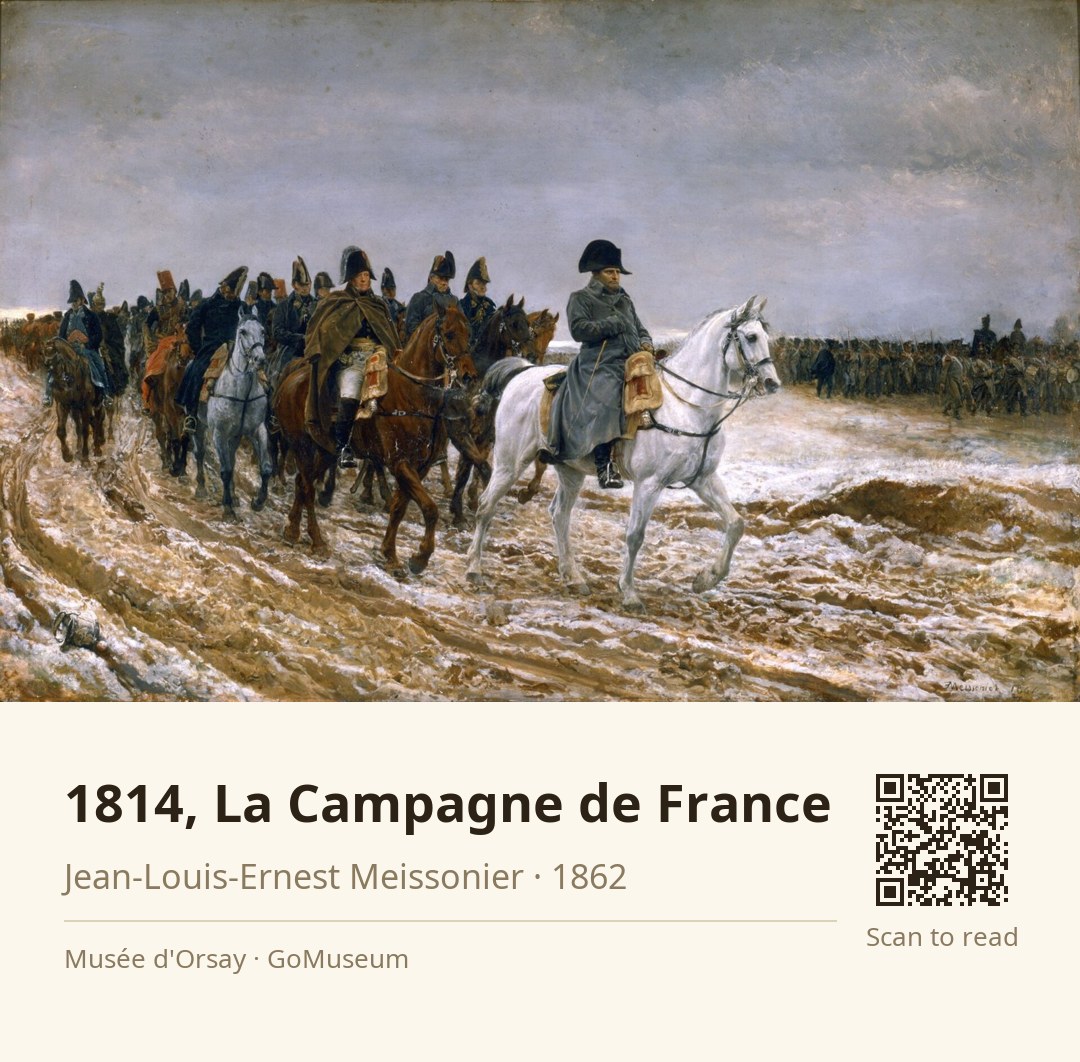
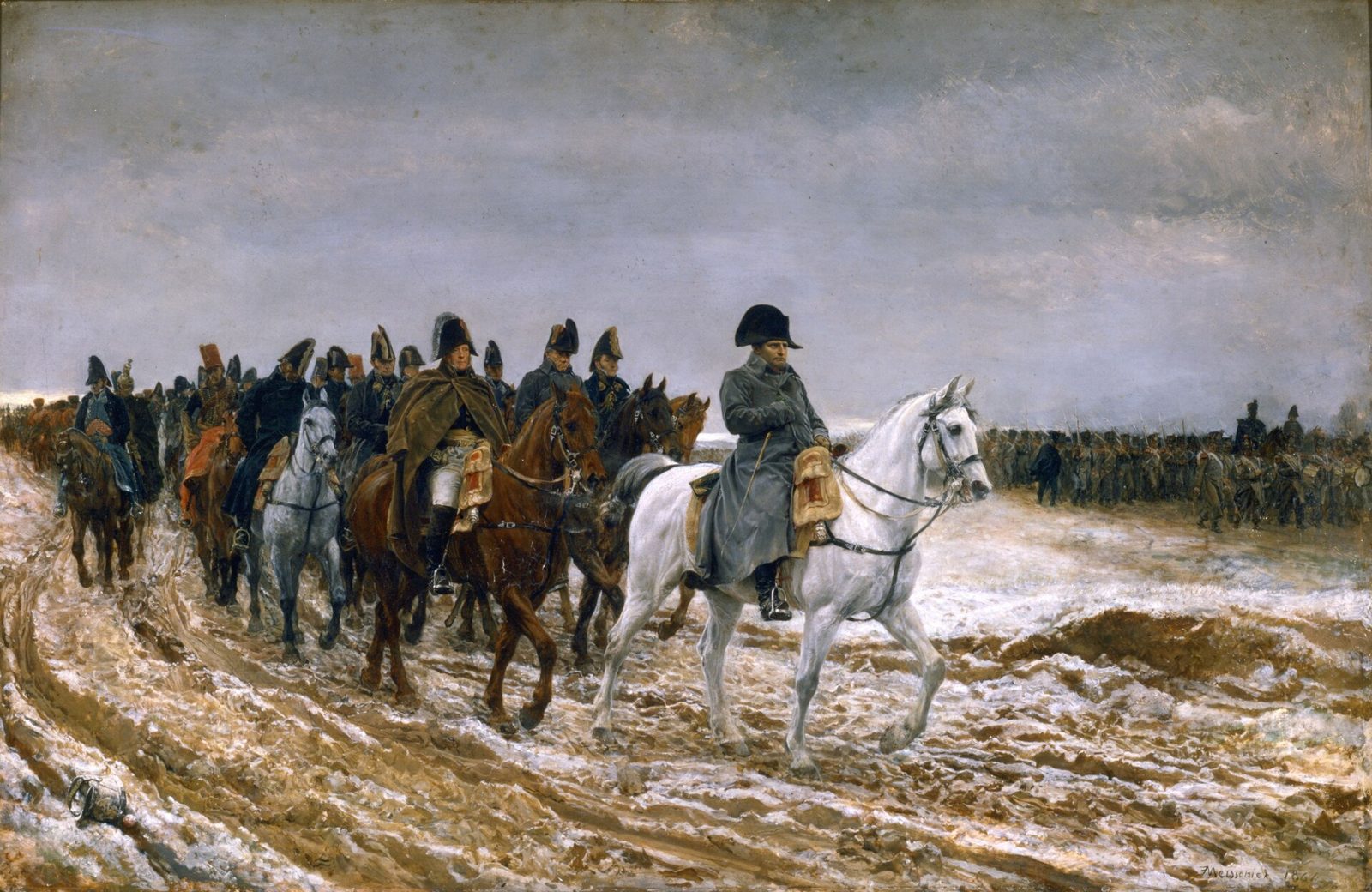
🎧 This work has audio narration — listen in the appTake a moment to really look at "1814, La Campagne de France" by Jean-Louis-Ernest Meissonier. Notice how Napoleon sits atop his white horse, his posture slightly slouched, and his expression deeply contemplative. The dark, cloudy sky looms overhead, and the barren landscape stretches out, capturing the harshness of the retreat during one of Napoleon's most challenging campaigns.
These details matter because they reveal not just the physical struggle of the moment but also the emotional weight on Napoleon's shoulders. His rumpled clothing and weary demeanor reflect the toll of leadership in times of despair. The calmness of his horse contrasts sharply with his own fatigue, emphasizing his vulnerability as a leader. This painting isn’t just about a military campaign; it’s a poignant exploration of loss, resilience, and the human experience in the face of adversity.
Meissonier, known for his meticulous attention to detail, created this piece between 1860 and 1864, capturing a pivotal moment in history that marked the decline of Napoleon’s empire. The painting was so impactful that it fetched a record price when sold in 1890, a testament to its significance.
As you stand here, consider what this moment in history means to you. How does the struggle of a leader resonate in today’s world?
Jean-Louis-Ernest Meissonier was a prominent French academic painter and sculptor born on February 21, 1815, in Lyon. He developed a passion for painting early in life, eventually abandoning a career in his father's dye business to pursue art. Meissonier became renowned for his meticulous depictions of Napoleon and military scenes, characterized by extraordinary detail and craftsmanship. His works garnered immense acclaim, earning him a place among the most successful artists of the Second Empire alongside Gérôme and Cabanel.
Throughout his career, Meissonier focused on genre scenes from the seventeenth and eighteenth centuries, portraying everyday life with an emphasis on authenticity. His paintings, often featuring men engaged in leisurely activities, showcased his ability to capture intricate details, earning him comparisons to the Dutch master Gabriel Metsu. Despite his success, some critics later deemed his work lacking in spontaneity and life, with notable figures like Édouard Manet and Edgar Degas offering harsh assessments.
Meissonier's legacy is marked by his dedication to historical accuracy and the meticulous preparation of his works. He was honored with numerous accolades, including membership in the Académie des beaux-arts. His influence persisted beyond his death on January 31, 1891, as he played a crucial role in the art community, helping to establish the Société nationale des beaux-arts. Today, he is remembered as a significant figure in the academic tradition of French painting, particularly for his contributions to military art and genre scenes.
Jean-Louis-Ernest Meissonier created '1814, La Campagne de France' between 1860 and 1864, capturing a pivotal moment in Napoleon's military career during the grim retreat of the French Campaign of 1814. This painting was exhibited at the Salon des Artistes français in Paris in 1864, where it received significant acclaim. It was later shown at the Exposition Universelle in 1867, further solidifying its reputation. The painting was purchased in 1866 by banker Gustave Delahante for a staggering 85,000 francs. In a remarkable turn of events, it was sold in 1890 for 500,000 francs, a record price for a contemporary artwork at the time, before being acquired by Alfred Chauchard for 850,000 francs. Today, it resides in the Musée d'Orsay, where it continues to draw attention for its emotional depth and historical significance.
Meissonier's meticulous craftsmanship shines through in '1814, La Campagne de France.' The painting is executed in oil on wood, allowing for a rich texture and depth that enhances the emotional weight of the scene. Notice how the brushwork feels almost restless, capturing the tension of the moment. The composition is carefully structured, with Napoleon at the center, his slouched posture contrasting with the calmness of his horse. The dark, brooding sky looms overhead, while the barren landscape stretches out, amplifying the sense of despair. Meissonier's attention to detail is extraordinary; he even borrowed Napoleon's saddle for accuracy. This dedication extends to the horse's portrayal, where he employed groundbreaking techniques to illustrate its gait, creating a lifelike representation that adds to the painting's realism. The scale is surprisingly intimate for such a grand subject, inviting viewers to connect personally with the historical narrative.
By focusing on the somber realities of Napoleon's retreat, Meissonier introduced a new emotional depth to military art, emphasizing themes of loss and resilience. This painting not only captured the attention of contemporaries but also set a precedent for future artists who sought to convey the human experience behind historical events. Its meticulous detail and emotional resonance influenced a generation of painters, marking a shift towards a more nuanced portrayal of history in art. Remember, this wasn't just about military glory; it was about the very human struggles behind it all.
One surprising detail about Meissonier's process is his commitment to historical accuracy; he not only borrowed Napoleon's saddle but also had a replica of Napoleon's overcoat made, which he wore while modeling for the painting. This level of dedication to authenticity highlights his desire to create a work that was not only visually stunning but also true to the historical figure he was depicting.
Meissonier was among the first to illustrate the appui diagonale gait, where diagonal pairs of a horse's legs move in unison with minimal knee flexion, showcasing his groundbreaking approach to equine movement.
In addition to Napoleon, the painting includes recognizable figures such as Ney, Berthier, Drouot, Flahaut, and Gourgaud, all of whom were part of his military staff during the campaign.
Having served as a captain of artillery during the June Days uprising in 1848, Meissonier's exposure to the realities of war and leadership likely deepened his understanding of the emotional weight carried by leaders like Napoleon, which is reflected in the painting's somber tone.