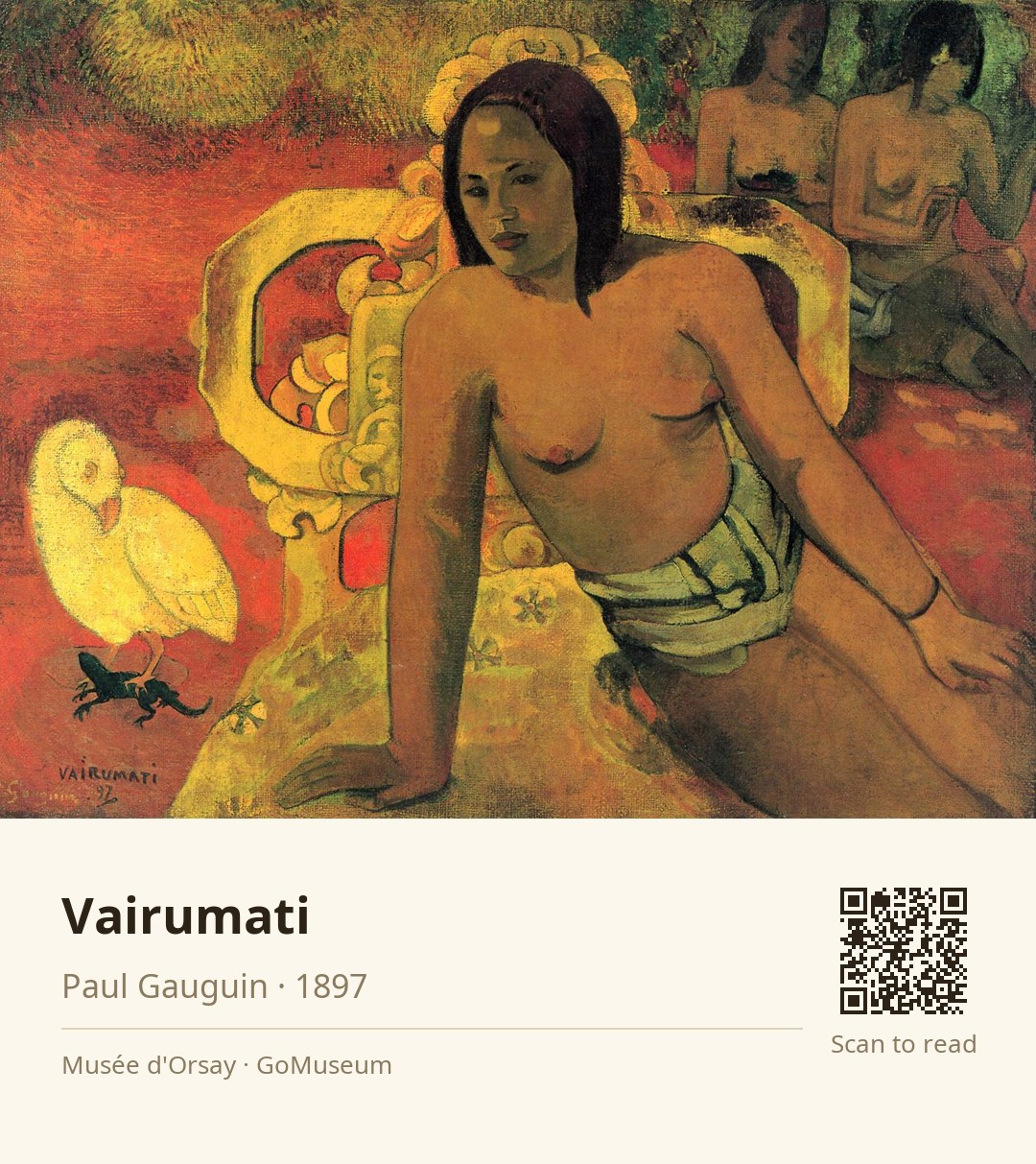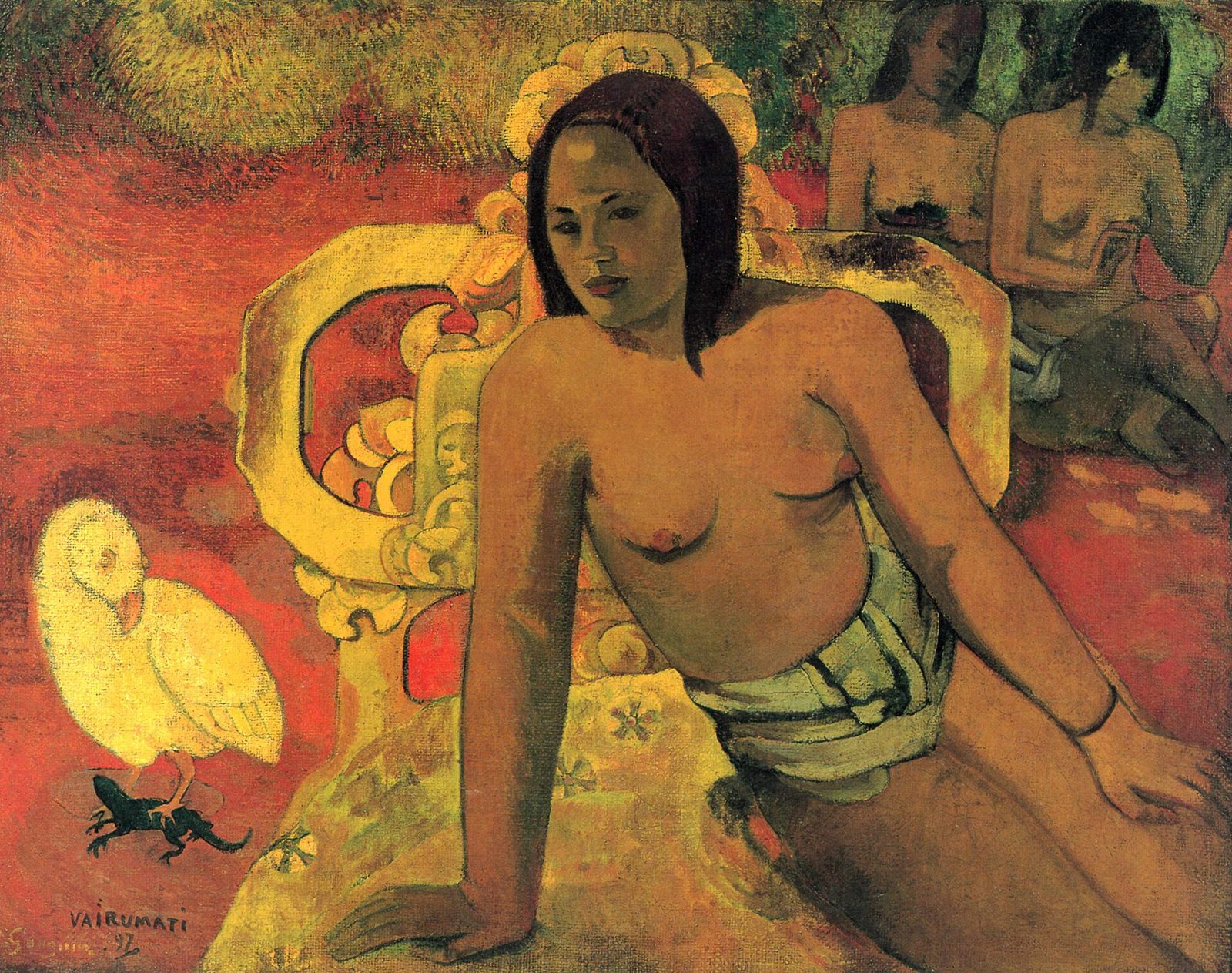
Take a moment to really look at "Vairumati" by Paul Gauguin. Notice the vibrant colors and the way they seem to pulse with life. The deep blues and greens contrast beautifully with the warm skin tones of the figure at the center. This isn’t just a painting; it’s a window into Gauguin’s fascination with Tahiti, where he sought to escape the constraints of Western civilization.
Now, focus on the figure’s expression. There’s a serene yet enigmatic quality to her gaze, inviting you to ponder her story. This detail matters because it reflects Gauguin's desire to capture not just the physical beauty of his subjects but their inner worlds, a hallmark of his Symbolist approach. He was deeply influenced by the idea of portraying the spiritual and emotional essence of his subjects, moving beyond mere representation.
Created in 1897, during his time in Tahiti, "Vairumati" represents a pivotal moment in Gauguin's career. He was searching for authenticity in a world he felt was increasingly artificial. This painting is a testament to that quest, showcasing his bold use of color and form that would later influence modern art.
As you stand here, think about what it means to seek beauty and truth in a world that often feels chaotic. What stories do you think the figure in "Vairumati" holds?
Eugène Henri Paul Gauguin was a French artist born on June 7, 1848, in Paris. His early life in Peru, where he experienced a privileged childhood, deeply influenced his artistic vision. Initially a stockbroker, Gauguin turned to painting full-time after a financial crisis in 1882. He was largely self-taught, drawing inspiration from his connections with artists like Camille Pissarro, who introduced him to Impressionism.
Gauguin's work evolved into a distinct style characterized by bold colors and symbolic themes, diverging from traditional Impressionism. His time in Brittany and later in Tahiti marked significant phases in his career, where he sought to capture the essence of native life and spirituality. Despite struggling with health and financial issues in his later years, his art gained recognition posthumously, largely due to the efforts of art dealer Ambroise Vollard.
Today, Gauguin is celebrated as a key figure in Post-Impressionism and a precursor to modern art, influencing artists like Picasso and Matisse. His exploration of color and form continues to resonate, securing his place in art history as a visionary who sought to transcend the confines of Western civilization.
In 1897, Paul Gauguin created 'Vairumati', a striking oil on canvas that captures a moment in the artist's life during his time in Tahiti. This painting was part of a transformative period for Gauguin, who sought to escape the constraints of Western civilization. Initially, Gauguin exhibited his work with the Impressionists, but by the late 1890s, he was carving out his unique style, one that resonated deeply with the vibrant culture and landscapes of Tahiti. After its completion, 'Vairumati' was first owned by Gauguin himself before passing through the hands of notable art dealer Ambroise Vollard, who played a crucial role in promoting Gauguin's work. The painting later found a home in the collection of Prince Matsukata Kojiro. It has since been showcased in significant exhibitions, including 'Les Origines de l'art contemporain' in 1947 and a dedicated Gauguin exhibition at the Orangerie des Tuileries in 1949. Today, it resides in the Musée d'Orsay in Paris, a testament to Gauguin's lasting impact on the art world.
As you gaze at 'Vairumati', pay attention to Gauguin's bold brushwork and the way he layers color to create depth and emotion. The vibrant hues are not just for show; they evoke the lushness of Tahiti and the warmth of its people. Notice how the light interacts with the figure, casting gentle shadows that enhance her serene expression. Gauguin's composition is strikingly deliberate; the central figure draws your eye, while the surrounding colors swirl and pulse, almost as if the painting itself is alive. This technique, a hallmark of his Synthetist style, allows the viewer to feel the spiritual connection he sought to portray, transforming the canvas into a vivid dialogue between the subject and the viewer.
One curious aspect of 'Vairumati' is that it was painted during a time when Gauguin was grappling with personal struggles, including financial instability and health issues. Despite these challenges, he managed to create a work that would later be celebrated for its beauty and emotional depth, showcasing his resilience as an artist.
During the time he painted 'Vairumati', Gauguin was dealing with significant personal challenges, including financial instability and health issues, which added layers of resilience and depth to his artistic expression.
Ambroise Vollard, an influential art dealer, played a crucial role in promoting Gauguin's work, including 'Vairumati', after the artist's death, helping to establish his legacy and influence in the art world.