Ploughing in the Nivernais
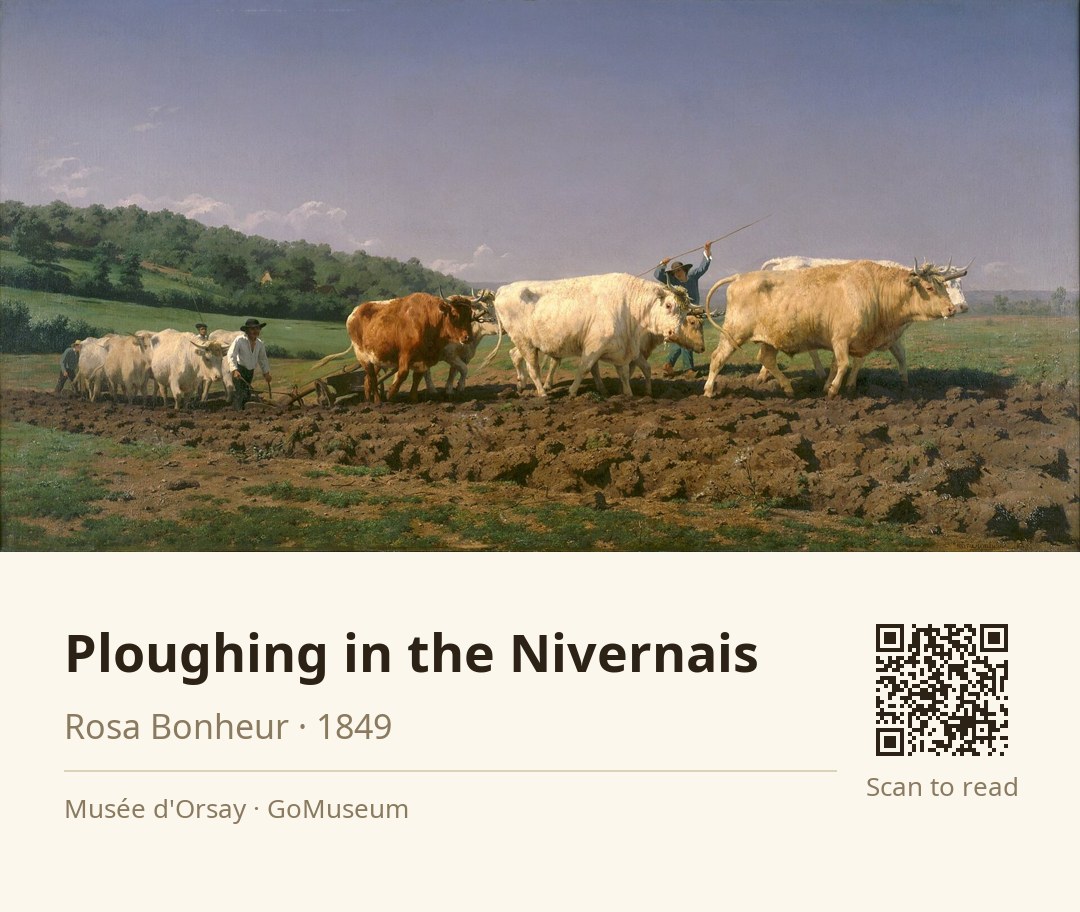
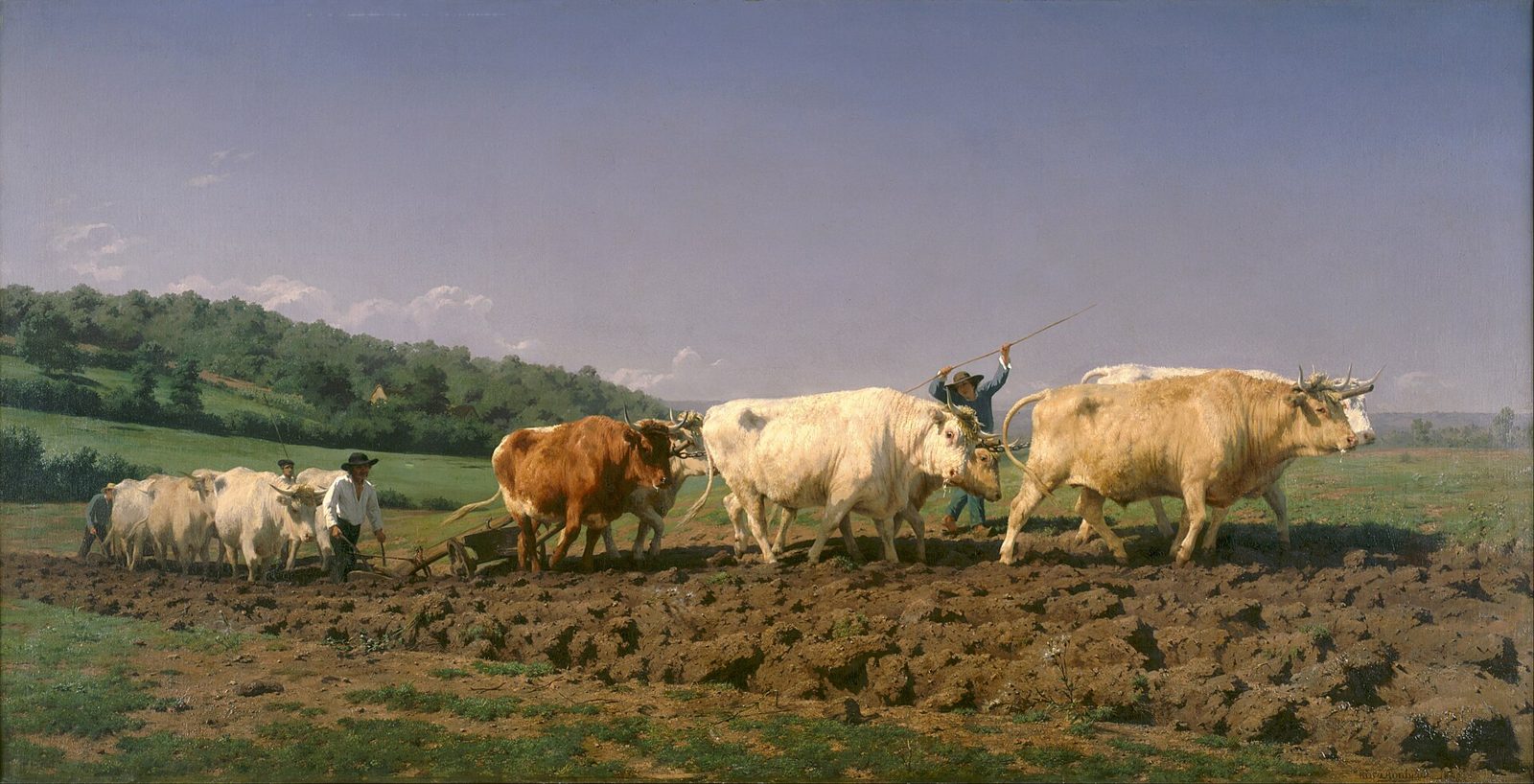
🎧 This work has audio narration — listen in the appTake a moment to really look at "Ploughing in the Nivernais." Notice the powerful oxen, their muscles taut and glistening in the sunlight, as they pull the plough through the rich, dark earth. The way the artist, Rosa Bonheur, captures the texture of the soil and the sheen of the animals is nothing short of breathtaking.
These details matter because they reflect Bonheur's deep respect for rural life and the labor that sustains it. The oxen, central to the painting, symbolize strength and the connection between humans and nature. In a world increasingly drawn to urban chaos, Bonheur's work serves as a reminder of the beauty and importance of agricultural traditions.
Created in 1849, this piece was commissioned by the French government, and it won Bonheur a First Medal at the Salon that same year. It was inspired, in part, by George Sand's novel "La Mare au Diable," which celebrates the nobility of peasant life.
As you stand here, consider what this painting says about the relationship between people and the land. How does it make you feel about the work that goes into cultivating our food and the lives of those who do it?
Rosa Bonheur, born Marie-Rosalie Bonheur on March 16, 1822, in Bordeaux, was a pioneering French painter and sculptor renowned for her realistic depictions of animals. Raised in an artistic family, she faced early challenges, including the loss of her mother at eleven. Her father, a painter, nurtured her talent, leading her to study animal anatomy in Paris and create detailed studies that would inform her celebrated works. Bonheur gained fame with her monumental painting "The Horse Fair," exhibited in 1853, which showcased her exceptional skill and unique perspective on animal life.
Living openly with her partner Nathalie Micas for over 40 years, Bonheur defied societal norms of her time. Despite facing gender biases, she became the most famous female artist of the 19th century, earning accolades and commissions, including "Ploughing in the Nivernais." Her work fell into obscurity in the 20th century but has seen a resurgence in appreciation in the 21st century. Bonheur's legacy as a trailblazer for women in art and her dedication to capturing the essence of animals solidify her place in art history. She passed away on May 25, 1899, leaving behind a rich artistic heritage.
Rosa Bonheur's 'Ploughing in the Nivernais' was commissioned by the French government in 1848 for a museum in Lyon, with a hefty price tag of 3,000 francs. Initially, it was intended to celebrate the agricultural life depicted in George Sand's novel 'La Mare au Diable.' The painting made its debut at the Salon of 1849, where it won Bonheur a prestigious First Medal, solidifying her reputation as a leading artist of her time. Though it was meant for Lyon, the government decided to keep it in Paris, displaying it at the Musée du Luxembourg until 1920. After Bonheur's death, it found a home in the Louvre before eventually moving to the Musée d'Orsay in 1986. Over the years, it has been featured in various exhibitions, including the 1889 World Fair, showcasing its enduring appeal and significance in the art world.
As you gaze at 'Ploughing in the Nivernais,' take a moment to appreciate the meticulous brushwork that brings the scene to life. Bonheur employs a vibrant palette, with the earthy tones of the soil contrasting beautifully against the bright blue sky. Notice how the light dances across the oxen's muscular forms, highlighting their strength and vitality. The composition is carefully structured, with the oxen forming a diagonal line that draws your eye across the canvas, creating a sense of movement and rhythm. The foreground is rich with detail, showcasing the freshly turned earth, while the background fades into a soft, sunlit landscape, giving depth to the scene. This balance of clarity and softness is reminiscent of Dutch masters, whom Bonheur admired and studied, allowing her to capture not just a moment in time, but the very essence of rural life.
Did you know that Rosa Bonheur's 'Ploughing in the Nivernais' was commissioned by the French government for 3,000 francs? This was no small sum in 1848! It was intended for a museum in Lyon, but after its stunning debut at the Salon of 1849, it was decided to keep it in Paris instead. Imagine the excitement of the art world at that time—Bonheur's work was not just a painting; it was a statement of rural life and a celebration of the agricultural revolution. The painting's success helped cement her reputation as one of the most prominent artists of her time, and it’s fascinating to think how a single commission could change the course of an artist's career.
Growing up in a family of artists, Bonheur was encouraged to pursue her passion for painting animals from a young age, which was further nurtured by her father's decision to bring live animals into their studio for her to study.
Upon its exhibition at the Salon of 1849, the painting was met with acclaim, winning Bonheur a First Medal and significantly boosting her reputation, establishing her as a leading artist of her time.