 Image: Phyrexian · Internet Archive Book Images · Shadowgate from Novara, ITALY · Arnaud 25
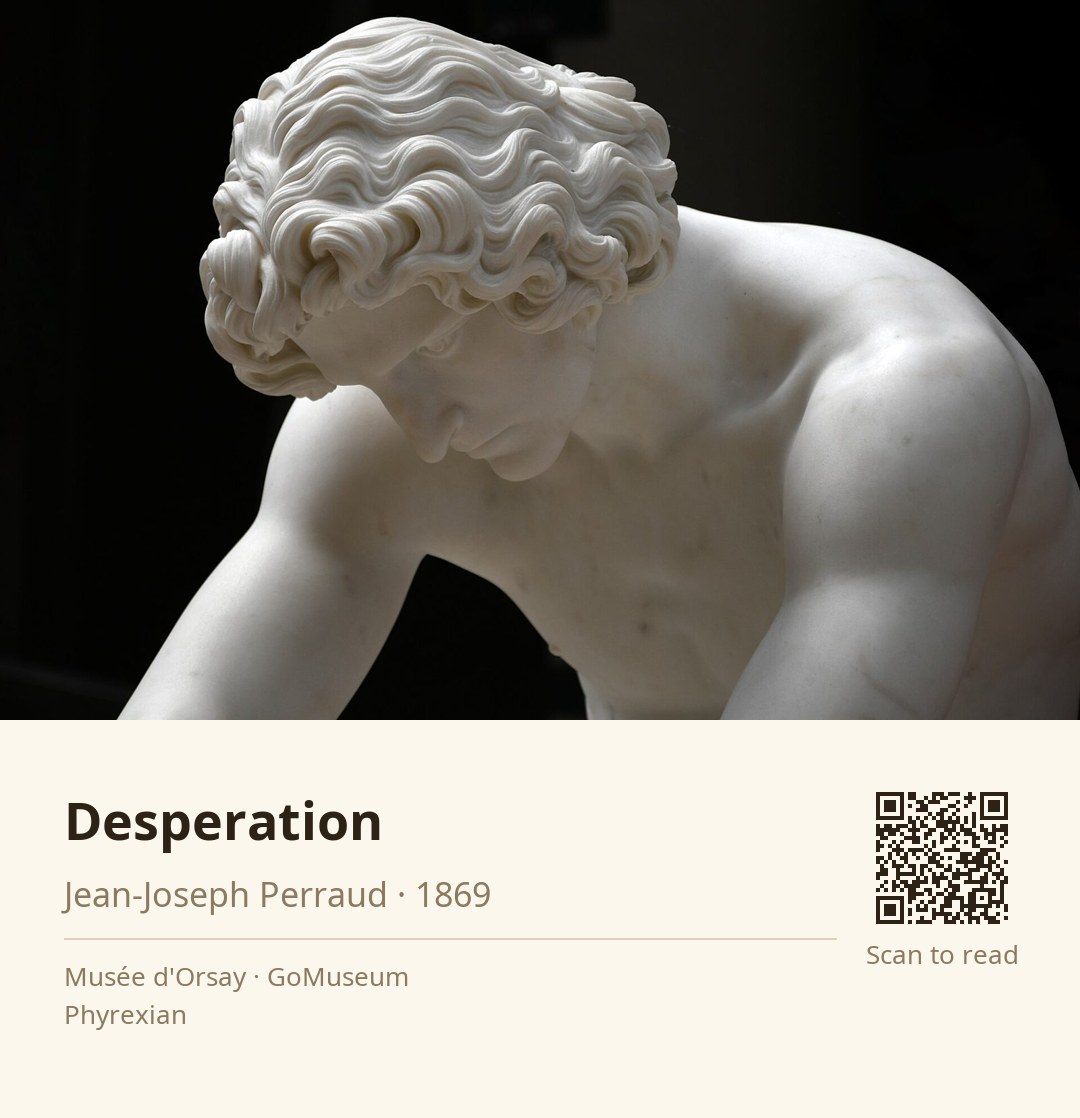
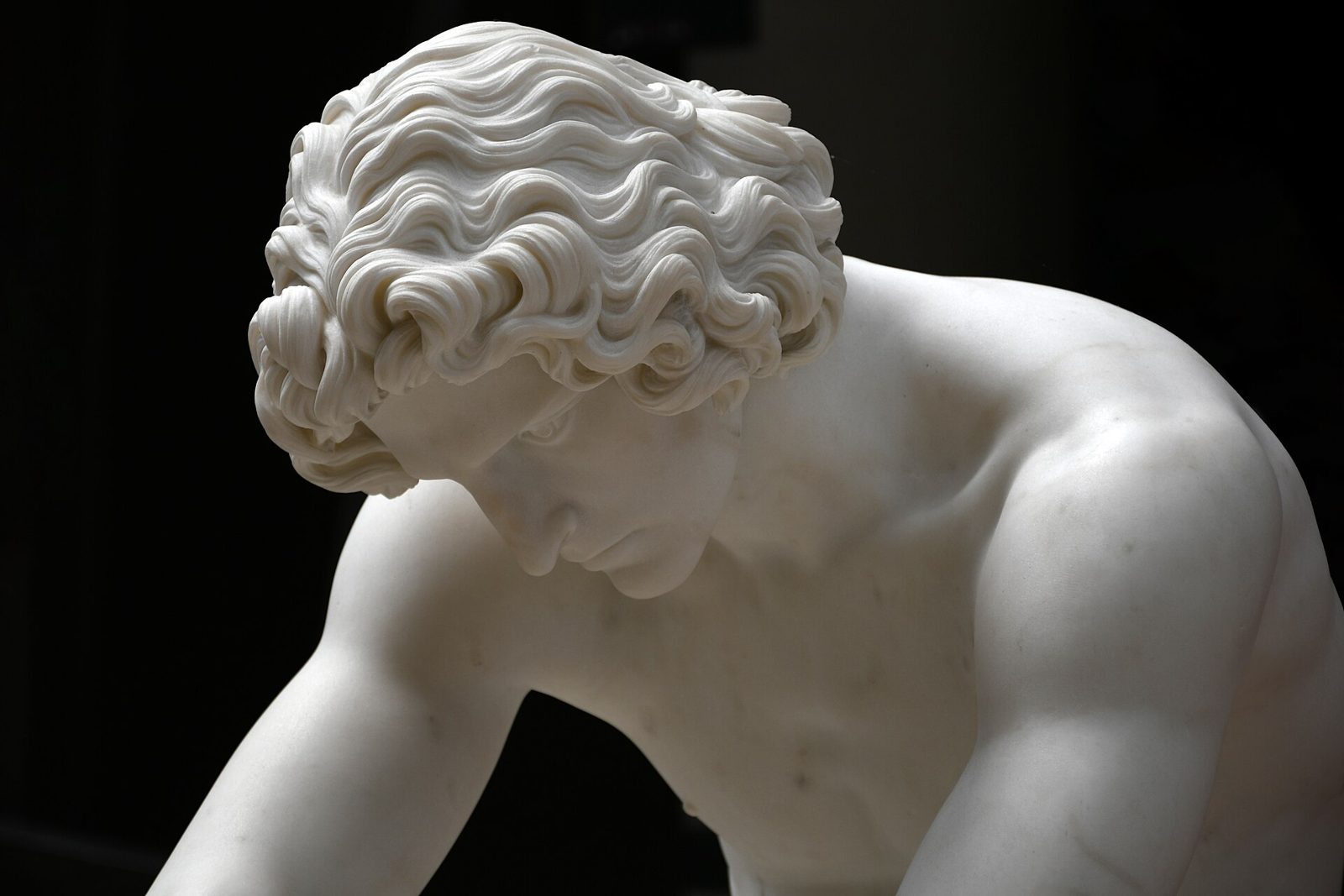
The figure of a man, captured in a moment of deep contemplation, embodies the essence of despair in Jean-Joseph Perraud's sculpture, "Desperation." The intricately carved hair flows around his bowed head, while the well-defined musculature of his shoulders and arms conveys a sense of both strength and vulnerability. This contrast highlights the emotional weight of the figure, inviting you to ponder the depths of his sorrow.
Perraud's choice of marble adds a lifelike quality to the work, enhancing the emotional resonance of the subject. The smooth surface reflects light, creating a striking juxtaposition against the dark background, which serves to isolate the figure and amplify his internal struggle. The artist's meticulous attention to anatomical detail not only showcases his skill but also emphasizes the universal nature of despair, making it relatable to anyone who has faced hardship.
Created in 1869, "Desperation" was first exhibited at the Salon des artistes français, where it earned a medal of honor, affirming Perraud's status as a prominent sculptor of his time.
Jean-Joseph Perraud was a prominent French academic sculptor born on April 26, 1819, in Jura and died on November 2, 1876, in Paris. He studied at the École des Beaux-Arts under notable mentors and won the prestigious Prix de Rome in 1847. His career flourished during the Second Empire, earning him significant recognition, as he became a member of the Académie des Beaux-Arts and was honored as an officer of the Legion of Honor.
Perraud's work is characterized by a blend of neoclassicism and romanticism, evident in major pieces like "Telemachus Bringing the Urn to Phalante" and "The Childhood of Bacchus," now housed in the Louvre. His contributions to public architecture include the Lyrical Drama group on the Palais Garnier and the figure of Berlin at the Gare du Nord. Despite his acclaim, his style fell out of favor after his death, yet he remains a significant figure in 19th-century French sculpture, reflecting the artistic transitions of his time. Perraud's legacy endures through his works and the collection he bequeathed to the city of Lons-le-Saunier.
Crafted from marble, Perraud's 'Desperation' showcases the artist's exceptional skill in sculpting. The smooth, polished surface of the marble not only enhances the lifelike quality of the figure but also allows for intricate details, like the flowing hair and defined musculature. You can almost feel the weight of the stone, transformed into a poignant expression of human emotion.
Created in 1869, 'Desperation' was first unveiled at the Salon des artistes français, where it garnered significant acclaim, earning a medal of honor. This recognition solidified Perraud's reputation as a leading sculptor of his era. The sculpture was later exhibited at the 1873 Exposition Universelle in Vienna, further showcasing its impact and appeal across borders.
Interestingly, Perraud was not only a sculptor but also a co-winner of the prestigious Prix de Rome in 1847, which allowed him to study at the Villa Medici in Rome. During his time there, he formed a close friendship with the architect Charles Garnier, who would later commission Perraud for the façade of the Palais Garnier, the famous Paris opera house.
While studying at the Villa Medici in Rome, Perraud developed a close friendship with architect Charles Garnier, who later commissioned him for the façade of the Palais Garnier.
Perraud studied at the École des Beaux-Arts under the guidance of Etienne-Jules Ramey and Augustin-Alexandre Dumont.
Jean-Joseph Perraud is buried in Montparnasse Cemetery in Paris.