 Image: Phyrexian · ketrin1407 · ketrin1407 · Shadowgate from Novara, ITALY
Jeunesse d'Aristote
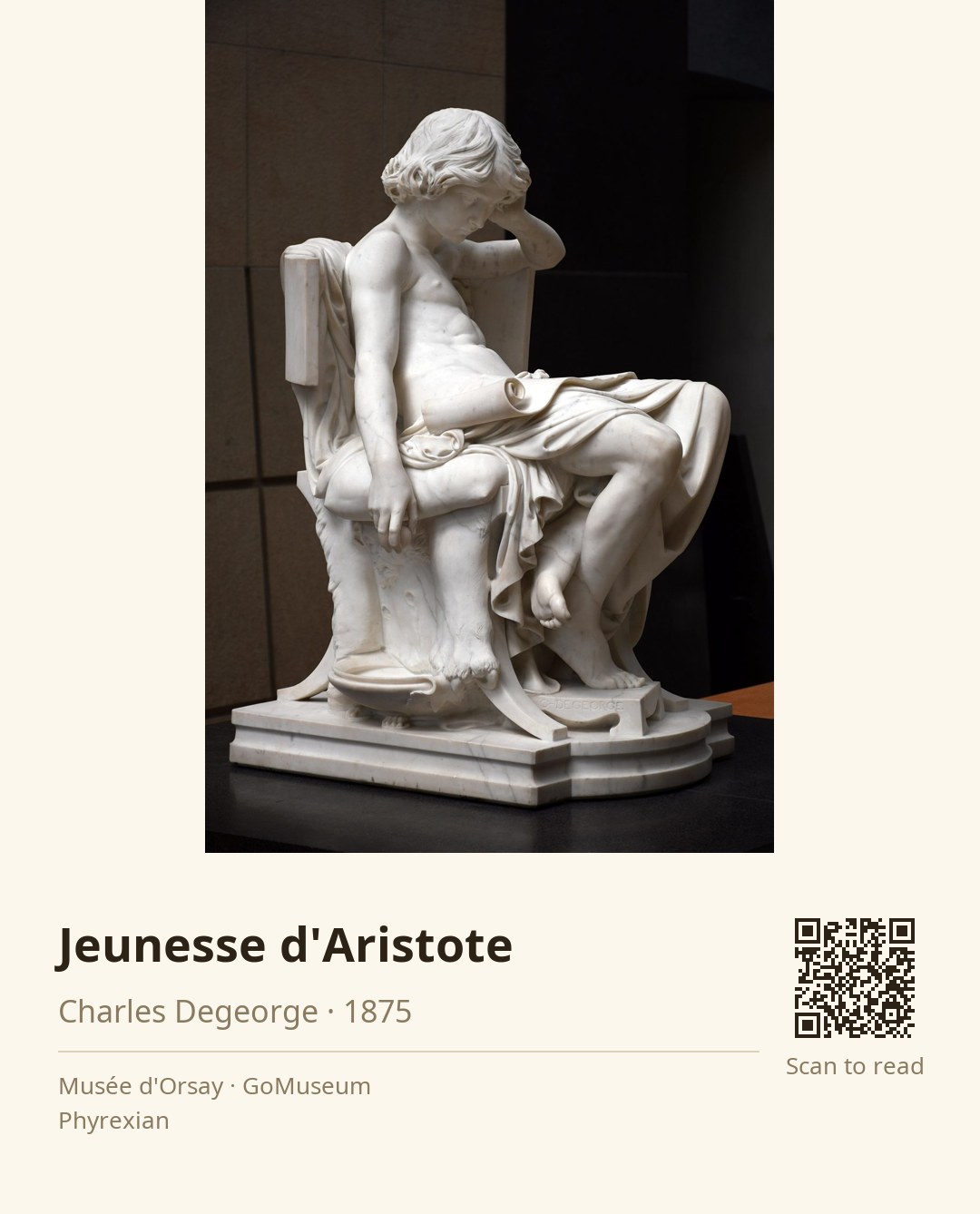
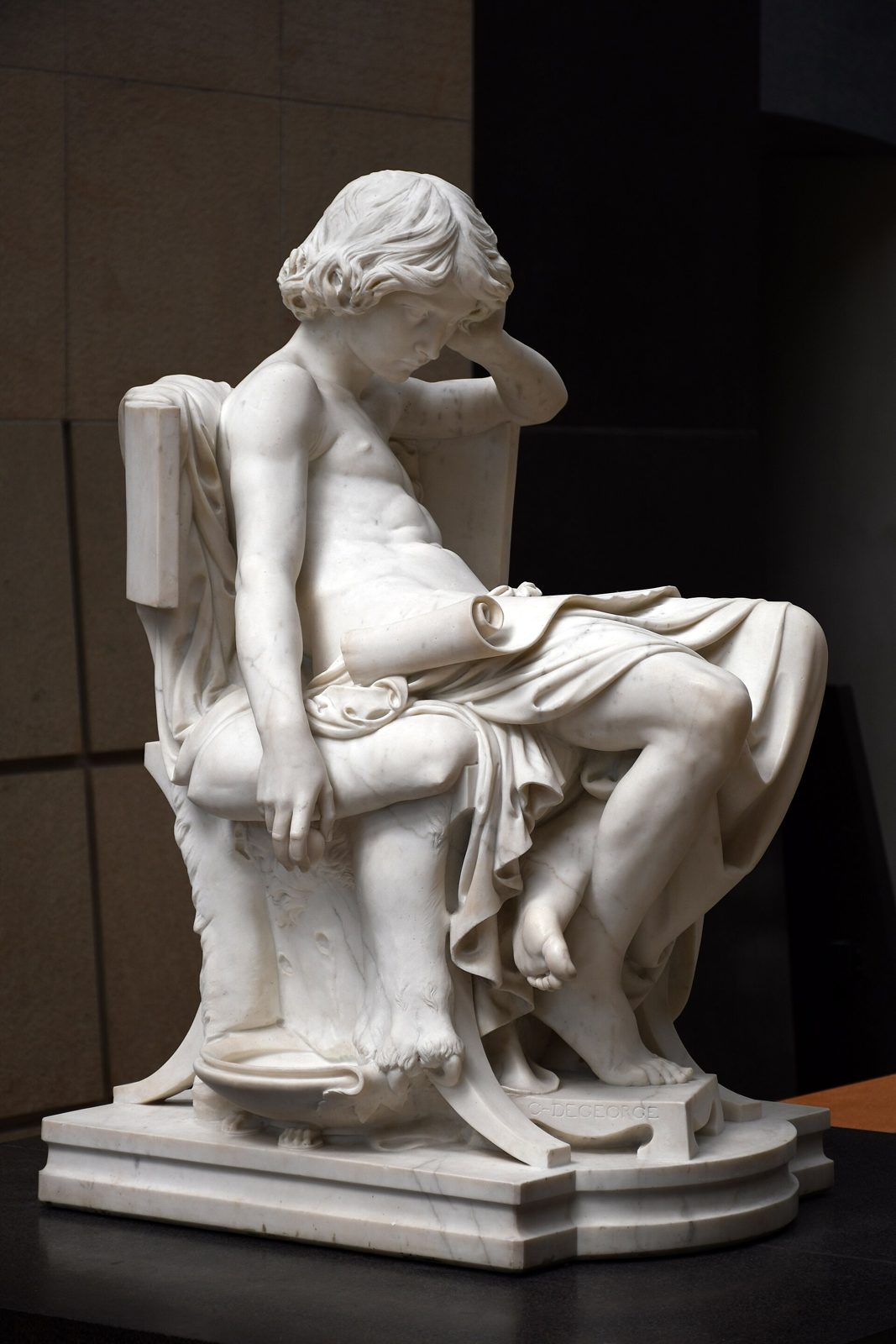
🎧 This work has audio narration — listen in the appThe young figure of Aristotle, seated thoughtfully in a large chair, captures a moment of introspection. His right hand supports his head, while a scroll rests on his lap, hinting at his scholarly pursuits. The gentle curves of his semi-nude form and the intricate drapery that partially covers him draw attention to the serene expression on his face, suggesting a deep contemplation of knowledge.
This sculpture, created by Charles Degeorge in 1875, embodies the essence of youth and intellectual curiosity. The smooth marble finish enhances the lifelike quality of the figure, emphasizing the delicate folds of the cloth and the naturalism of the pose. Degeorge’s choice to depict Aristotle in this contemplative state not only reflects the philosopher's quest for wisdom but also invites viewers to engage with their own thoughts and inquiries.
Charles Degeorge, a French sculptor born in Lyon, became known for his ability to infuse life into his works, as seen in "Jeunesse d'Aristote." His artistic journey included studying at the École des Beaux-Arts in Paris, where he honed his skills in sculpture and medal-making.
Charles Jean Marie Degeorge was a French sculptor and medallist born in 1837 in Lyon and died in 1888 in Paris. He studied at the École des beaux-arts in Lyon and later in Paris, where he honed his craft under notable artists. Degeorge gained recognition for his ability to infuse sculptural qualities into his medal designs, winning the prestigious Grand Prix de Rome in 1866. His most celebrated work, "La jeunesse d'Aristote," captures the philosopher in a moment of youthful contemplation, showcasing his skill in marble sculpture. Throughout his career, he created numerous busts, including one of his friend Henri Regnault, and contributed to public monuments, reflecting his strong ties to Lyon. Degeorge's works are characterized by their expressive forms and attention to detail, securing his place in the history of 19th-century French art. He is interred at the Père-Lachaise Cemetery in Paris, a testament to his lasting impact on the artistic community.
The lifelike quality of the figure is achieved through meticulous carving, evident in the delicate folds of the drapery that drapes over the chair and partially covers the figure. Each curve and contour is thoughtfully rendered, inviting you to appreciate the skill involved in transforming a solid block of stone into a dynamic representation of youthful contemplation. The texture of the marble adds a subtle sheen, enhancing the figure's serene expression and the intricate details of the scroll resting on his lap.
Created in 1875, 'Jeunesse d'Aristote' was a significant work for Charles Degeorge, a French sculptor who had a notable career. Degeorge's work was well-received, and he continued to exhibit at various salons throughout his career. The piece is now housed in the Musée d'Orsay, where it remains a testament to Degeorge's artistic legacy.
Interestingly, Charles Degeorge was not only a sculptor but also a skilled medallist. He won the prestigious Grand Prix de Rome in 1866 for his work in medal engraving, which showcased his versatility and artistic talent.
In addition to being a sculptor, Charles Degeorge was also a skilled medallist, showcasing his versatility in the arts.
Charles Degeorge received the Grand Prix de Rome in 1866 for his exceptional work in medal engraving.