 Image: Phyrexian · Phyrexian · Phyrexian · Phyrexian · Phyrexian
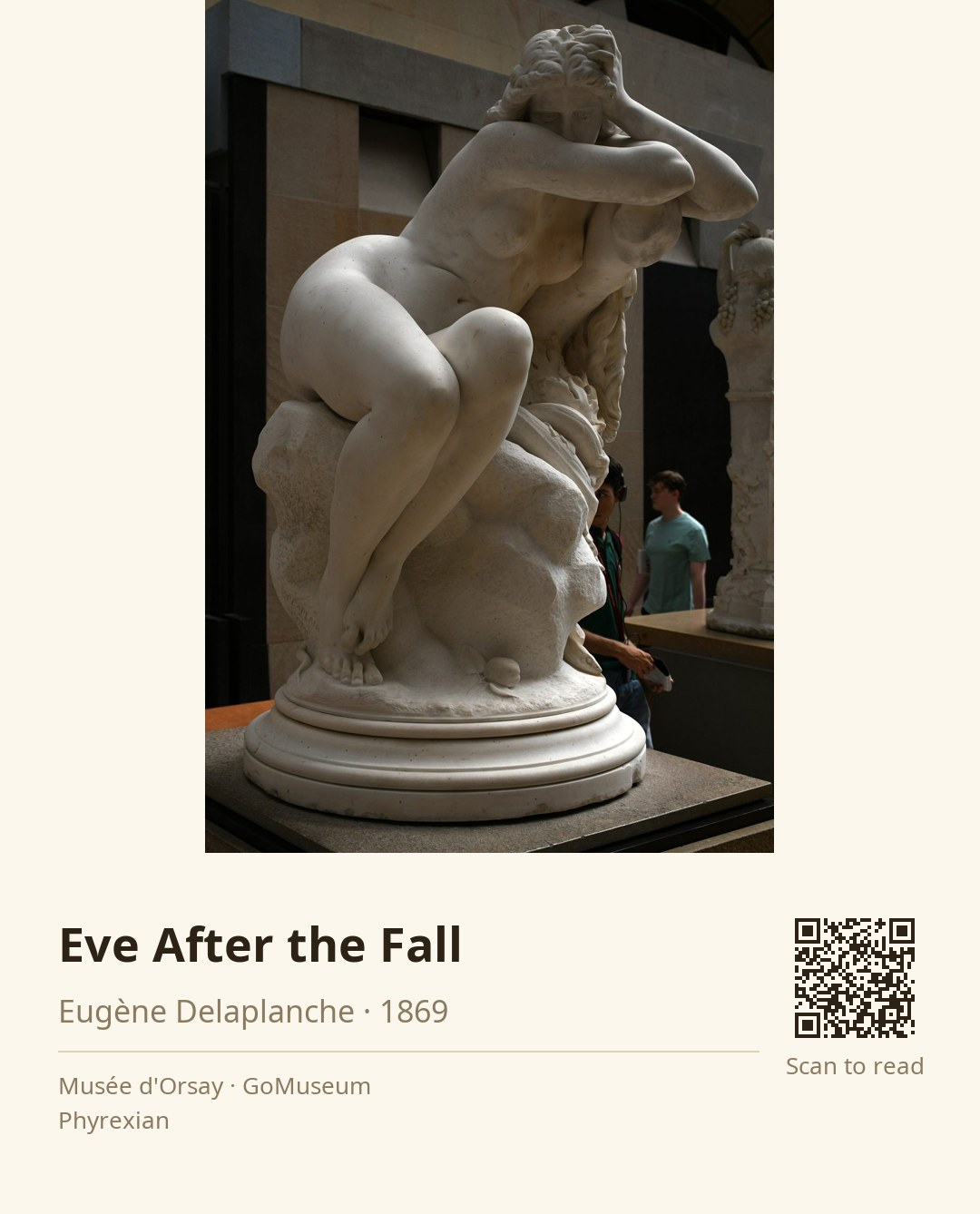
Eve After the Fall
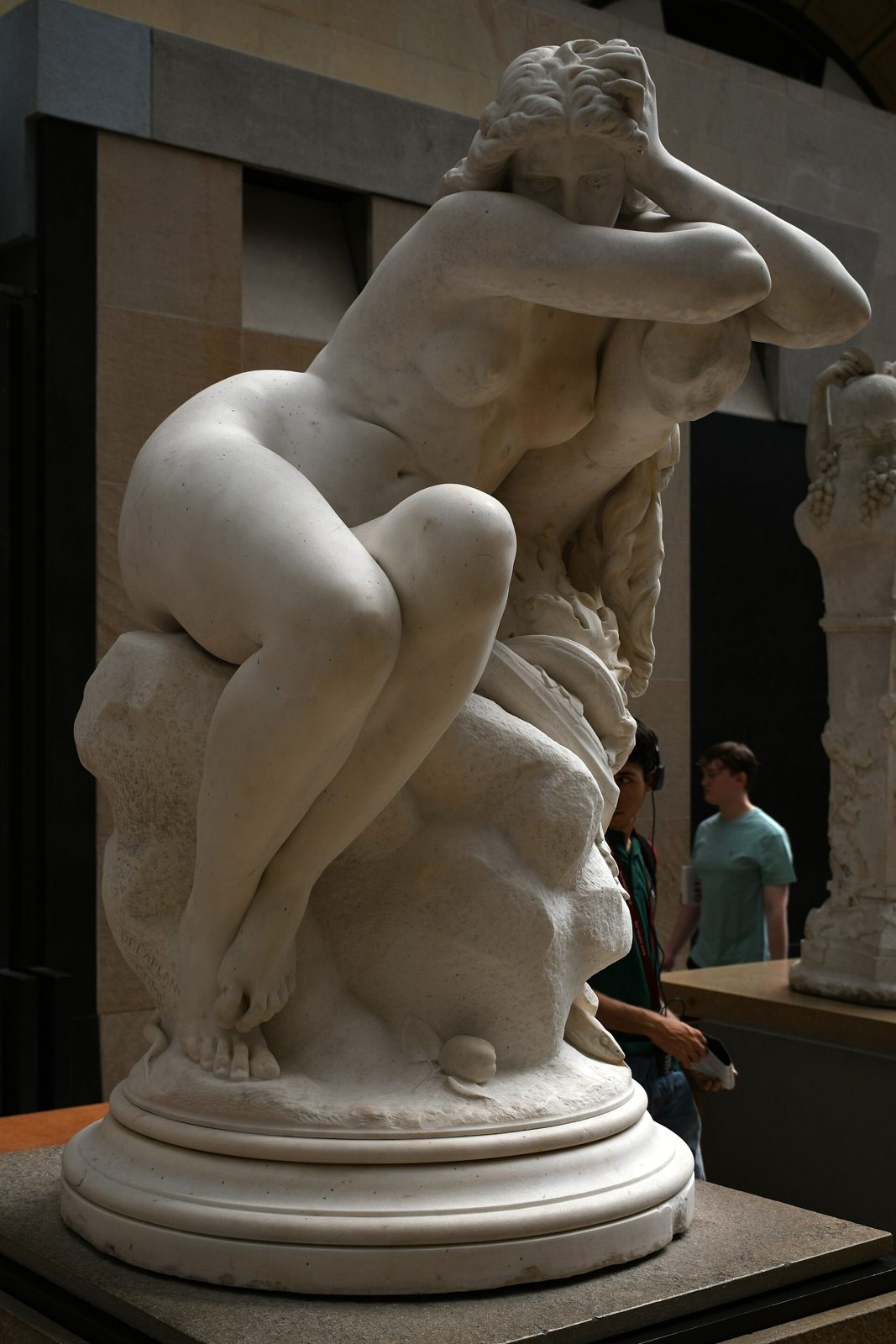
🎧 This work has audio narration — listen in the appEve sits in a moment of quiet reflection, her body poised on a rocky base that echoes the weight of her thoughts. Notice how her right arm rests thoughtfully on her knee while her left hand cradles her head, partially hiding her face, suggesting a deep sense of remorse. The smooth surface of the marble captures the delicate flow of her long hair, which cascades down her back, adding to the intimate atmosphere of this moment.
This portrayal of Eve, created by Eugène Delaplanche in 1869, encapsulates the biblical figure's emotional turmoil after the fall from grace. The compactness of her pose, with legs drawn up and toes pointed, creates a sense of vulnerability, emphasizing her isolation. The subtle detailing in the texture of the rock contrasts with her smooth skin, highlighting the tension between her human frailty and the harshness of her surroundings.
Delaplanche's work was first exhibited at the Salon des artistes français in Paris in 1870, where it drew attention for its poignant representation of a pivotal moment in biblical narrative.
Eugène Delaplanche was a prominent French sculptor born on February 28, 1836, in Belleville, Seine. A student of Francisque Duret, he won the prestigious Prix de Rome in 1864, allowing him to study at the Villa Medici in Rome until 1867. His works, characterized by naturalism and a dignified simplicity, include notable pieces such as "Messenger of Love," "Aurora," and "Virgin of the Lilies," all housed in the Luxembourg Museum. Delaplanche's mastery is evident in his acclaimed "Music" at the Paris Opera House and his contributions to public monuments, including the statues of "Security" and "Commerce" in Paris's Hôtel de Ville. He was awarded the medal of honor in 1878 and became a professor at the École des Beaux-Arts in 1886. Delaplanche's legacy endures through his extensive representation in museums, including the Musée d'Orsay and the Glyptothek in Copenhagen, marking his significant place in art history. He passed away on January 10, 1891, and is buried in Père-Lachaise Cemetery in Paris.
Eugène Delaplanche crafted 'Eve After the Fall' from marble, a material known for its ability to capture fine details and convey a sense of purity. The artist employed a technique called 'taille avec mise aux points,' which involves careful carving and polishing to achieve a smooth finish. This meticulous approach allows the light to dance across Eve's skin, enhancing her delicate features and flowing hair. The contrast between the polished surface of her body and the rough texture of the rocky base creates a striking visual dialogue, emphasizing her vulnerability against the harshness of her surroundings.
Created in 1869, 'Eve After the Fall' was first exhibited at the Salon des artistes français in Paris in 1870, where it was assigned the inventory number 4416. The sculpture garnered significant attention for its emotional depth, resonating with viewers who connected with Eve's portrayal of remorse. Delaplanche's work went on to be showcased at the 1873 Exposition universelle in Vienna and again at the 1878 Exposition universelle in Paris, further solidifying its reputation.
Viewers were deeply moved by the emotional depth of the sculpture, particularly relating to Eve's expression of remorse.