The Gleaners
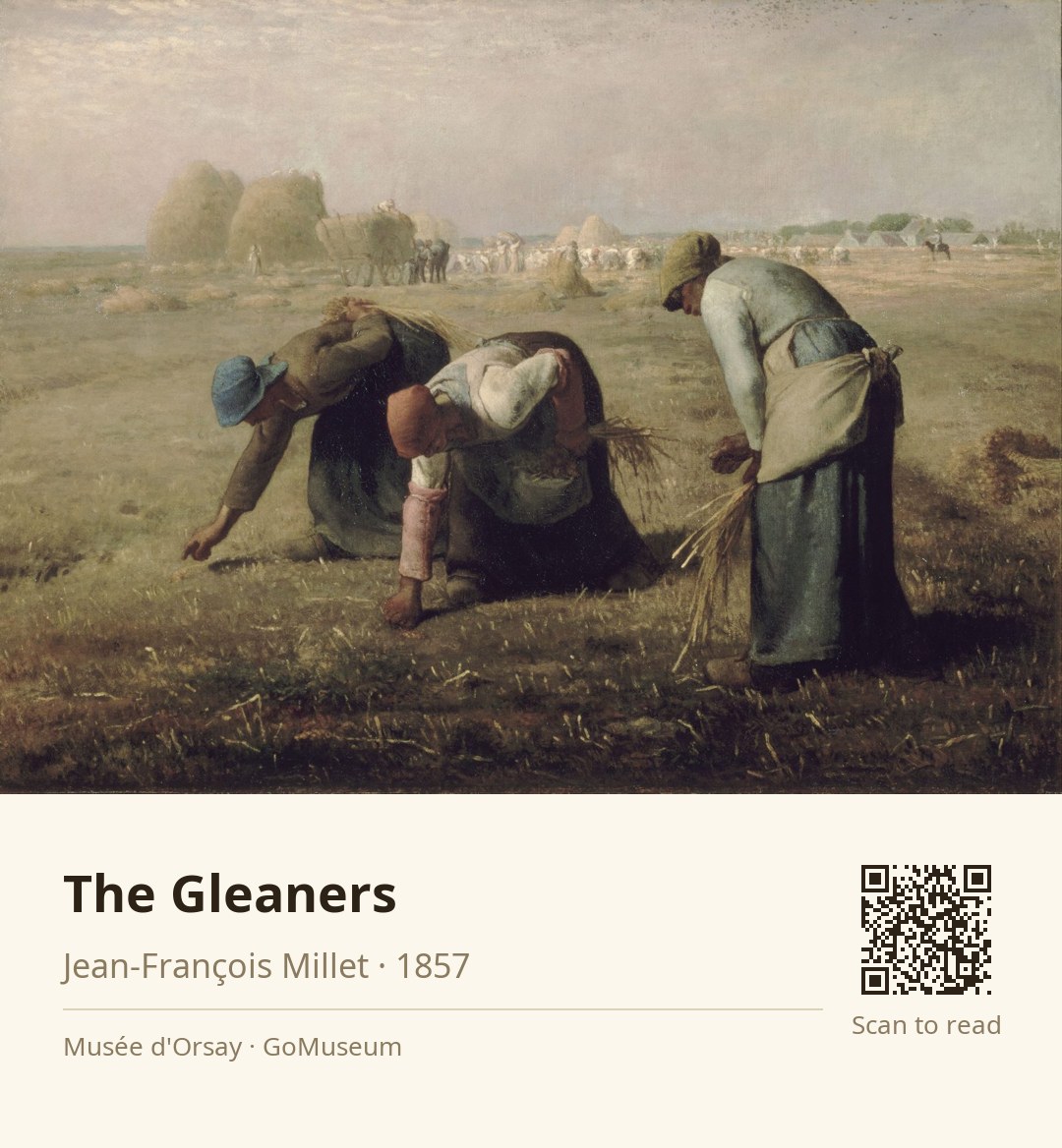
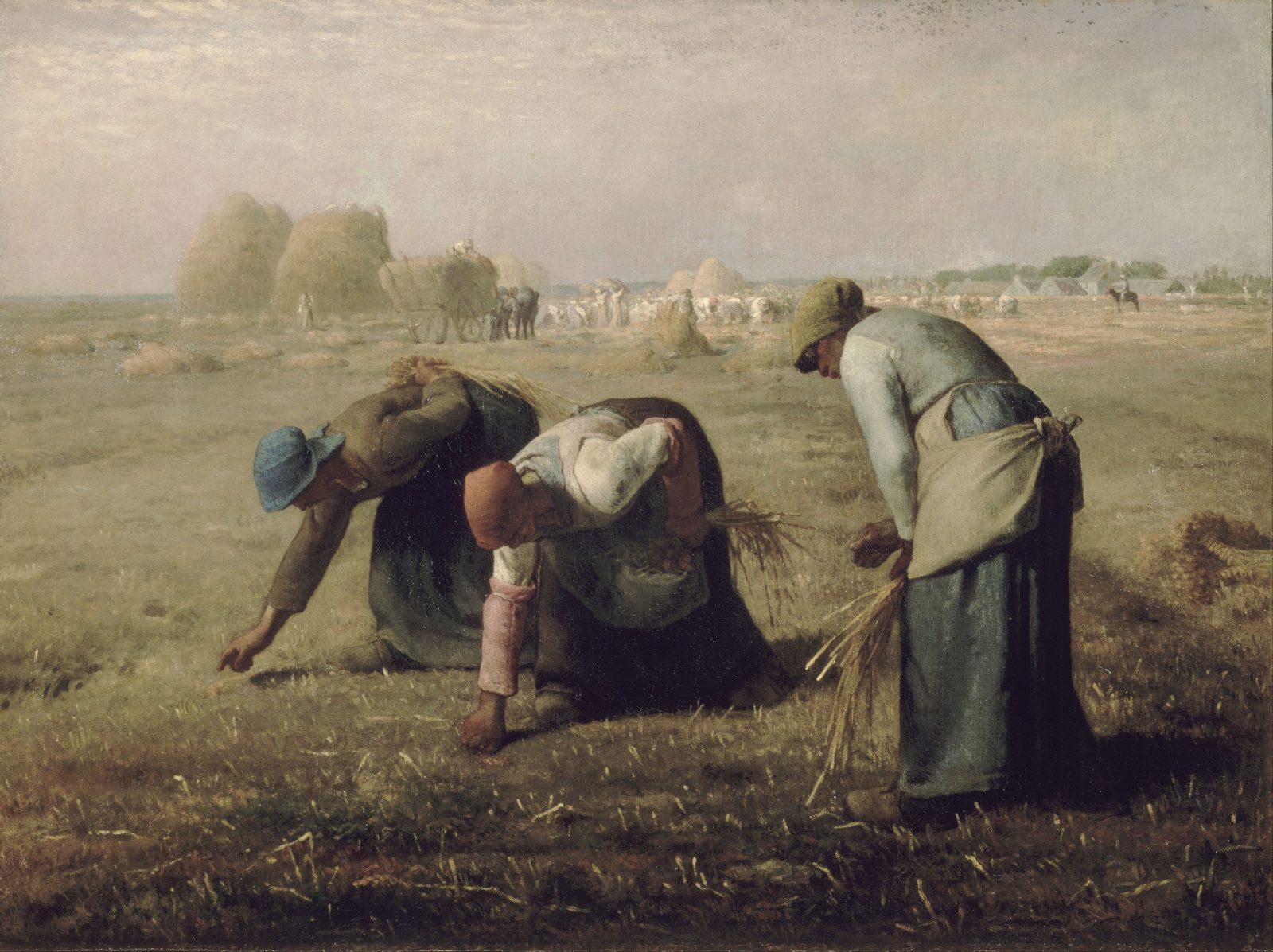
🎧 This work has audio narration — listen in the appTake a moment to really look at "The Gleaners" by Jean-François Millet. Notice how the three women in the foreground are bent over, their hands sifting through the earth, gathering the leftover stalks of wheat. Their posture is not just a depiction of labor; it’s a powerful statement about their struggle and dignity. Now, focus on the contrast between these women and the bountiful harvest in the background, where the sunlit fields are teeming with abundance. This juxtaposition highlights the harsh reality of rural poverty, a theme that resonated deeply when the painting was unveiled in 1857. Millet wasn’t just painting a scene; he was challenging the viewers, particularly the upper classes, to confront the uncomfortable truth about the labor that sustains their wealth. Millet created this piece during a time when France was grappling with the aftermath of revolution and social upheaval. The gleaners, often overlooked, symbolize the working class, and their portrayal was revolutionary in itself. Instead of glorifying the rich, Millet brought the plight of the poor into the spotlight, making it impossible to ignore. As you stand here, think about the stories these women carry. What does their labor mean to you? How does it reflect the ongoing struggles of workers today? Let this painting linger in your mind, reminding you of the unseen efforts that support our lives.
Jean-François Millet was a pivotal figure in 19th-century French art, born on October 4, 1814, in Gruchy, Normandy. As a founding member of the Barbizon school, he is celebrated for his profound depictions of peasant life, embodying the Realism movement. Millet's early years were steeped in agricultural labor, which deeply influenced his artistic themes. After studying under various artists, he moved to Paris, where he initially struggled but eventually gained recognition for his work.
Millet's paintings often highlighted the dignity of rural laborers, showcasing their struggles and connection to the land. His notable works, such as "The Gleaners" and "The Angelus," reflect a shift from idealized pastoral scenes to a more authentic representation of contemporary social conditions. Despite facing criticism early in his career, he found success in the mid-1850s, producing masterpieces that resonated with the public and critics alike.
Millet's legacy lies in his ability to elevate the everyday lives of farmers to the realm of fine art, influencing generations of artists and solidifying his place in art history as a champion of the working class. He passed away on January 20, 1875, in Barbizon, leaving behind a rich body of work that continues to inspire.
Jean-François Millet's 'The Gleaners' was unveiled at the Salon of 1857, where it quickly stirred controversy among the upper classes of France. This painting, measuring a striking 33 by 44 inches, was larger than typical works depicting labor, which usually favored religious or mythological themes. Critics were unsettled by the portrayal of the working class, interpreting it as a glorification of poverty and a reminder of the social tensions following the French Revolution of 1848. One critic even likened the painting to a harbinger of revolution, suggesting it evoked the specter of the guillotines from 1793. Initially sold for 3,000 francs to an Englishman named Binder, Millet had to accept a lower price than he desired. Over time, however, the painting's value skyrocketed, culminating in its purchase by Champagne maker Jeanne-Alexandrine Louise Pommery for 300,000 francs in 1890, after which it was donated to the Louvre and eventually moved to the Musée d'Orsay.
The brushwork feels deliberate yet loose, capturing the movement of the women as they bend over the earth. Notice how the earthy tones of the foreground contrast sharply with the vibrant yellows and greens of the bountiful harvest behind them. This choice of color not only emphasizes the disparity between the gleaners and the harvest but also evokes a sense of longing and struggle. The composition is striking; the triangular arrangement of the women draws your eye across the canvas, leading you from their toil to the distant fields. The scale of the painting enhances its impact, making the gleaners appear monumental, almost heroic in their labor. Millet's choice to depict them in such a grand manner challenges the viewer to reconsider their place in society and the value of their work.
Millet's 'The Gleaners' left a profound legacy in the art world, influencing a generation of artists who sought to depict the lives of the working class with dignity. Its raw portrayal of rural poverty inspired contemporaries like Pissarro and van Gogh, who echoed Millet's themes in their own works. The painting is often credited with paving the way for the social realism movement, which aimed to highlight the struggles of ordinary people. Art historian Robert Rosenblum noted that Millet introduced 'imposing new presences' in mid-century art, reshaping how artists approached themes of labor and class. This shift not only changed artistic representation but also encouraged a broader societal conversation about the role of the working class in a rapidly modernizing world.
One surprising anecdote about 'The Gleaners' is that despite its initial poor reception, it became a highly sought-after piece after Millet's death. In 1889, it was sold for a staggering 300,000 francs, a price that shocked many at the time. The buyer, Madame Pommery, aimed to donate the painting to the Louvre, which she successfully did, thus ensuring its place in art history. Interestingly, this acquisition came after a failed attempt to purchase another of Millet's works, 'L'Angélus,' showing her determination to secure a significant piece of art for the French public.
Before 'The Gleaners,' Millet created a vertical painting of the same subject in 1854 and an etching in 1855, indicating his ongoing interest in the theme of gleaning.
Millet sold 'The Gleaners' for 3,000 francs, which was below his desired price of 4,000 francs, highlighting his financial struggles at the time and the pressure he faced to sell quickly.
The presence of birds in the sky, ready to peck at the forgotten grains, serves as a subtle reminder of the shared struggle for survival among both humans and nature, reinforcing the painting's themes of labor and scarcity.