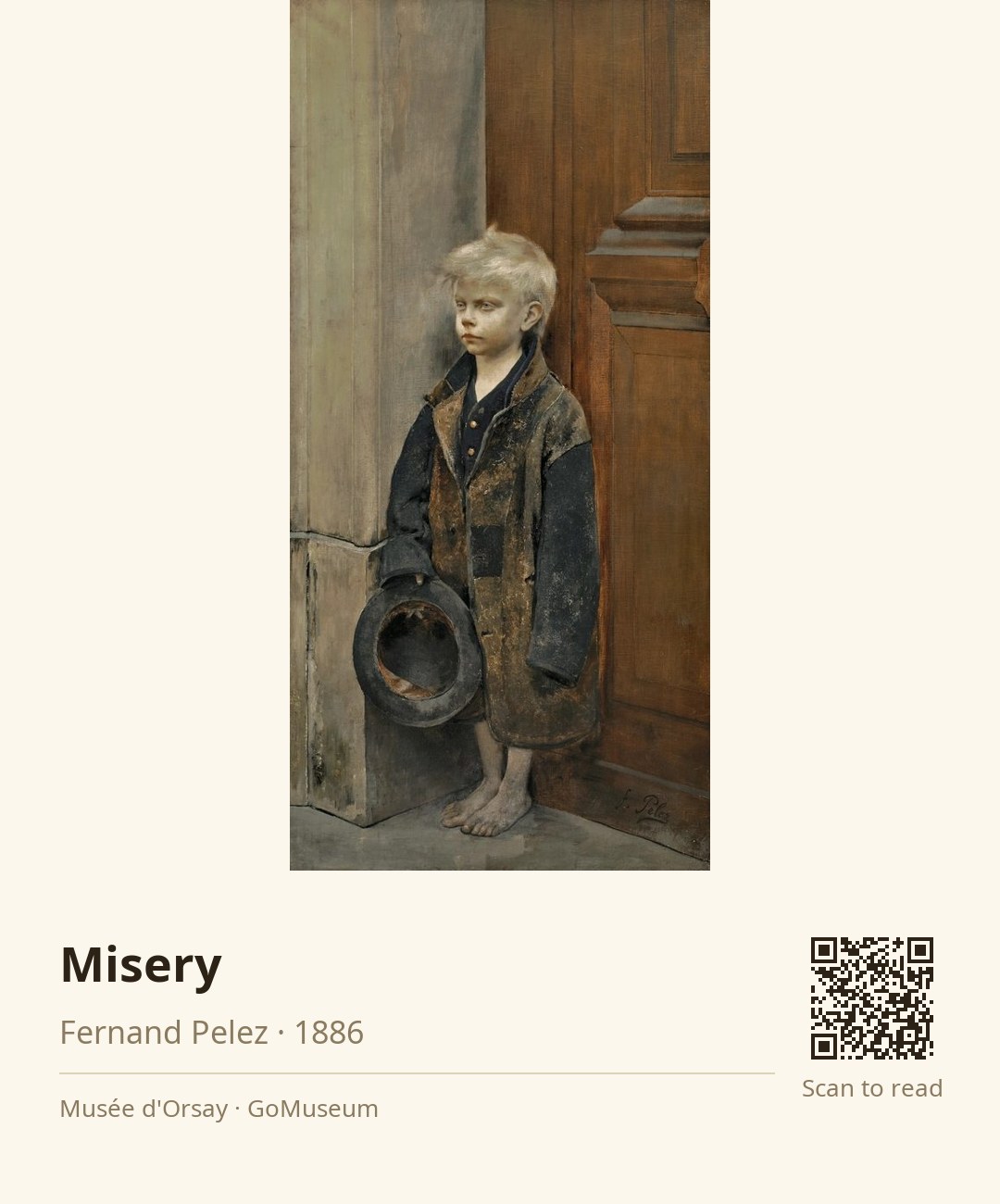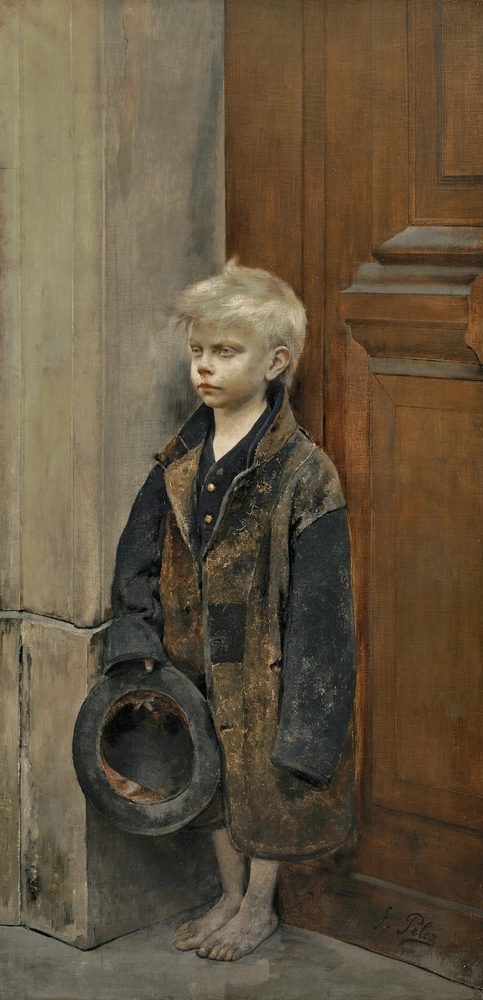
The young boy in "Misery" stands barefoot against a rough stone wall, his oversized, tattered coat hanging loosely around him. In his right hand, he clutches a hat, the weight of his expression heavy as he gazes slightly to the left, embodying the stark realities of poverty. The muted earthy tones of the painting enhance the somber mood, while the detailed brushwork captures the textures of his worn clothing and the surfaces around him.
Pelez's choice to depict this solitary figure reflects his commitment to portraying social issues through a realistic lens. The boy’s vulnerability is palpable, inviting viewers to confront the harsh conditions faced by the impoverished. The wooden door and stone wall not only frame the boy but also symbolize the barriers that separate him from a better life. This work, created in 1886, is a poignant example of Pelez's shift towards focusing on the struggles of the lower classes, influenced by the naturalist movement and his own social consciousness.
Fernand Pelez was a French painter of Spanish descent, born on January 18, 1843, in Paris. He was the son of a painter and received early artistic training from his father. Initially influenced by academic styles, Pelez later embraced naturalism, focusing on the struggles of the working class and social issues. His notable works include "The Mouthful of Bread" and "Grimaces et Misères," which reflect his deep concern for human suffering and societal inequities. Despite early recognition, including medals at the Salon, his career faltered in the 1880s, leading him to withdraw from public life after the disappointing reception of "L'Humanité" in 1896. Pelez's legacy was revived with a major exhibition at the Petit Palais in 2009, highlighting his contributions to the depiction of marginalized communities in art. His work remains significant in the context of 19th-century realism and social commentary. Pelez passed away on August 7, 1913, in Paris.
Pelez's technique in 'Misery' is strikingly detailed, showcasing his mastery of oil paint on canvas. The brushwork is meticulous, capturing not just the textures of the boy's tattered coat but also the rough surfaces of the stone wall behind him. Each stroke seems deliberate, enhancing the emotional weight of the scene. The muted earthy palette—browns, grays, and ochres—serves to amplify the somber mood, immersing the viewer in the boy's world of hardship. The composition is intimate yet stark, with the boy positioned centrally against the wall, emphasizing his isolation. Pelez's choice of scale allows the viewer to feel the weight of the boy's despair, making it impossible to look away. This careful handling of paint and composition draws you into a moment that feels both personal and universal, a snapshot of a harsh reality.
Interestingly, Pelez was not initially successful in his career, facing significant challenges in the 1880s. After the disappointing reception of 'L'Humanité' at the Salon of 1896, he chose to withdraw from public life, refusing to exhibit or sell his work.
Fernand Pelez was born in Paris.
In the 1880s, Pelez faced commercial failure and became a recluse after the disappointing reception of his work L'Humanité.
A major exhibition of Pelez's work took place at the Petit Palais in Paris from September 24, 2009, to January 17, 2010.