A Box at the Theatre des Italiens
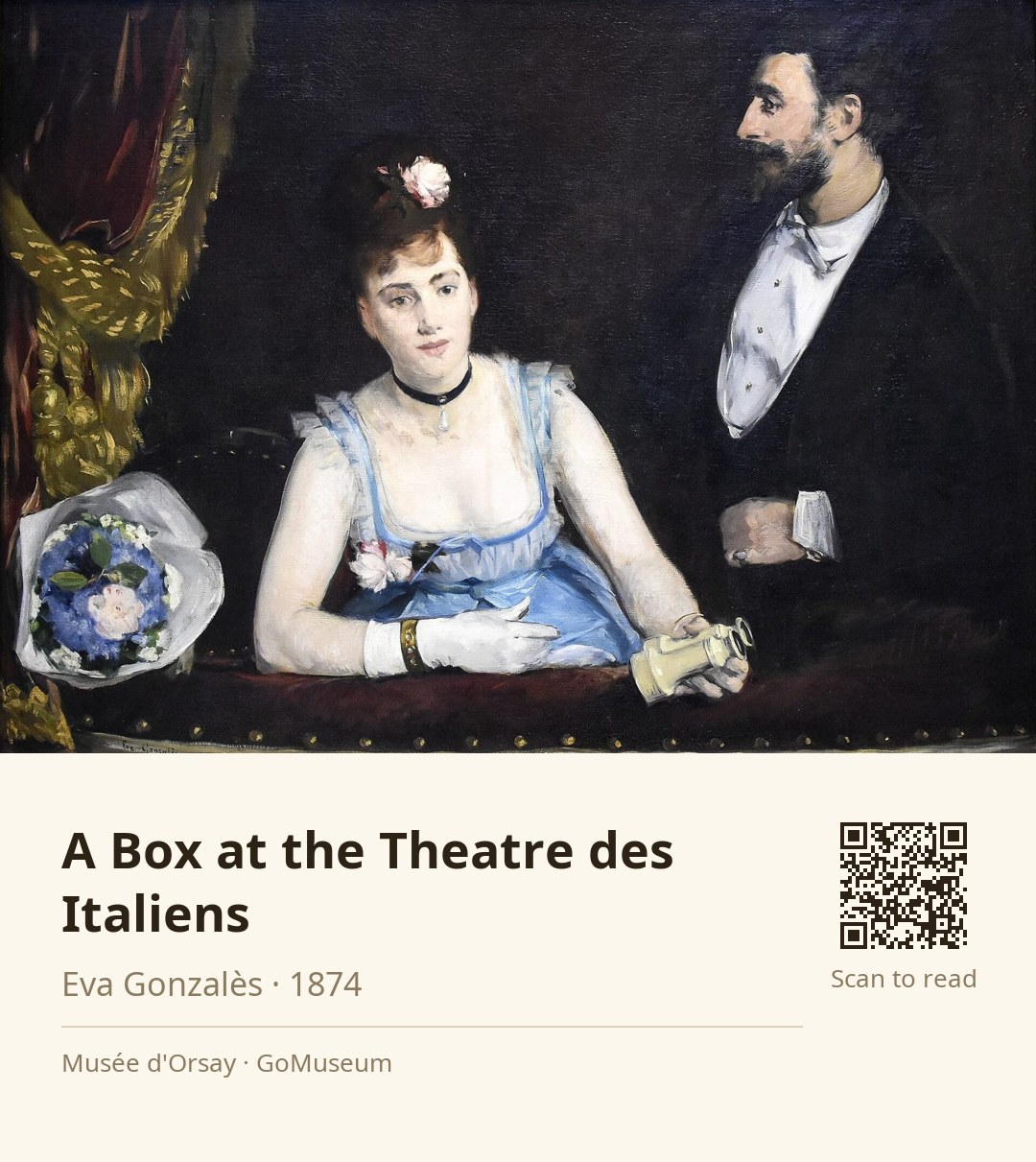
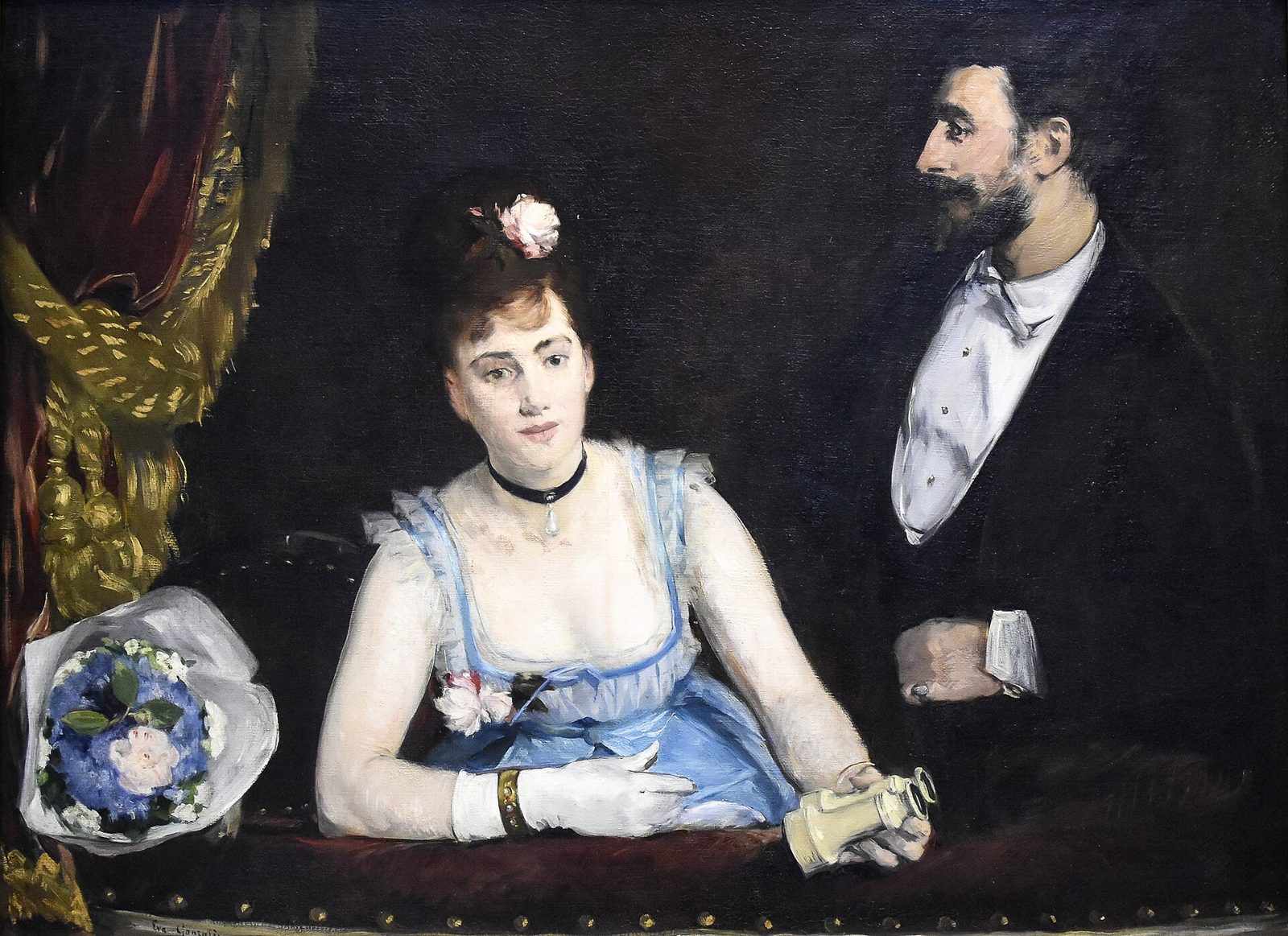
🎧 This work has audio narration — listen in the appTake a moment to really look at "A Box at the Theatre des Italiens." Notice how the seated woman, dressed in elegant attire, leans forward, her gaze piercing through the canvas directly at you. The man beside her stands, seemingly oblivious to the stage, his attention elsewhere. This contrast is striking and speaks volumes about the dynamics of gender in the 19th century.
Why does this matter? Well, in 1874, when Eva Gonzalès painted this, women were often relegated to passive roles in society, especially in public spaces like theaters. Yet here, the woman is not just an observer; she commands the scene, dressed in jewels and positioned in the most prestigious box, a symbol of status and visibility. Her assertive posture challenges the norms of her time, suggesting independence and engagement rather than mere objectification.
Gonzalès, a student of Édouard Manet, was breaking boundaries with this work. While many female artists were expected to focus on domestic themes, she chose a bold contemporary subject, elevating the everyday experience of women in public life to the grandeur of fine art.
As you stand here, think about the implications of her gaze. Is she merely a spectacle, or is she redefining how women are seen in society? What stories might she be telling us beyond the frame?
Eva Gonzalès was a pioneering French Impressionist painter born in Paris on April 19, 1847. Raised in an artistic environment, she was introduced to the cultural elite through her father, a writer. At sixteen, she began her formal art training, first with Charles Chaplin and later under Édouard Manet, who became a significant influence on her work. Gonzalès was the only formal student of Manet, and their relationship was both personal and professional, with her often serving as his model.
Her paintings, characterized by a blend of technical skill and an intuitive approach, earned her praise from critics like Émile Zola. Despite being part of the Impressionist movement, she did not exhibit in their exhibitions, yet her style aligned closely with theirs. Works such as "A Loge in the Théâtre des Italiens" showcased her unique perspective, blending feminine sensibility with bold themes.
Gonzalès married Henri Guérard in 1879 and had a son shortly before her untimely death in childbirth in 1883. Her legacy, though overshadowed during her lifetime, has gained recognition, with her works now celebrated in major collections, affirming her place in art history as one of the most notable female Impressionists of the 19th century.
The work features her sister, Jeanne Constance Philippe, and her future husband, Henri Guérard, as models. Initially, Gonzalès submitted this piece to the Salon in 1874, but it faced rejection from the jury, who deemed it too radical for its time. However, it found a home at the Salon triennal in Ghent and was later exhibited at the Salon des Réfusés in 1875. Eventually, it was accepted into the official Salon in 1879, marking a significant moment in her career. The painting was later showcased at the 1900 Paris Exposition and is now housed in the Musée d'Orsay, where it has been since 1986. Its journey reflects the challenges Gonzalès faced as a female artist in a male-dominated art world, navigating societal expectations while striving for recognition.
In 'A Box at the Theatre des Italiens,' Gonzalès employs bold brushwork and a striking composition to draw the viewer's eye. The painting's horizontal format allows for a sweeping view of the theater box, where the seated woman and standing man create a dynamic tension. Notice how the woman's assertive posture contrasts sharply with the man's indifference; her direct gaze meets yours, inviting engagement. The use of color is particularly noteworthy—Gonzalès contrasts the pale skin of the woman with the dark, rich tones of the theater box, enhancing her prominence. The red curtain on the left edge adds a dramatic flair, framing the scene and emphasizing the woman's elite status. This choice of color and composition not only highlights the subject's visibility but also challenges the traditional portrayal of women as passive observers in such social settings.
One intriguing aspect of 'A Box at the Theatre des Italiens' is its initial rejection from the Salon, which was a significant blow for Gonzalès. Critics at the time labeled the painting as having 'masculine vigor,' a curious remark given that it was created by a female artist. This rejection led her to exhibit at the Salon des Réfusés, a venue for works that were turned away by the official Salon, highlighting the ongoing struggle for recognition faced by women artists in the 19th century.
The theater box was a popular motif among artists of the time, as it symbolized social spectacle and visibility, particularly for women. By choosing this setting, Gonzalès engaged with contemporary life, elevating a scene often reserved for satirical prints to a grand artistic statement.
As Manet's only formal student, Gonzalès absorbed his techniques and ideas, which shaped her early style. However, she later developed her own distinctive approach, evident in her bold choice of subject matter and composition in 'A Box at the Theatre des Italiens,' which diverged from the expectations placed on female artists.
The rejection of 'A Box at the Theatre des Italiens' highlights the challenges female artists faced in a male-dominated art world, where their work was often dismissed as lacking authenticity or deemed too radical. This incident underscores the societal biases that influenced artistic recognition and the struggle for women to gain acceptance in the art community.