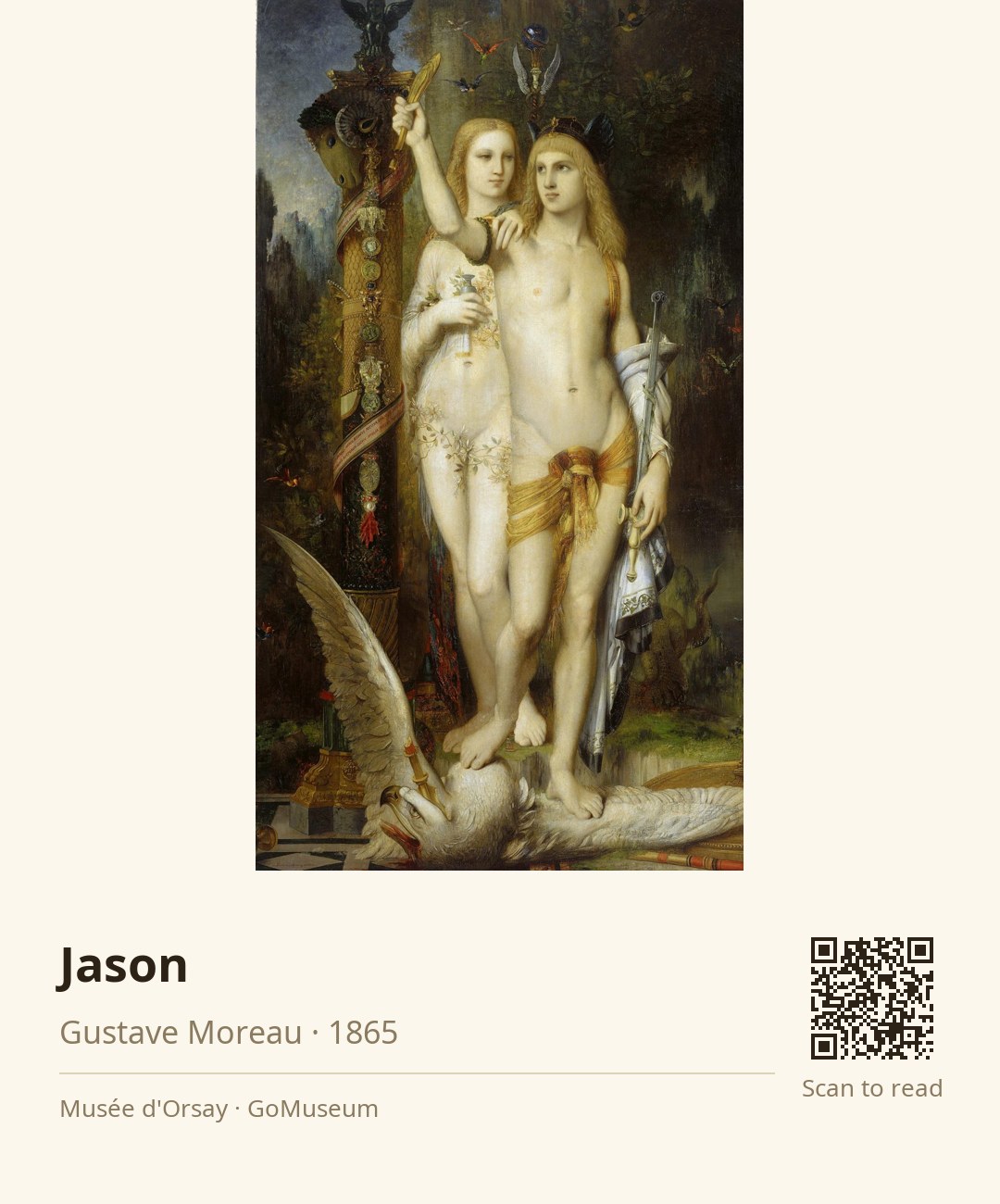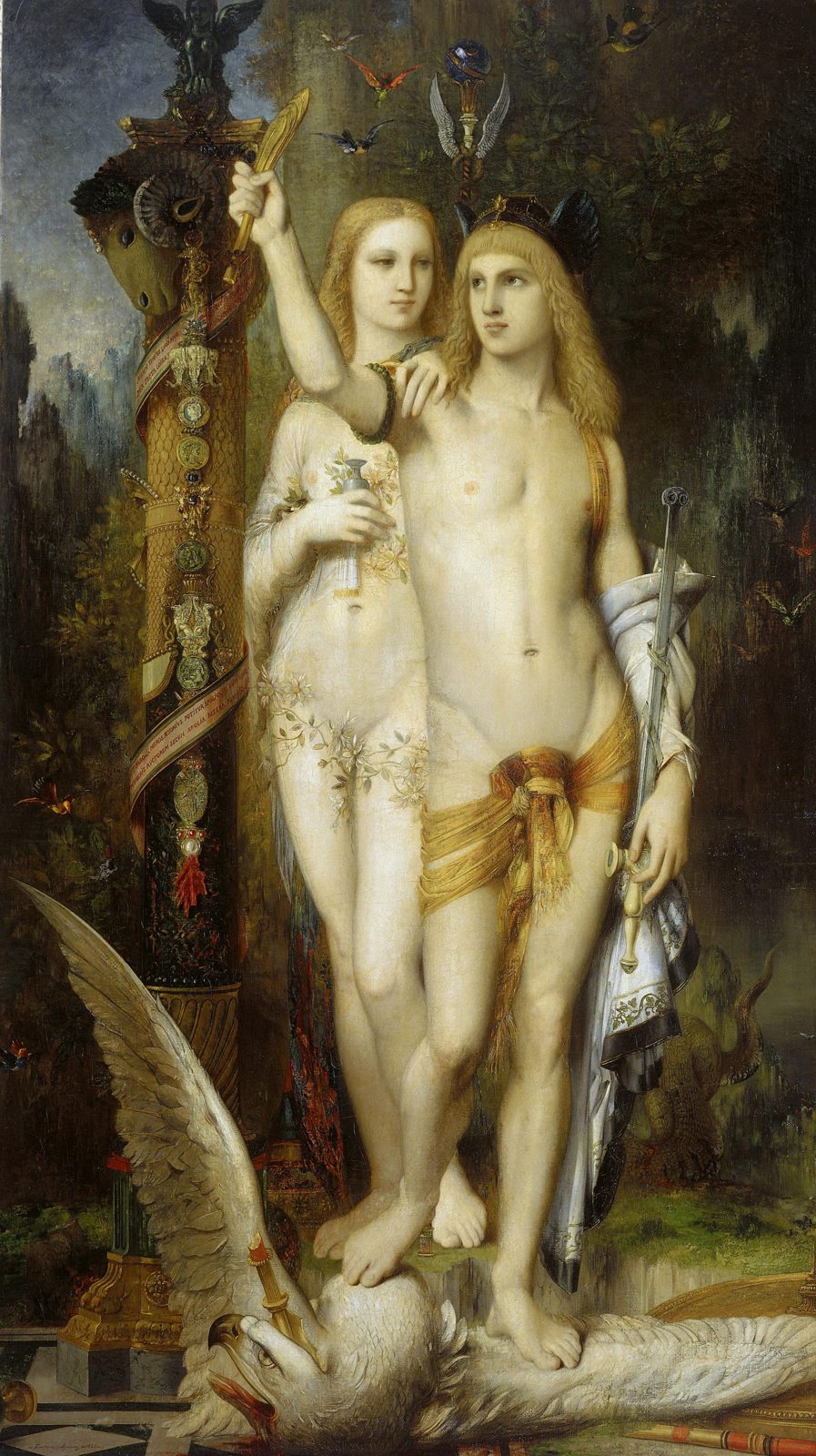
Take a moment to really look at "Jason" by Gustave Moreau. Notice how Jason stands triumphantly, almost bare, on the back of a white eagle, his right arm raised in victory. That piercing gaze he shares with Medea—do you feel the tension? It’s as if they’re caught in a moment of triumph and impending doom all at once.
Now, focus on the details: the dagger poised at Jason’s neck and the delicate vial in Medea’s hand. These elements are not just props; they symbolize the duality of their relationship. Medea’s potion helped Jason conquer the dragon, but it also hints at the darker path their love could take. This painting captures the essence of myth—where glory and tragedy are intertwined.
Created in 1865, this piece reflects Moreau's fascination with mythological themes, a hallmark of his Symbolist style. He invites us to explore deeper meanings behind the surface, urging us to question the nature of heroism and sacrifice.
As you stand here, think about this: What does victory mean if it comes at such a cost? How do you see the balance of power in their gaze? Let that linger as you move on.
Gustave Moreau, born on April 6, 1826, in Paris, was a pivotal figure in the Symbolist movement, celebrated for his intricate and mystical interpretations of biblical and mythological themes. His early education, influenced by his architect father and musician mother, fostered a deep appreciation for the arts. Moreau's artistic journey began at the École des Beaux-Arts, where he was mentored by François-Édouard Picot and later inspired by Théodore Chassériau.
His breakthrough came with the 1864 exhibition of "Oedipus and the Sphinx," which established his reputation. Moreau's work is characterized by rich detail and a unique blend of allegory and symbolism, earning him acclaim as the quintessential Symbolist painter. Despite his success, he became increasingly reclusive, rejecting numerous prestigious offers and exhibiting infrequently.
Moreau's legacy includes over 15,000 works, and he was instrumental in shaping the Symbolist aesthetic. His influence waned in the early 20th century but saw a resurgence in the 1960s, solidifying his status as a master of the movement. He passed away on April 18, 1898, leaving behind a vast collection of art that now resides in the Musée Gustave Moreau, a testament to his enduring impact on the art world.
Gustave Moreau's 'Jason' was unveiled in 1865 at the Salon des Artistes Français in Paris, where it was met with a mix of admiration and critique, typical for the artist's work. The painting quickly became a part of Moreau's legacy, showcasing his fascination with mythological themes. It later appeared at the 1900 Exposition Universelle, further solidifying its place in the art world. Over the years, 'Jason' passed through several notable collections, including that of Charles Ephrussi, before being donated to the public collection in 1908 by Théodore Reinach. This journey through various hands reflects the painting's growing recognition and importance, eventually finding its home at the Musée d'Orsay, where it continues to captivate audiences today.
In 'Jason', Moreau employs a vertical format that draws your eye upwards, emphasizing Jason's triumph. The brushwork is both meticulous and fluid, creating a sense of movement that contrasts with the stillness of the figures. Notice how the light plays across Jason's body, highlighting his muscular form while casting shadows that suggest depth and drama. The color palette is rich yet restrained, with the stark white of the eagle contrasting against the darker hues of Jason's skin and the subtle tones of Medea's gown. This choice enhances the tension between the characters, making their connection palpable. The composition is carefully structured, with Medea's figure positioned behind Jason, symbolizing her support yet also hinting at the darker implications of their bond. The inclusion of Ovid's text around the column adds layers of meaning, inviting viewers to ponder the narrative beyond the visual.
Did you know that Gustave Moreau was quite the reclusive artist? Despite his immense talent and the acclaim he received, he often turned down prestigious offers, including a chance to exhibit at the Salon Les XX in Brussels. This was a major opportunity for many artists, but Moreau preferred to work in his own world, focusing on his unique vision rather than chasing fame. His reluctance to sell his work and his choice to live a solitary life in his studio only add to the mystique surrounding his art.
Moreau's brushwork in 'Jason' is noted for its meticulousness combined with fluidity, creating a dynamic sense of movement that contrasts with the stillness of the figures, which is a hallmark of his Symbolist style.