The Birth of Venus
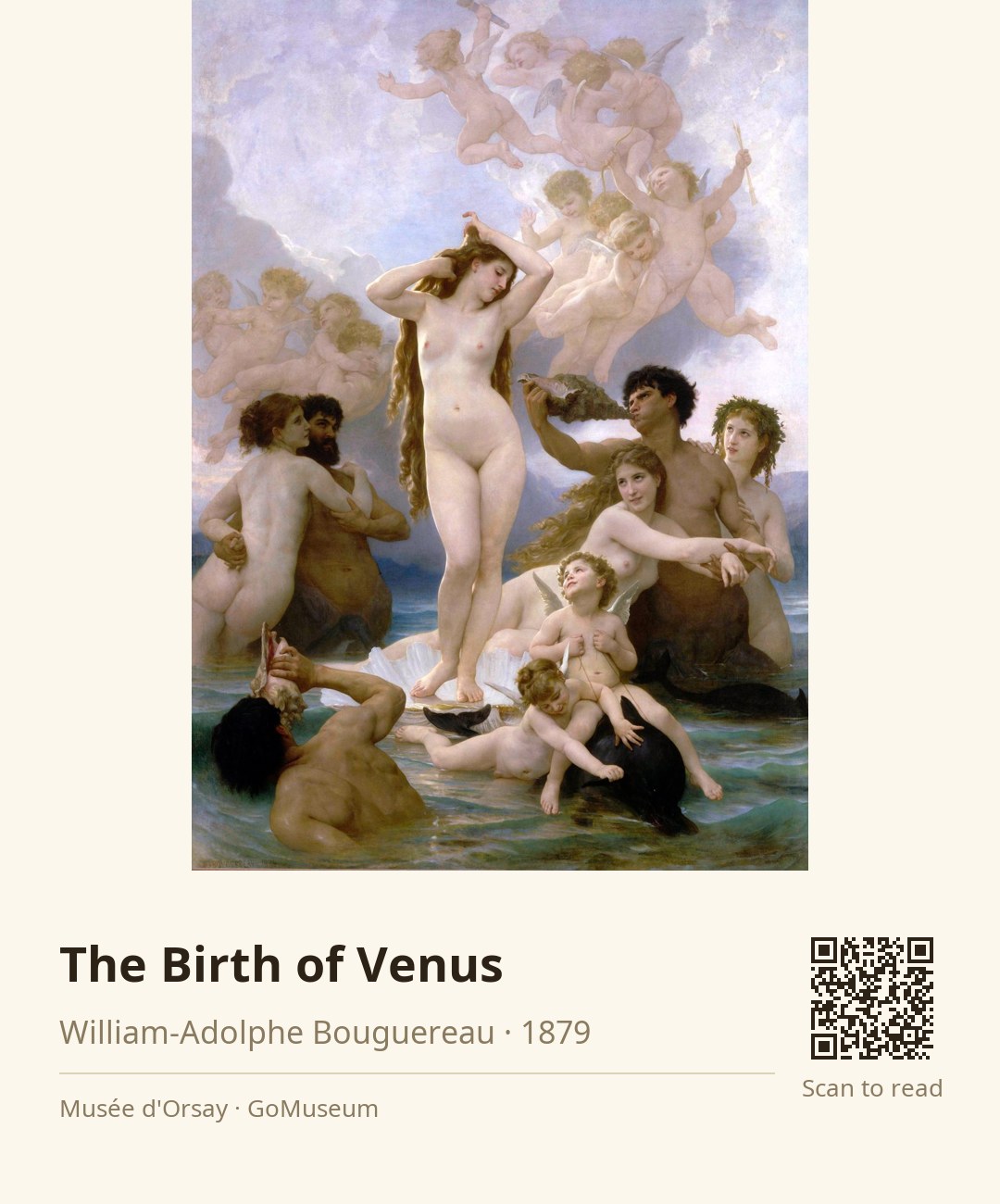
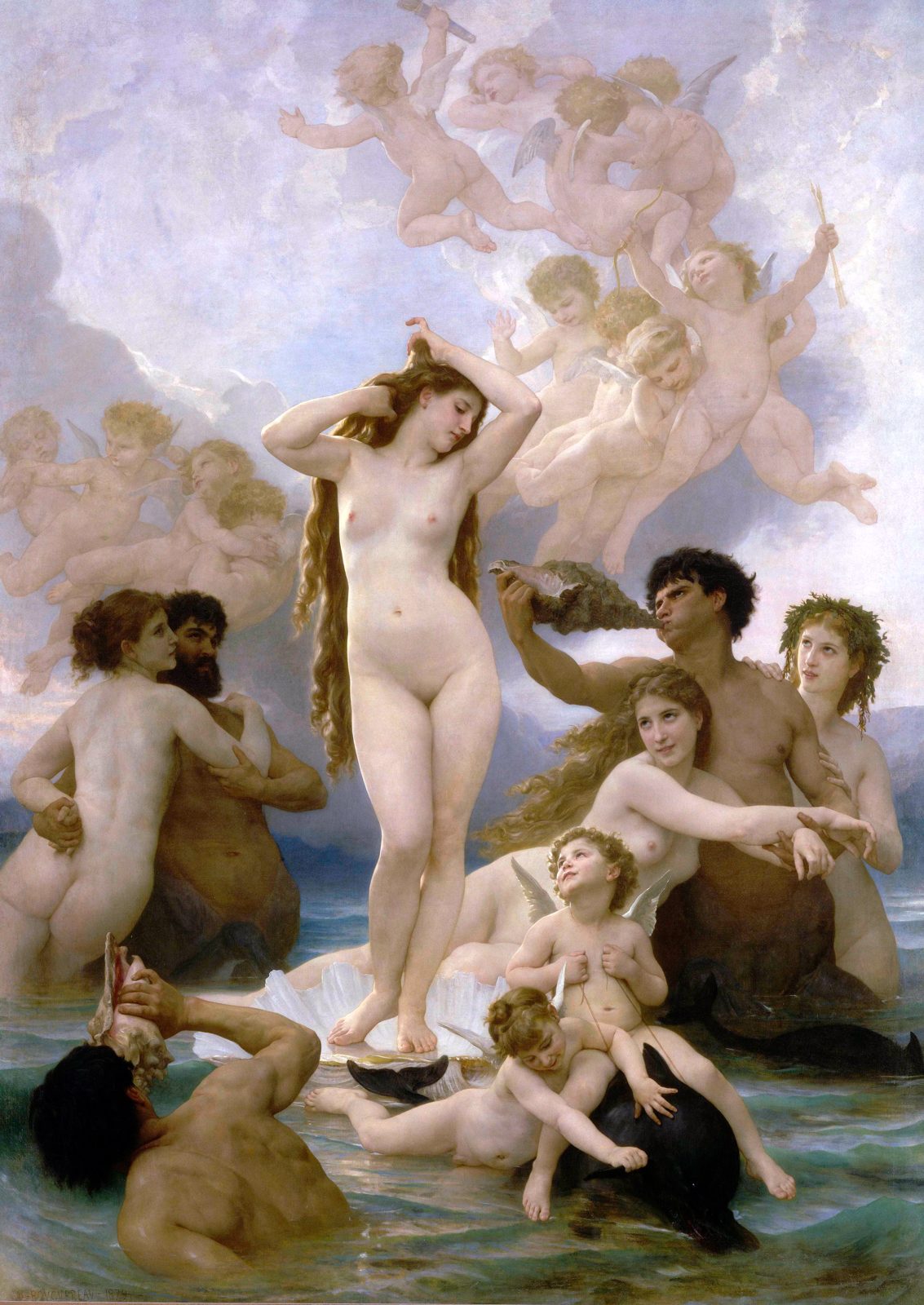
🎧 This work has audio narration — listen in the appAs you stand before "The Birth of Venus" by William-Adolphe Bouguereau, take a moment to really look at Venus herself. Notice how she stands confidently on that scallop shell, her arms gracefully raised as if she’s just emerged from the sea, embodying an ideal of beauty that’s both timeless and captivating. Now, focus on the way her hair flows—those luscious, thigh-length locks cascading down her back, almost dancing with the gentle waves. This isn’t just a hairstyle; it’s a symbol of her femininity and allure, meticulously crafted to draw your eye and evoke admiration. Bouguereau’s attention to detail here is extraordinary, capturing every strand with a lifelike quality that makes you feel as if you could reach out and touch it. Well, Bouguereau was a master of the academic style, and in this painting, he’s not just depicting a mythological figure; he’s celebrating the female form in a way that echoes the classical ideals of beauty from ancient Greece and Rome. Venus, in her serene nudity, represents an ideal that many artists aspired to but few achieved with such finesse. Created in 1879, this piece showcases Bouguereau's skill at blending myth with realism, a hallmark of his work that made him a household name in the art world of his time. Despite facing criticism from the avant-garde, his paintings, including this one, were immensely popular, especially in America. As you take in the scene, consider this: What does Venus’s calm demeanor say about our own perceptions of beauty and confidence? How does her story resonate with the ideals we hold today? Let that linger in your mind as you move on to the next artwork.
William-Adolphe Bouguereau was a prominent French academic painter born on November 30, 1825, in La Rochelle. He grew up in a family of merchants and developed a passion for art at a young age. Bouguereau studied at the École des Beaux-Arts and won the prestigious Prix de Rome in 1850, which allowed him to immerse himself in the classical art of Italy. His work, characterized by realistic depictions of mythological themes and the female form, gained immense popularity in France and the United States during his lifetime.
Despite his success, he faced criticism from the Impressionist movement, which deemed his style overly traditional. By the early 20th century, changing tastes led to a decline in his popularity, but a revival in the 1980s rekindled interest in his work. Bouguereau completed 822 known paintings, many of which remain lost. His legacy as a master of academic painting endures, particularly for his sensitive portrayals of women and children, marking him as a significant figure in art history. He passed away on August 19, 1905, leaving behind a complex legacy that continues to provoke discussion and admiration.
The Birth of Venus, painted by William-Adolphe Bouguereau in 1879, was unveiled at the Paris Salon the same year, where it quickly became a focal point of discussion. Bouguereau, a prominent figure in the academic art scene, created this piece as a modern interpretation of the classical myth of Venus emerging from the sea. Interestingly, the figure of Venus in this work was inspired by a previous character from Bouguereau's own painting, The Nymphaeum, completed just a year earlier. This connection highlights Bouguereau's evolving artistic vision. The reception of the painting was mixed; while it showcased Bouguereau's technical prowess and idealized beauty, it also drew criticism from contemporary artists and critics, particularly from the Impressionist movement, who viewed his style as overly polished and lacking in emotional depth. Despite the backlash, Bouguereau enjoyed significant popularity during his lifetime, especially among American collectors, and his works were often sought after. Today, The Birth of Venus resides in the Musée d'Orsay in Paris, a testament to its lasting impact and the artist's legacy.
As you gaze at 'The Birth of Venus', notice the extraordinary brushwork that Bouguereau employs. His technique is meticulous, with each stroke contributing to the lifelike quality of Venus's skin. The smooth transitions between light and shadow create a three-dimensional effect, making her figure almost leap off the canvas. The color palette is rich yet delicate, with soft pastels that evoke a sense of ethereal beauty. Bouguereau's use of contrapposto in Venus's pose not only emphasizes her femininity but also adds a dynamic quality to the composition. The way her hair flows and the gentle curves of her body draw your eye across the painting, guiding you from the scallop shell to the surrounding putti and nymphs. The scale of the canvas, towering at nearly ten feet, amplifies the grandeur of the scene, making Venus appear as a goddess descending from the heavens. This careful orchestration of elements creates an immersive experience, inviting you to lose yourself in the mythological narrative.
One intriguing detail about 'The Birth of Venus' is the shadowy figure that appears in the clouds to the upper left of the painting. It’s a playful nod to the artist's presence within his own work, suggesting that he is not just an observer but an integral part of the mythological narrative he has created.
The model for Venus was Marie Georgine, born Princess de Ligne, who also posed for other works by Bouguereau, including 'The Abduction of Psyche'.
In the upper-left corner of the painting, there is a shadowy figure that resembles the artist himself, suggesting Bouguereau's playful inclusion of his own presence within the mythological scene.