Portrait of Monsieur and Madame Auguste Manet
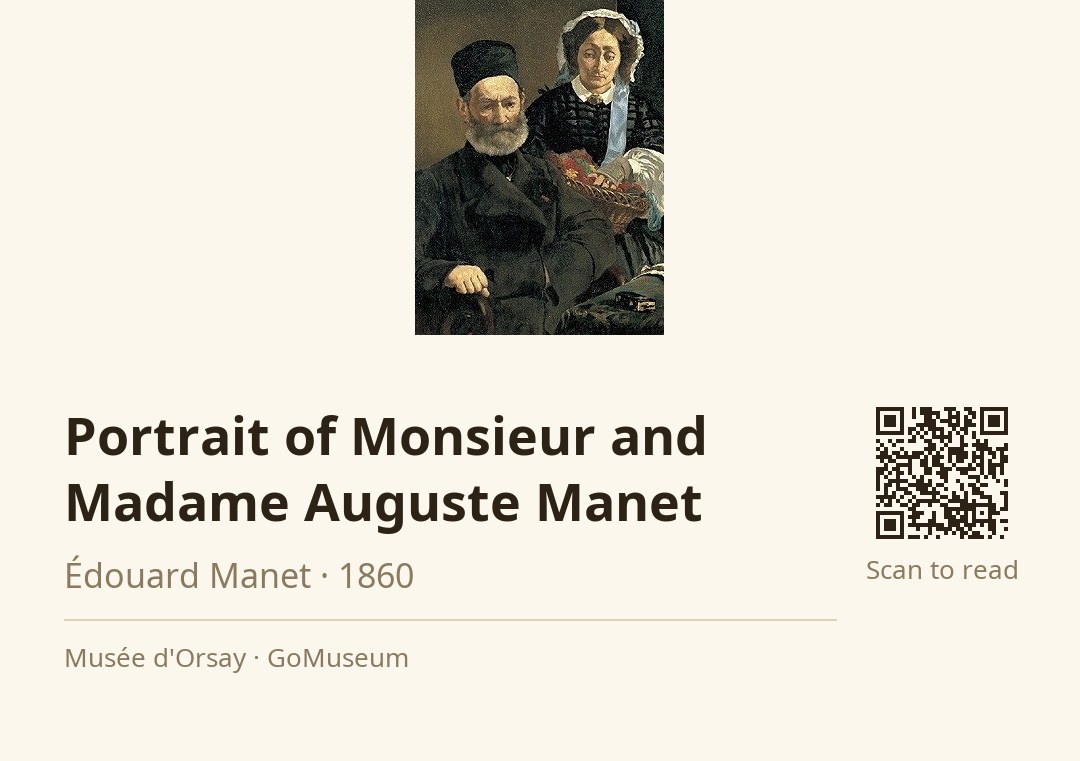
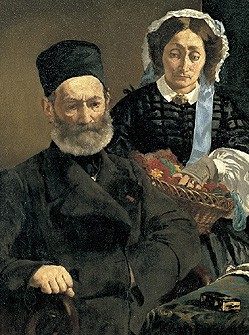
🎧 This work has audio narration — listen in the appTake a moment to really look at this portrait of Monsieur and Madame Auguste Manet. Notice how both figures are dressed in somber black, their expressions a mix of solemnity and introspection. The way Auguste sits, slightly slumped in his chair, while Eugénie stands with a basket of flowers, creates a poignant contrast between them.
These details matter because they reveal more than just the subjects’ appearances; they reflect the emotional weight of their lives. Auguste, a retired magistrate, is captured in a moment of vulnerability, while Eugénie's stance hints at her role as a caretaker, perhaps even a source of strength for her husband. This duality speaks to the complexities of family life and the pressures of societal expectations in the 19th century.
Manet painted this piece in 1860, during a time when he was still establishing his identity as an artist, stepping away from the conventional paths his family had envisioned for him. The portrait was first shown at the Paris Salon in 1861, where it received mixed reviews, but it was a crucial step in Manet's journey toward modernism.
As you take in this artwork, think about the stories behind the faces. What emotions do you see reflected in their expressions? How does this portrait resonate with your own experiences of family and connection?
Édouard Manet, born on January 23, 1832, in Paris, emerged as a pivotal figure in 19th-century art, bridging Realism and Impressionism. From an affluent family, he initially faced pressure to pursue a naval career but instead dedicated himself to painting, influenced by his uncle and the Old Masters. His early works, including "The Luncheon on the Grass" and "Olympia," sparked controversy and challenged traditional artistic norms, marking him as a revolutionary force.
Manet's style, characterized by loose brushwork and a focus on contemporary life, diverged from the meticulous techniques of his predecessors. He often depicted modern Parisian scenes, capturing the essence of leisure and social dynamics. Despite initial rejection from the art establishment, he gained recognition among progressive artists and became a mentor to the Impressionists.
Throughout his life, Manet formed connections with influential figures like Baudelaire and Zola, who defended him against critics. His later works, such as "A Bar at the Folies-Bergère," showcased his evolving style and mastery of color. Manet's contributions to art history are profound; he is celebrated not only for his innovative techniques but also for elevating still life and modern subjects to the forefront of artistic expression. He passed away on April 30, 1883, leaving behind a legacy that continues to inspire artists today.
Édouard Manet's 'Portrait of Monsieur and Madame Auguste Manet' was painted in 1860, a pivotal moment in his artistic journey. This portrait, featuring his parents, was first exhibited at the Paris Salon in 1861, where it received a mixed reception. Critics were often perplexed by Manet's departure from traditional portraiture, which contributed to the controversy surrounding his work. Initially owned by Manet's brother Eugène, the painting later passed to Julie Manet, the artist's niece, before being donated to the French state in 1977. It found its home at the Musée d'Orsay in 1985, where it remains today, a testament to Manet's evolving legacy and the shifting tastes in art over the decades.
As you gaze at this portrait, consider the way Manet's brushwork captures the essence of his subjects. The loose, expressive strokes create a sense of immediacy, almost as if the figures could step out of the canvas at any moment. The somber black attire of Monsieur and Madame Manet contrasts sharply with the vibrant colors of the flowers Eugénie holds, drawing your eye to her figure. Notice how the composition balances their postures: Auguste's slumped position suggests weariness, while Eugénie's upright stance conveys resilience. This interplay of light and shadow adds depth, enhancing the emotional weight of the scene.
Painted in 1860, this work represents Manet's early departure from traditional portraiture, setting the stage for the radical changes that would follow in the art world. While it was initially met with mixed reviews, it influenced a generation of artists who were eager to break free from the constraints of academic painting. Manet's candid portrayal of his parents, with their somber expressions and everyday attire, challenged the norms of idealized representation, paving the way for the Impressionists and their focus on modern life. Remember, this painting is not just about Manet's family; it's a reflection of the changing tides in art, where the personal became political and the mundane became magnificent.
One intriguing aspect of this portrait is that it was painted during a time when Manet's parents were concerned about his career choice. They worried he had strayed too far from the respectable paths of law or naval service, which they had envisioned for him. This painting served as a reassurance to them, showcasing his talent and commitment to his art, even as it diverged from their expectations.
In the foreground, there is a small missal with marked pages and a weaving tool on the table, which hints at the couple's domestic life and interests, adding depth to their portrayal.
This portrait served as a reassurance to Manet's parents, who were worried about his choice to pursue art instead of a more conventional career, showcasing his commitment to his craft during a time of familial concern.