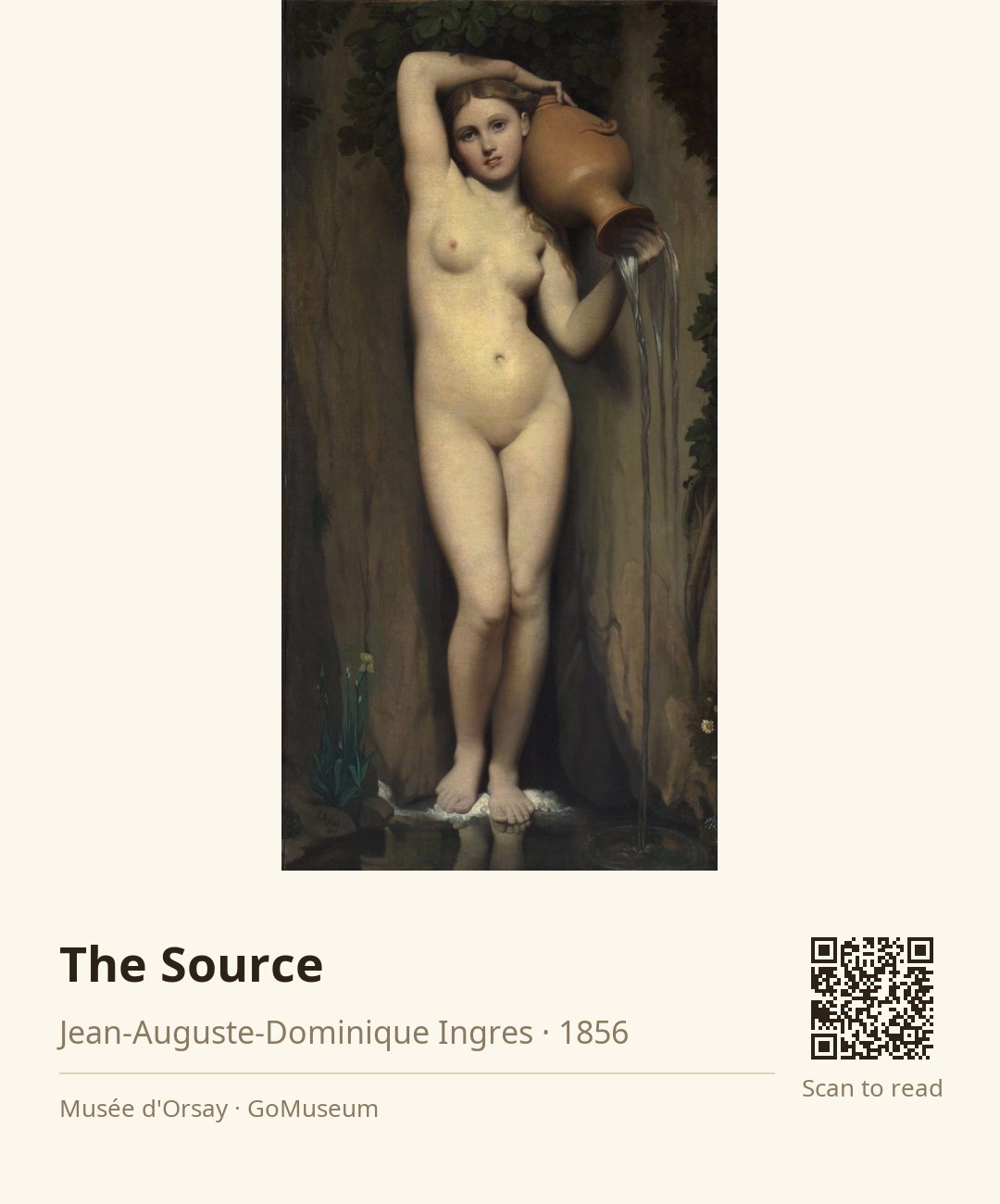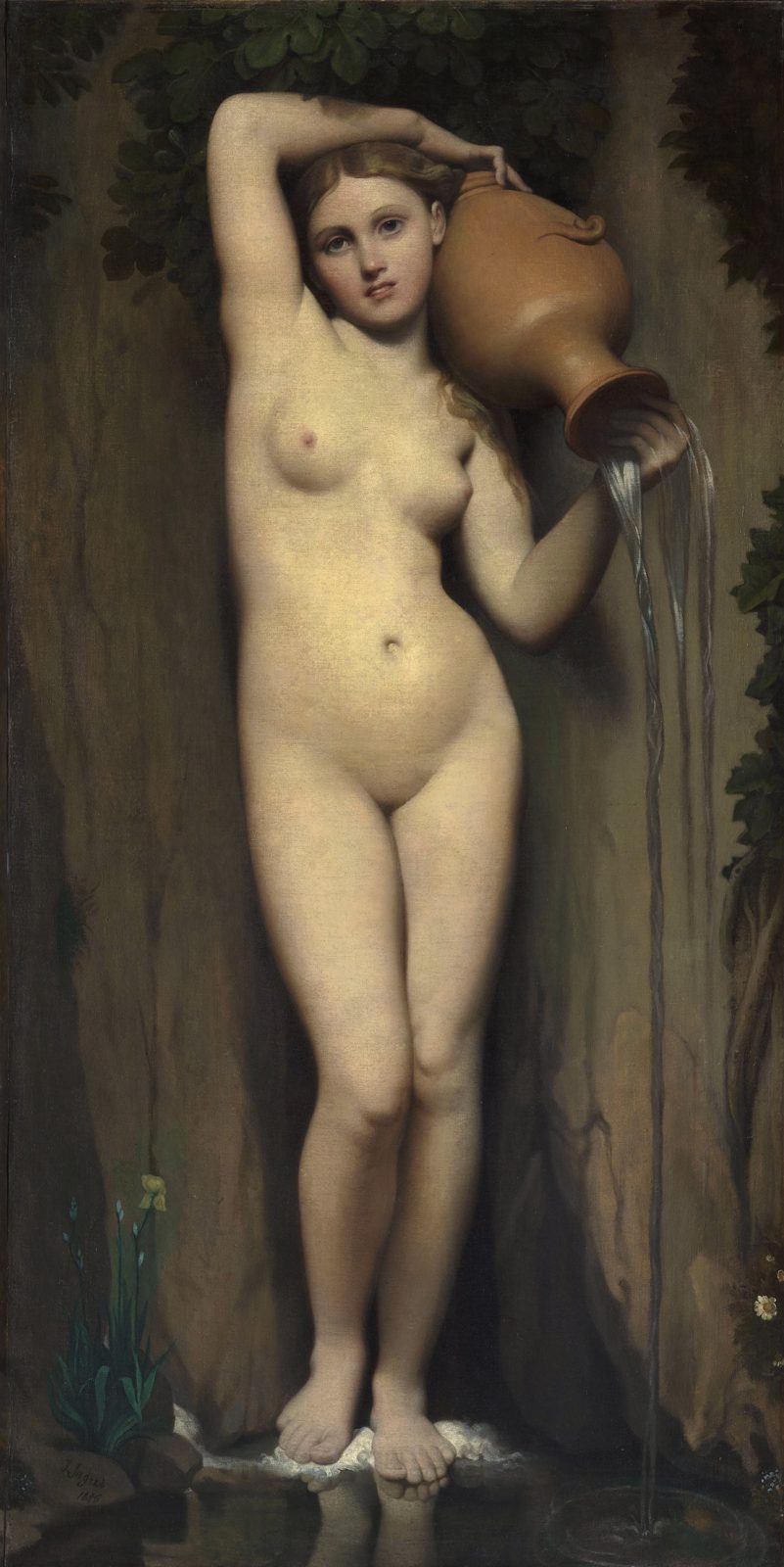
Take a moment to really look at "The Source" by Ingres. Notice how the woman stands confidently, her body elegantly curved, as she pours water from a pitcher. The way the water cascades down creates a sense of movement, almost as if it’s alive, separating her from the viewer. This flowing water symbolizes not just a physical source, but also the wellspring of creativity and inspiration, linking her to the Muses of classical mythology. The flowers framing her add a layer of vulnerability, hinting at the delicate balance between beauty and desire. Ingres, known for his neoclassical style, captures this tension beautifully, reminding us that nature and femininity are intertwined. Completed in 1856, at the age of seventy-six, Ingres was already a celebrated figure in the art world, yet he continued to explore themes of beauty and inspiration. As you stand here, consider what this figure represents to you. Does she evoke a sense of tranquility, or perhaps a deeper contemplation on the relationship between nature and femininity? Let her presence linger in your thoughts as you move through the museum.
Jean-Auguste-Dominique Ingres was a pivotal figure in French Neoclassicism, born on August 29, 1780, in Montauban. He was the son of a versatile artist, which nurtured his early artistic inclinations. Ingres studied under Jacques-Louis David in Paris, where he developed a commitment to academic traditions, aspiring to elevate history painting above all genres. His early career was marked by struggles, as critics dismissed his style as archaic, yet he persevered, achieving recognition with works like "The Vow of Louis XIII" in 1824.
His portraits, characterized by expressive distortions, became his most celebrated contributions, influencing modern artists such as Matisse and Picasso. Ingres's time in Italy, from 1806 to 1824, was crucial; he immersed himself in the study of Renaissance masters, which shaped his distinctive style. Despite facing criticism for his meticulous approach, he remained steadfast in his vision of beauty, emphasizing drawing over color.
Later in life, he returned to Paris, where he continued to create significant works, including "The Turkish Bath." Ingres's legacy endures as a bridge between classical traditions and modern art, embodying the tension between adherence to established norms and the evolving landscape of artistic expression. He passed away on January 14, 1867, leaving behind a profound impact on the art world.
Completed in 1856, 'The Source' was first shown in a private exhibition at Ingres' studio in Paris. The painting quickly garnered attention and was acquired by Count Charles-Marie Tanneguy Duchâtel for a staggering 25,000 francs just a year later. This marked a significant moment in Ingres' career, as he was already an established artist at seventy-six, serving as the president of the École des Beaux-Arts. The painting then made its way to the Louvre in 1878 before being transferred to the Musée d'Orsay in 1986. Its reception was overwhelmingly positive, with critics praising it as a defining work of Ingres' legacy. Notably, the model for 'The Source' was the young daughter of Ingres' concierge, which adds a layer of personal history to this celebrated piece.
As you gaze at 'The Source', take a moment to appreciate Ingres' meticulous technique. The brushwork is smooth and deliberate, creating a polished surface that enhances the figure's elegance. Notice how the light dances across the woman's skin, highlighting her curves and creating a lifelike quality. Ingres employs a vertical composition, drawing your eye upward along the figure's graceful form, while the flowing water acts as a dynamic element that separates her from the viewer. The use of color is equally striking; the soft, natural hues of her skin contrast beautifully with the vibrant greens of the ivy and flowers. This careful balance of color and form not only showcases Ingres' skill but also evokes a sense of harmony between the figure and her natural surroundings.
A surprising tidbit about 'The Source' is that Ingres' model, the daughter of his concierge, faced a tragic fate; she reportedly died young due to drink and disease. This stark reality contrasts sharply with the idealized beauty captured in the painting, raising questions about the relationship between art and the lives of those who inspire it.
Two of Ingres' students, Paul Balze and Alexandre Desgoffe, assisted in creating the background and the water jar for 'The Source', showcasing the collaborative nature of artistic production during that era.
The model for 'The Source', the daughter of Ingres' concierge, faced a tragic fate, reportedly dying young from drink and disease, which contrasts sharply with the idealized beauty depicted in the painting and raises questions about the relationship between art and the lives of its subjects.
'The Source' was prominently displayed in several exhibitions, including the Exposition Universelle in London in 1862 and the École impériale des Beaux-Arts in Paris in 1867, highlighting its significance in the art world and its lasting legacy.