The Birth of Venus
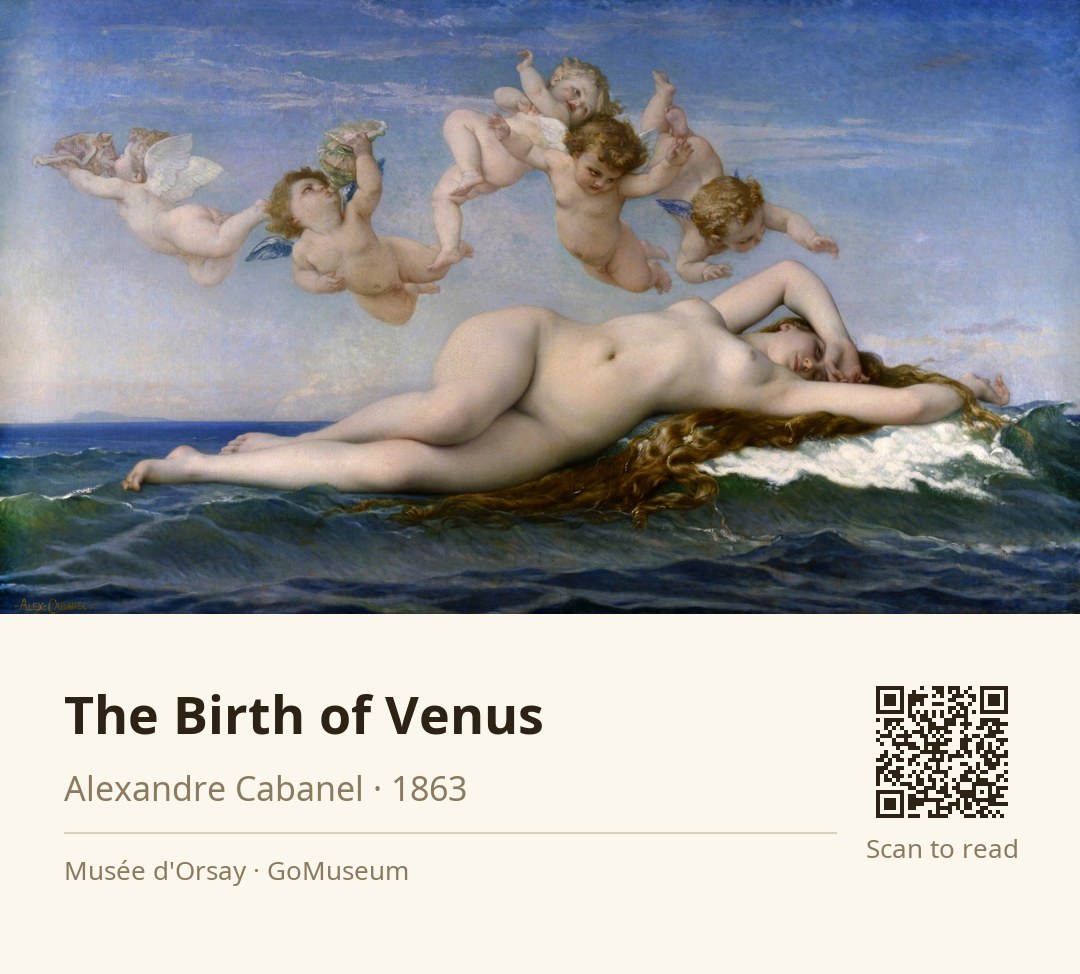
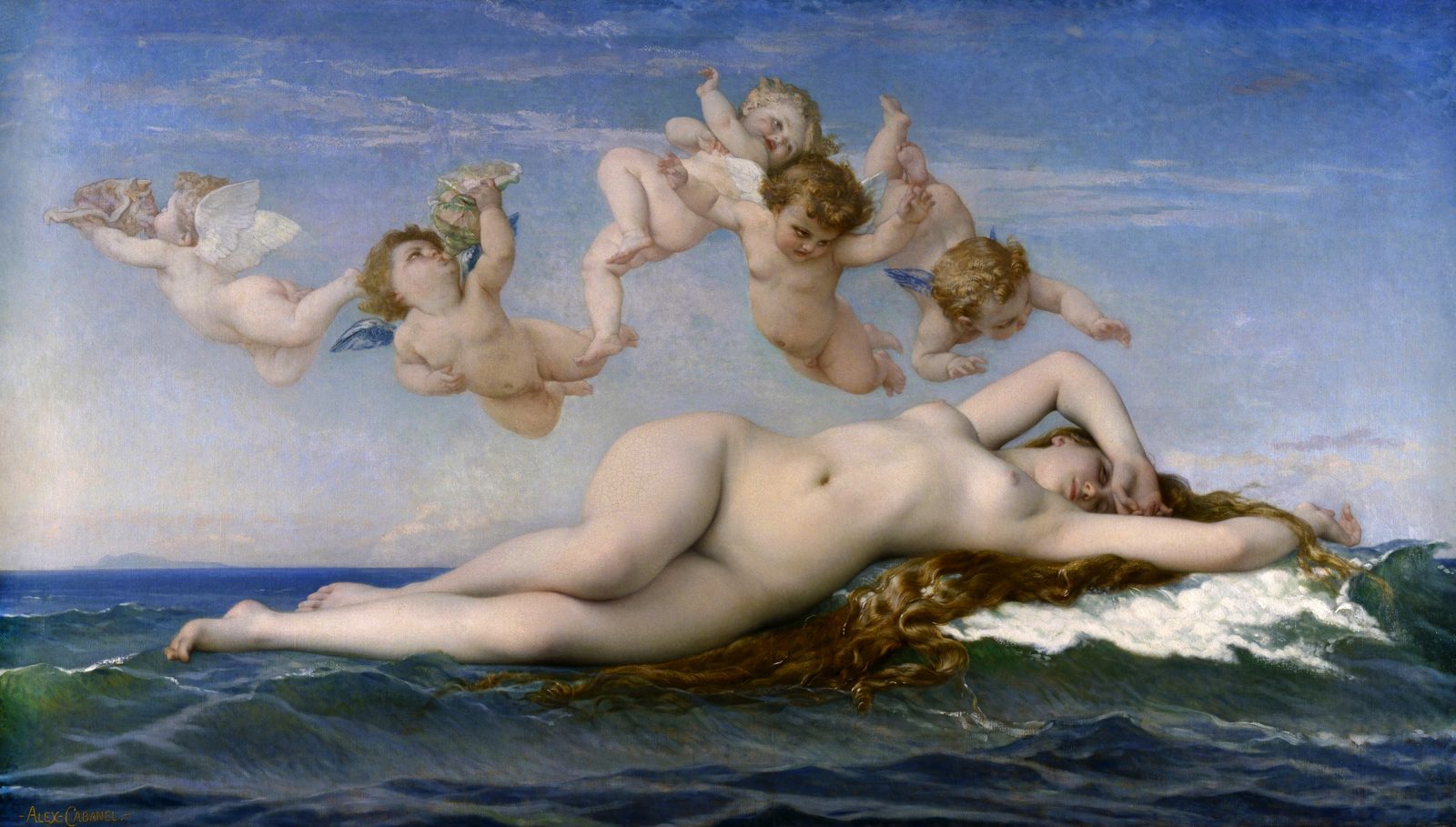
🎧 This work has audio narration — listen in the appTake a moment to really look at "The Birth of Venus" by Alexandre Cabanel. Notice how Venus emerges from the waves, her skin glowing with a soft, almost ethereal light. The way her hair cascades around her shoulders, mingling with the foam, creates a sense of movement that draws your eye across the canvas. These details matter because they embody the ideal of beauty that Cabanel was celebrated for during his time. The opalescent colors and delicate brushwork not only highlight Venus’s divine femininity but also reflect the academic style that was in vogue in the 19th century. This painting was a sensation at the 1863 Salon, instantly purchased by Napoleon III, which speaks volumes about its impact and the allure of its subject. Cabanel was a master of mythological themes, and this work exemplifies the tension between classical ideals and the emerging modernity of his era. While other artists were pushing boundaries, Cabanel’s Venus remained a vision of traditional beauty, captivating audiences with her serene yet enigmatic expression. As you stand here, consider how this painting challenges your own perceptions of beauty and femininity. What does Venus represent to you in today’s world?
Alexandre Cabanel was a prominent French painter born on September 28, 1823, in Montpellier. He emerged from humble beginnings as the son of a carpenter, beginning his artistic journey at the Montpellier School of Fine Arts before moving to Paris in 1839. There, he studied at the École des Beaux-Arts under François-Édouard Picot. Cabanel's career flourished as he became known for his historical, classical, and religious subjects, as well as his exquisite portraiture. His most famous work, "The Birth of Venus," showcased his mastery of the academic style and was acquired by Napoleon III, solidifying his status as a leading artist of the Second Empire.
Cabanel was deeply involved in the art community, serving as a member of the Salon jury and later as a professor at the École des Beaux-Arts. His influence shaped the direction of French painting during the belle époque. Despite facing criticism from modernists like Émile Zola and Joris-Karl Huysmans, he defended innovative works, showcasing his commitment to the evolving art scene. Cabanel passed away on January 23, 1889, leaving behind a legacy marked by both admiration and controversy, and his contributions continue to be celebrated in art history.
The Birth of Venus was unveiled at the Salon of 1863, where it quickly became a sensation. Commissioned by Napoleon III, it was purchased for a staggering 20,000 francs, a testament to its immediate acclaim. The painting was hung in the Élysée Palace in 1865 and later moved to the Luxembourg Palace in 1870. After the fall of the Empire, it was reserved for the state and eventually entered the collections of the Luxembourg Museum in 1923, before finding its home at the Musée d'Orsay in 1978. Cabanel, who had trained under François-Édouard Picot at the École des Beaux-Arts, was already a celebrated artist by this time, known for his mythological themes and portraits. His work was both adored and critiqued, particularly by contemporaries like Émile Zola, who dismissed it as overly idealized. Yet, Cabanel's Venus captivated audiences, embodying the grace and beauty that the conservative French Salon valued, even as modern artists began to challenge these ideals.
As you gaze at The Birth of Venus, take note of Cabanel's masterful brushwork. The delicate, almost silky strokes create a sense of softness in Venus's skin, enhancing her ethereal quality. The opalescent colors, particularly the subtle pinks and whites, give her an almost otherworldly glow, as if she is emerging from the very foam of the waves. The composition is carefully structured, with Venus positioned centrally, drawing your eye immediately to her serene expression. The gentle curves of her body contrast with the dynamic movement of the waves, creating a tension that feels both tranquil and alive. Notice how the light plays across her form, highlighting the contours and lending depth to the painting. This careful manipulation of light and color not only showcases Cabanel's technical skill but also evokes a dreamlike quality that invites viewers to linger.
Cabanel's *The Birth of Venus* is a striking embodiment of academic art that not only captivated audiences in its time but also set the stage for future artistic dialogues. When it debuted at the Salon of 1863, it was a resounding success, purchased by Napoleon III himself. This painting's lush, sensual depiction of Venus marked a high point in the academic tradition, showcasing the idealized beauty that the French Salon championed. Yet, it also sparked conversations about the role of the female nude in art. Critics like Émile Zola viewed Cabanel's work as a polished facade, contrasting sharply with the emerging realism of artists like Manet. Thus, while Cabanel's Venus was celebrated for its beauty, it also highlighted the tensions between traditional and modern approaches in art, influencing generations to come. Remember this: Cabanel's work didn't just reflect the past; it challenged the future of artistic expression.
One fascinating tidbit about 'The Birth of Venus' is that it was an instant sensation at the Salon of 1863, so much so that it caught the eye of none other than Napoleon III. He purchased the painting for a whopping 20,000 francs, which was a significant sum at the time. This immediate acclaim not only secured Cabanel's reputation but also marked a pivotal moment in his career, as he was soon appointed a professor at the prestigious École des Beaux-Arts. Imagine the thrill of an artist seeing their work go from the gallery walls to the grand halls of power!
Cabanel came from humble beginnings as the son of a carpenter, which instilled in him a strong work ethic and ambition. His early training at the Montpellier School of Fine Arts and later at the École des Beaux-Arts under François-Édouard Picot shaped his academic style, emphasizing classical beauty and technique.
Cabanel was a prominent member of the Salon jury for many years, influencing which artworks were accepted for exhibition. His conservative tastes often clashed with emerging modernist movements, and his refusal to accept works by artists like Édouard Manet led to the establishment of the Salon des Refusés, marking a significant moment in art history.