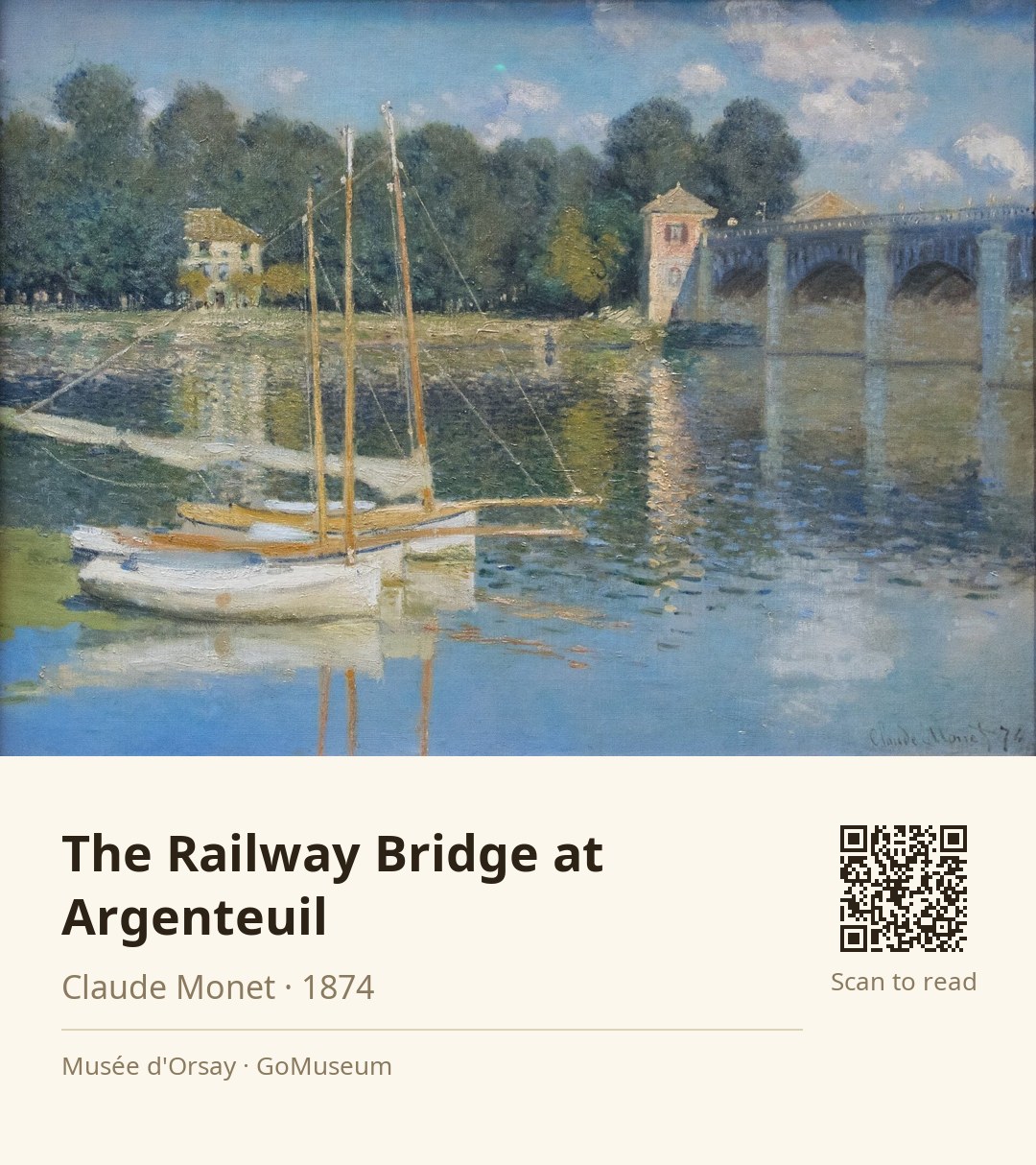
The Railway Bridge at Argenteuil
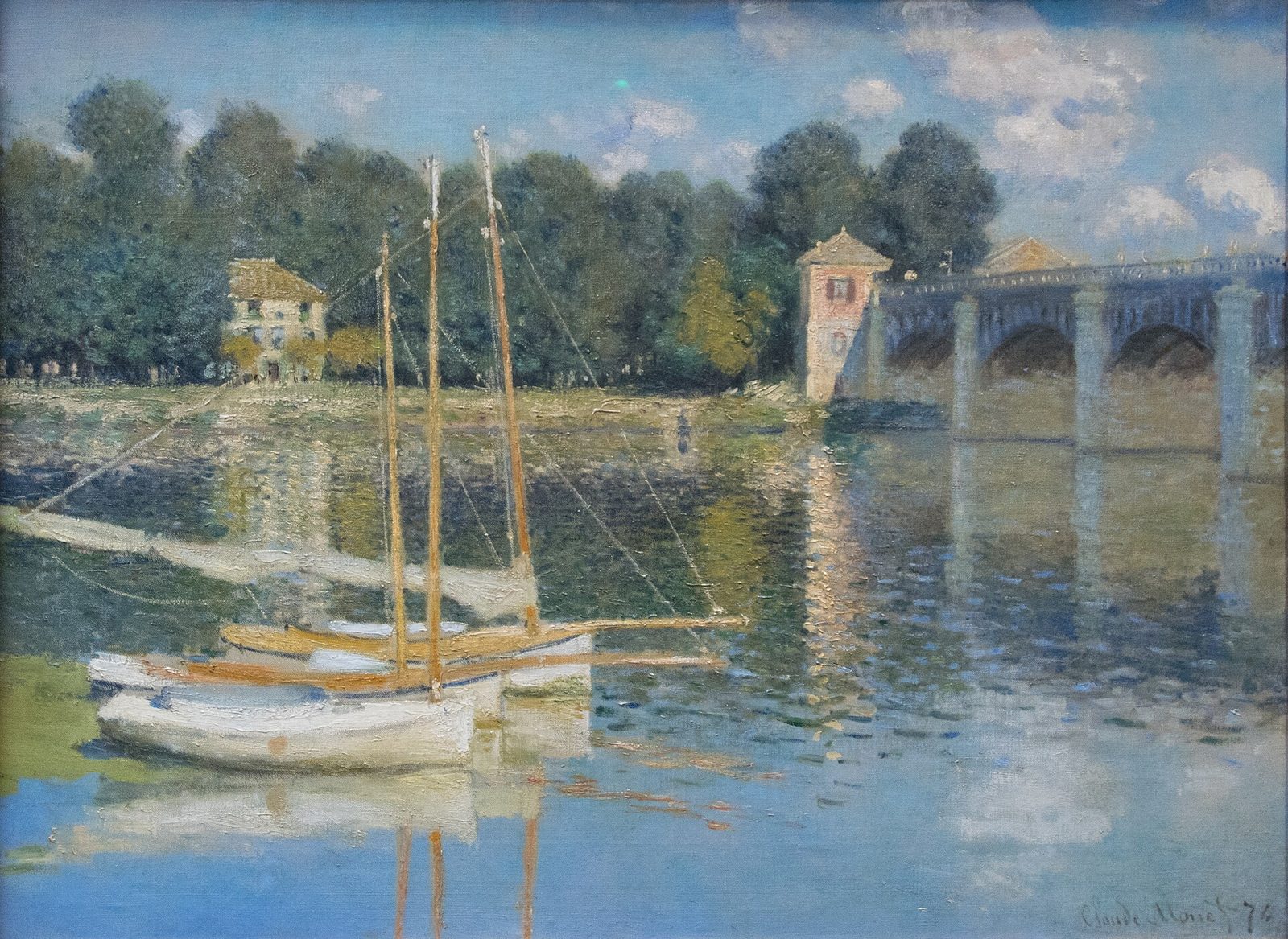
🎧 This work has audio narration — listen in the appTake a moment to really soak in the scene before you. Monet’s "The Railway Bridge at Argenteuil" captures a lively moment along the Seine, where the interplay of water and light dances across the canvas. Notice how the vibrant blues and greens pop against the soft, hazy background. Look closely at the bridge itself—those delicate arches seem to almost shimmer, don’t they?
These details matter because they embody Monet’s revolutionary approach to capturing the essence of a moment. Instead of focusing on fine details, he emphasizes the feeling of the scene, the fleeting effects of light and atmosphere. This was a radical departure from traditional painting, marking the birth of Impressionism, a movement that sought to express perception rather than reality.
Painted in 1874, this piece was showcased at the second Impressionist exhibition just two years later, a bold statement from an artist who was still finding his voice. Monet was not just painting a bridge; he was inviting viewers to experience the world as he saw it—alive, dynamic, and ever-changing.
As you stand here, think about what it would have been like to witness this vibrant riverside scene in the 19th century. What stories do you think the people in the boats could tell?
Oscar-Claude Monet, born on November 14, 1840, in Paris, was a pioneering French painter and a founder of Impressionism, a movement that transformed the art world. Raised in Le Havre, he developed a passion for nature and painting early on, encouraged by his mother, while his father hoped he would pursue a business career. After his mother's death in 1857, Monet moved in with his aunt, who supported his artistic ambitions.
Monet's career began with caricatures, but he soon sought formal training, studying under Eugène Boudin, who introduced him to plein air painting. His breakthrough came in 1866 with "La Femme à la robe verte," which garnered attention at the Salon. The term "Impressionism" originated from his work "Impression, Sunrise," exhibited in 1874, marking a shift away from traditional art.
Throughout his life, Monet focused on capturing the essence of light and color in nature, creating series of paintings that depicted the same scenes under varying conditions, such as his famous haystacks and water lilies. He settled in Giverny in 1883, where he cultivated a beautiful garden that became his muse. Despite personal hardships, including the loss of loved ones and health issues, Monet's relentless dedication to his craft solidified his place in art history as a master of modernism, influencing countless artists and leaving a lasting legacy. He died on December 5, 1926, in Giverny, celebrated as one of the most significant figures in art.
This painting, titled 'The Railway Bridge at Argenteuil,' was created by Claude Monet in 1874 and first showcased to the public at the Second Impressionist Exhibition in Paris in 1876. The artwork was commissioned by Jean-Baptiste Faure, a famous baritone, who acquired it directly from Monet through Édouard Manet. Over the years, it passed through several hands, including the Galerie Durand-Ruel in 1906 and Antonin Personnaz, before being bequeathed to the national museums in 1935. It was officially assigned to the Louvre in 1937 and later moved to the Musée d'Orsay in 1986. The painting has been featured in numerous exhibitions, including the Universal Exposition in Paris in 1900 and a dedicated Monet exhibition at the Orangerie in 1931. However, it faced a shocking incident of vandalism in 2007 when a visitor punched the canvas, causing significant damage. This event sparked discussions about the security of cultural treasures, highlighting the ongoing challenges museums face in protecting their collections.
As you gaze at this painting, take note of Monet's masterful brushwork. The strokes are loose and fluid, creating a sense of movement that mirrors the lively scene along the Seine. The vibrant blues and greens are not just colors; they pulse with life, capturing the shimmering reflections on the water's surface. Monet's technique of applying paint directly onto the canvas without extensive underdrawing allows for an immediacy that feels almost spontaneous. The composition draws your eye towards the bridge, with its delicate arches framed by the lush greenery and the boats at rest. This interplay of light and shadow, achieved through quick, dappled brushstrokes, evokes the transient nature of the moment, inviting you to experience the scene as Monet did—a fleeting glimpse of beauty.
In a surprising twist of fate, 'The Railway Bridge at Argenteuil' was vandalized in 2007 during a chaotic night at the Musée d'Orsay. A group of intoxicated individuals broke into the museum and, in a moment of panic, one of them punched the painting, leaving a ten-centimeter tear in the canvas.
The scene captures the bustling activity along the Seine, particularly at Argenteuil, which was a popular sailing destination in the 19th century. This area hosted numerous regattas during the Universal Expositions, making it a vibrant hub for leisure and social gatherings.