The White Horse
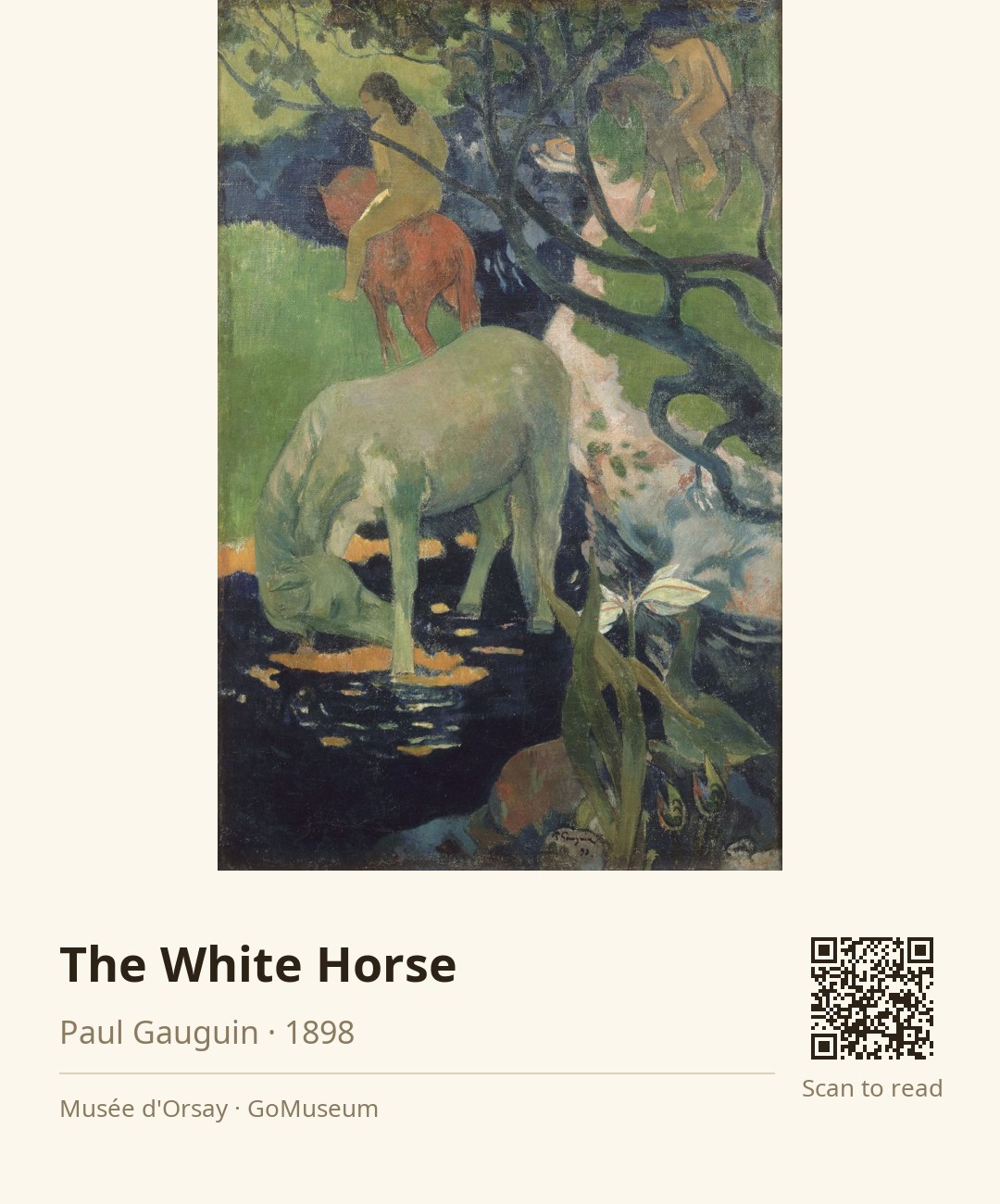
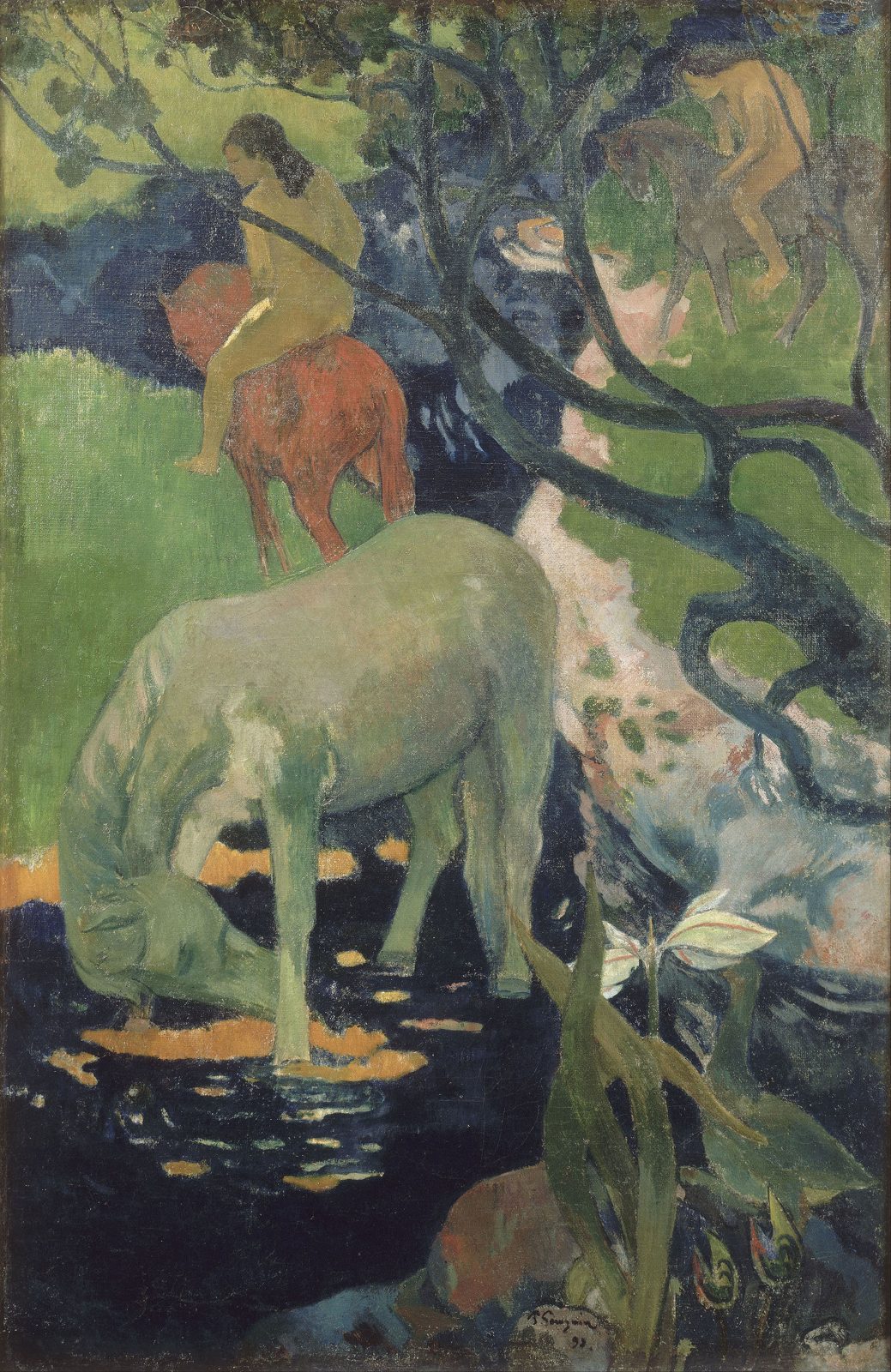
🎧 This work has audio narration — listen in the appTake a moment to really look at "The White Horse" by Paul Gauguin. Notice how the horse, with its strikingly greenish hue, stands out against the lush backdrop of Tahiti. It’s almost as if the horse is a part of the landscape itself, merging with the vibrant greens and blues of the river and foliage.
This choice of color is not just a stylistic whim; it reflects Gauguin's desire to convey a deeper symbolism. In Tahitian culture, the color white is often associated with the divine and the spiritual realm, hinting at the horse's possible connection to local beliefs about life and death.
Gauguin painted this piece in 1898 during his second stay in Tahiti, a time when he sought to escape the constraints of Western society and immerse himself in a world he idealized. This painting, commissioned by a local pharmacist who ultimately rejected it for its unconventional colors, showcases Gauguin's unique vision and his ability to transform reality into something more profound and dreamlike.
As you stand here, consider how this artwork invites you to reflect on the relationship between nature and spirituality. What feelings does the serene scene evoke in you?
Eugène Henri Paul Gauguin was a French artist born on June 7, 1848, in Paris. His early life in Peru, where he experienced a privileged childhood, deeply influenced his artistic vision. Initially a stockbroker, Gauguin turned to painting full-time after a financial crisis in 1882. He was largely self-taught, drawing inspiration from his connections with artists like Camille Pissarro, who introduced him to Impressionism.
Gauguin's work evolved into a distinct style characterized by bold colors and symbolic themes, diverging from traditional Impressionism. His time in Brittany and later in Tahiti marked significant phases in his career, where he sought to capture the essence of native life and spirituality. Despite struggling with health and financial issues in his later years, his art gained recognition posthumously, largely due to the efforts of art dealer Ambroise Vollard.
Today, Gauguin is celebrated as a key figure in Post-Impressionism and a precursor to modern art, influencing artists like Picasso and Matisse. His exploration of color and form continues to resonate, securing his place in art history as a visionary who sought to transcend the confines of Western civilization.
Paul Gauguin painted 'The White Horse' in 1898 during his second stay in Tahiti, a period marked by his quest to escape Western civilization. This artwork was commissioned by Ambroise Millaud, a local pharmacist, who ultimately rejected it, deeming the horse's vibrant green hue too unconventional. After its rejection, the painting became part of the collection of Daniel de Monfreid, a close friend of Gauguin, until 1927 when it was acquired by the national museums of France. It was displayed at various exhibitions, including the 1905 exhibition at the Grossherzoglichen Museum in Weimar and the 1989 exhibition at the Grand Palais in Paris. Over the years, it transitioned through several prestigious collections, including the Musée du Luxembourg and the Louvre, before finding its permanent home at the Musée d'Orsay in 1986.
In 'The White Horse,' Gauguin employs a strikingly bold color palette, with luminous greens and deep blues that create a dreamlike quality. The brushwork is expressive yet controlled, giving the scene a sense of serenity while also conveying a restless energy. Notice how the composition is structured with the horse at the center, drawing your eye through the painting. The lack of a visible horizon and the overhead view create an intimate, enclosed space, almost like a visual cocoon. The use of decorative colors enhances the painting's symbolic nature, transforming the natural landscape into a vibrant tapestry that reflects Gauguin's idealized vision of Tahiti. The flowers and foliage are not mere background details; they are integral to the overall harmony of the piece, inviting you to lose yourself in this lush, imagined paradise.
Painted in 1898 during his time in Tahiti, it reflects Gauguin's departure from traditional European art norms, embracing a more symbolic and expressive use of color. This work influenced not only his contemporaries but also future generations of artists, including the likes of Picasso and Matisse, who drew inspiration from his bold color palette and emotional depth. The painting's serene yet otherworldly quality invites viewers to consider the spiritual connections between nature and humanity, a theme that resonates throughout modern art. Remember this: Gauguin's work was not just about what he saw, but how he felt, marking a significant turn in the narrative of art history.
One surprising twist in the story of 'The White Horse' is that it was originally commissioned by a pharmacist named Ambroise Millaud, who lived in Tahiti. However, Millaud rejected the painting, claiming that the horse appeared too green for his taste. Imagine being the artist, pouring your heart into a piece, only to have it turned down because of color! This rejection didn't stop the painting's journey; it eventually found its way into the collection of Georges Daniel de Monfreid, where it remained until 1927, before entering the prestigious collections of the Musée d'Orsay.
The horse is painted with a striking greenish hue, which was considered unconventional and led to its rejection by the original commissioner, Ambroise Millaud. This choice reflects Gauguin's bold experimentation with color, aiming to create a dreamlike quality rather than a realistic representation.
Gauguin's tumultuous background, including his financial struggles and desire to escape Western civilization, deeply influenced his artistic vision. His time in Tahiti allowed him to explore themes of spirituality and nature, which are vividly expressed in 'The White Horse'.