Portrait of Madame Charpentier
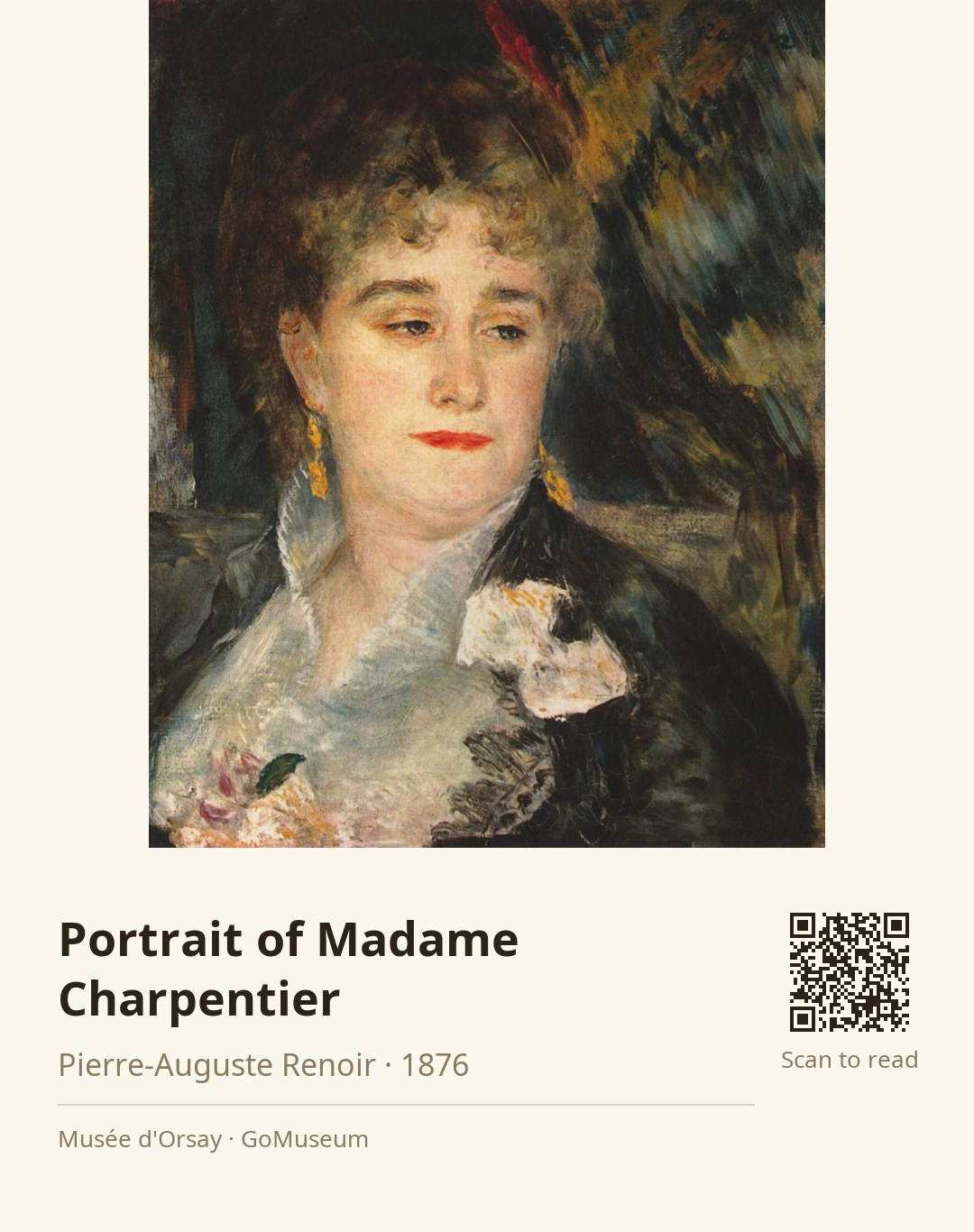
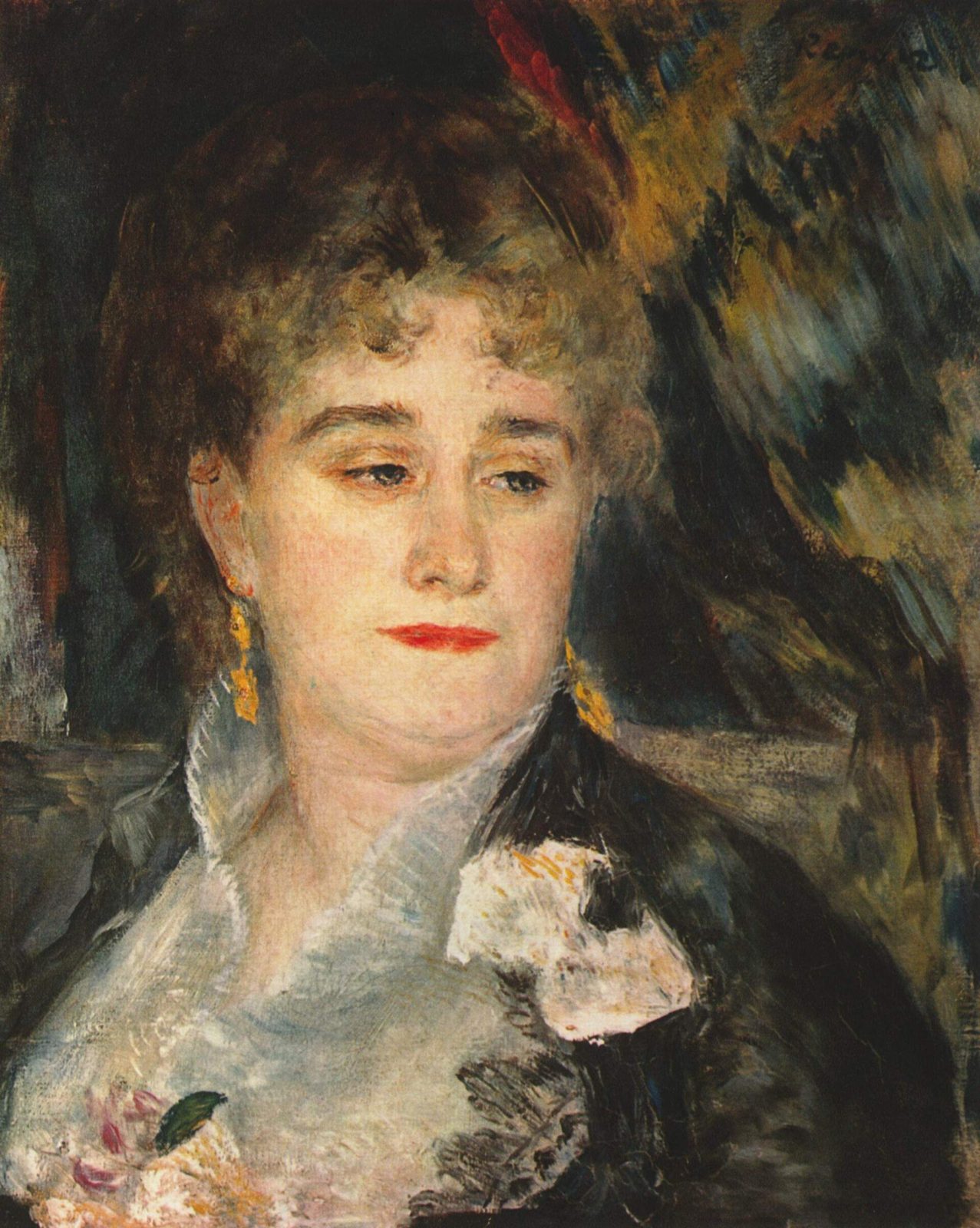
🎧 This work has audio narration — listen in the appTake a moment to really look at Renoir's "Portrait of Madame Charpentier." Notice how Madame Charpentier is turned slightly, as if she's just engaged in a conversation, her gaze inviting you into her world. The soft brushstrokes create a sense of warmth, while the dark background makes her figure pop, drawing your attention to her elegant attire and poised demeanor.
This isn’t just a portrait; it’s a glimpse into the life of a woman who hosted salons filled with artists and intellectuals. The way Renoir captures her expression suggests a depth of character and sophistication, reflecting the vibrant social circles she moved in. It’s a testament to the Impressionist style, where light and emotion take center stage over rigid detail.
Painted in 1876, this work was part of a pivotal moment in Renoir's career, as he sought to establish himself as a portrait artist. Madame Charpentier was the wife of a prominent music publisher, and through her, Renoir connected with the cultural elite of Paris.
As you stand here, think about the conversations that might have taken place in her salons. What stories do you think she could tell if she could speak?
Pierre-Auguste Renoir, born on February 25, 1841, in Limoges, France, emerged as a pivotal figure in the Impressionist movement. His early life in a modest family led him to Paris, where he honed his artistic skills amidst the masterpieces of the Louvre. Initially apprenticed in a porcelain factory, Renoir's passion for painting flourished, particularly after studying under Charles Gleyre, where he befriended fellow artists like Monet and Sisley.
Renoir's work celebrated feminine beauty and vibrant social scenes, exemplified in iconic pieces like "Dance at Le Moulin de la Galette." Despite facing criticism early on, he gained recognition, especially after participating in the first Impressionist exhibition in 1874. His style evolved over the years, transitioning towards realism influenced by classical masters like Raphael.
Throughout his life, Renoir balanced personal struggles, including health issues, with a prolific output, reportedly creating around four thousand works. He became a beloved figure in art history, known for his warm palette and expressive brushwork. Renoir passed away on December 3, 1919, leaving a legacy that continues to inspire artists and art lovers alike.
Renoir's 'Portrait of Madame Charpentier' was painted in 1876 and first exhibited at the Third Impressionist Exhibition in Paris in 1877. This was a crucial period for Renoir as he aimed to solidify his reputation as a portrait artist. Madame Charpentier, the wife of a prominent music publisher, was a key figure in Parisian society, hosting salons that brought together artists, intellectuals, and politicians. The painting was well-received, showcasing Renoir's evolving style and his ability to capture the essence of his subjects. Over the years, it has been displayed in notable exhibitions, including the Exposition Universelle in 1900 and later at the Musée d'Orsay, where it remains a highlight of the collection. Its provenance traces back to Madame Charpentier herself, indicating its significance in her life and social circle.
In this portrait, Renoir employs a technique that embodies the essence of Impressionism. The soft brushwork creates a warm, inviting atmosphere, while the darker background serves to highlight Madame Charpentier's figure, making her attire and expression stand out. Notice how the light dances across her face, illuminating her features with a gentle glow. The composition, with her slightly turned posture, suggests a moment of engagement, as if she's listening intently to a conversation. This choice not only draws you in but also reflects the dynamic social interactions of her salons. The scale of the painting, relatively intimate at 46.3 by 38 centimeters, allows for a personal connection, making you feel as if you could step into her world.
Painted in 1876, it showcases Renoir's ability to blend traditional portraiture with the emerging Impressionist style, influencing countless artists who followed. This work captures the essence of its subject, Marguerite Charpentier, wife of a prominent music publisher, and reflects the social dynamics of the time. Renoir's approach to light and color in this piece helped redefine portrait painting, steering it away from rigid formalism towards a more vibrant, expressive form. Remember, this painting is a bridge between the classical and modern, a testament to Renoir's role in shaping the future of art.
This painting served as a stepping stone to create 'Madame Charpentier and her Children,' which is now housed in the Metropolitan Museum of Art in New York. It’s fascinating to think that this intimate portrait was just the beginning of a more complex narrative he wanted to explore!