The Painter's Studio
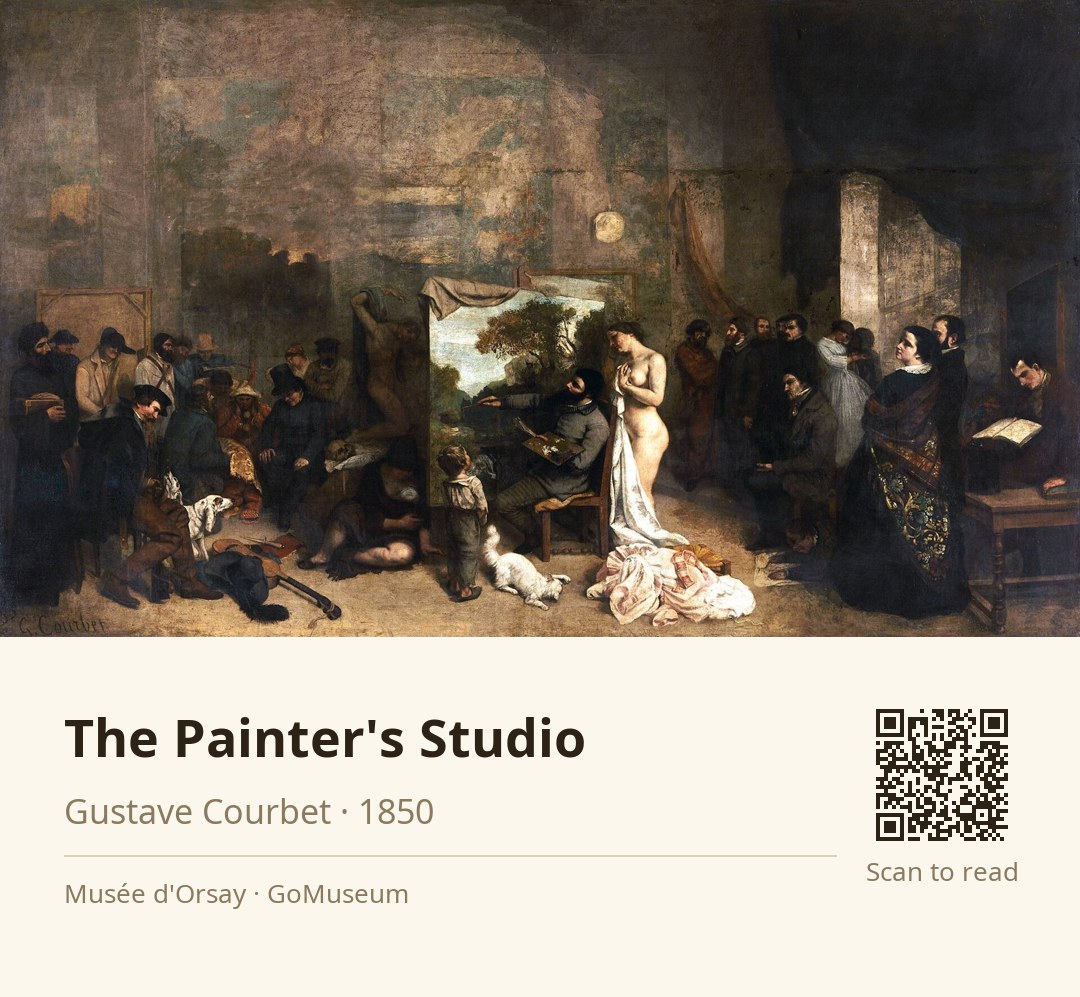
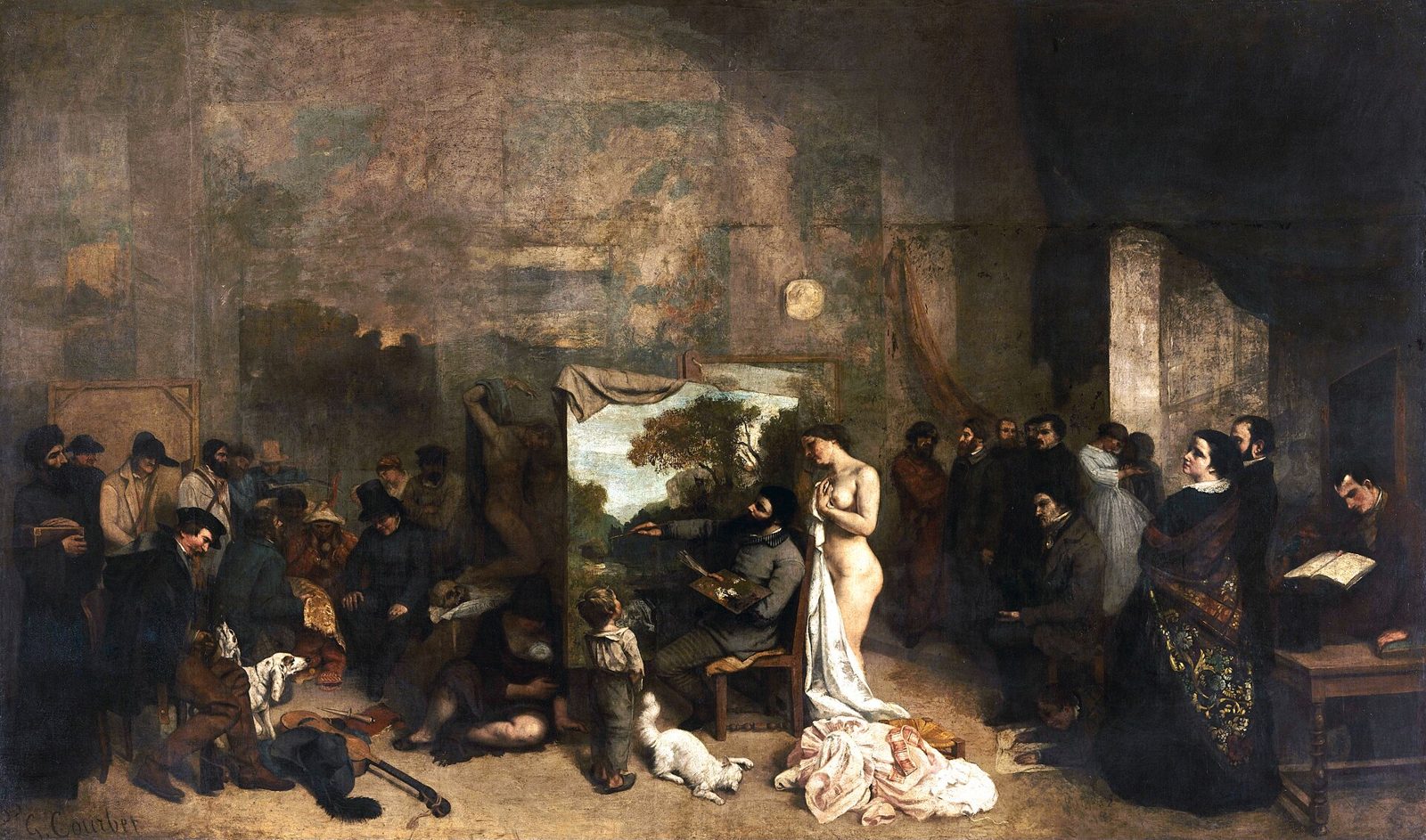
🎧 This work has audio narration — listen in the appTake a moment to really look at "The Painter's Studio" by Gustave Courbet. Notice how the artist has positioned himself at the center of the canvas, surrounded by a diverse crowd of figures. On the left, you see everyday people, while on the right, the elite of Parisian society gather, including the famous poet Charles Baudelaire. This striking contrast isn’t just for show; it represents Courbet’s belief that art should reflect all layers of society, not just the privileged few. Now, focus on the nude model in the center, who stands behind Courbet as he paints a landscape. This figure symbolizes the traditional academic art that Courbet was rebelling against. By turning away from her, he’s making a bold statement about his commitment to Realism and the new direction he wanted to take art. The unfinished paintings in the background, covered in a reddish-brown hue, further emphasize his struggle against the constraints of conventional art. Created in 1855, this painting was a personal manifesto for Courbet, reflecting seven years of his artistic journey and moral beliefs. He was determined to challenge the norms of the art world, which is why he famously opened his own exhibition when his work was rejected from the official Paris World Fair. As you stand here, think about what it means to represent society in art. How does Courbet’s vision resonate with our own views on art and culture today? What stories do you see in the faces around him?
Gustave Courbet, born on June 10, 1819, in Ornans, France, was a pioneering painter who championed the Realism movement in 19th-century art. Rejecting the conventions of academic painting and the idealism of Romanticism, he focused on depicting the world as he observed it, often portraying unidealized peasants and workers in monumental compositions. His early works gained recognition, notably "After Dinner at Ornans," which won him a gold medal at the Salon of 1849, allowing him to exhibit without jury approval.
Courbet's commitment to realism was revolutionary; he believed that art should stem from personal experience rather than historical or mythological themes. His bold approach often sparked controversy, challenging societal norms and addressing social issues, which resonated with later movements like Impressionism and Cubism. Despite facing criticism and imprisonment for his political involvement during the Paris Commune, Courbet continued to create until his death on December 31, 1877, in Switzerland.
His legacy endures as a transformative figure in art history, whose unflinching depictions of everyday life laid the groundwork for modern artistic expression. Today, Courbet is celebrated for his vigorous and uncompromising work, which continues to engage audiences with its raw honesty and depth.
Gustave Courbet's "The Painter's Studio" was created in 1855, during a pivotal moment in his career. After eleven of his works were accepted for the Paris World Fair, this particular piece was notably rejected. In a bold act of defiance, Courbet, with the support of his patron Alfred Bruyas, organized his own exhibition, the Pavilion of Realism, almost directly across from the official exposition. This move not only showcased his work but also set the stage for future exhibitions of rejected art, known as the Salon des Refusés. The painting itself is a culmination of seven years of Courbet's artistic and moral life, as he described it. The initial reception was mixed, with some critics praising its audacity, while others dismissed it. Eugène Delacroix, a prominent artist of the time, was one of the few who supported Courbet's vision. Over time, the painting changed hands several times, starting with Courbet's sister Juliette, before being sold at auction and eventually acquired by the Louvre in 1920 for a substantial sum, highlighting its growing significance in the art world.
When you gaze at "The Painter's Studio," notice how Courbet's brushwork conveys a sense of immediacy and raw emotion. The paint handling is both bold and spontaneous, reflecting his commitment to Realism. The central figure of Courbet himself is depicted with a sense of authority, as he paints the Loue River valley, a tribute to his homeland. The unfinished paintings in the background, obscured by a reddish-brown hue, suggest a struggle against traditional academic constraints. This choice not only emphasizes his rejection of the polished, idealized forms of the Academy but also mirrors his own artistic journey. The composition is carefully structured, with Courbet at the center, flanked by figures representing various societal layers. The left side showcases everyday people, while the right features Parisian elites, creating a dynamic tension that invites viewers to consider the role of art in society. The inclusion of a nude model, turned away from the viewer, serves as a poignant reminder of the academic art Courbet was rebelling against, further deepening the painting's impact.
One intriguing aspect of "The Painter's Studio" is the figure of the contorted 'lay figure' on the left side of the canvas. In a letter to his friend Champfleury, Courbet described how he envisioned this character, showcasing his intention to blend personal experiences with broader societal commentary. This detail highlights how Courbet's travels and interactions informed his artistic vision, making the painting not just a reflection of his studio but a tapestry of his life and influences.
This 'lay figure' represents the 'death' of the Royal Academy's art, reflecting Courbet's critique of traditional academic standards. It serves as a visual metaphor for the struggle between conventional and emerging artistic practices.
Many of the everyday figures on the left were inspired by Courbet's travels, particularly a trip to London in 1848, where he encountered a Jewish man and an Irishwoman. This blending of personal encounters with broader societal themes showcases his commitment to realism.
After its rejection, Courbet organized his own exhibition, the Pavilion of Realism, to showcase the painting, which marked a significant moment in art history by paving the way for future exhibitions of rejected works, known as the Salon des Refusés.