The Card Players
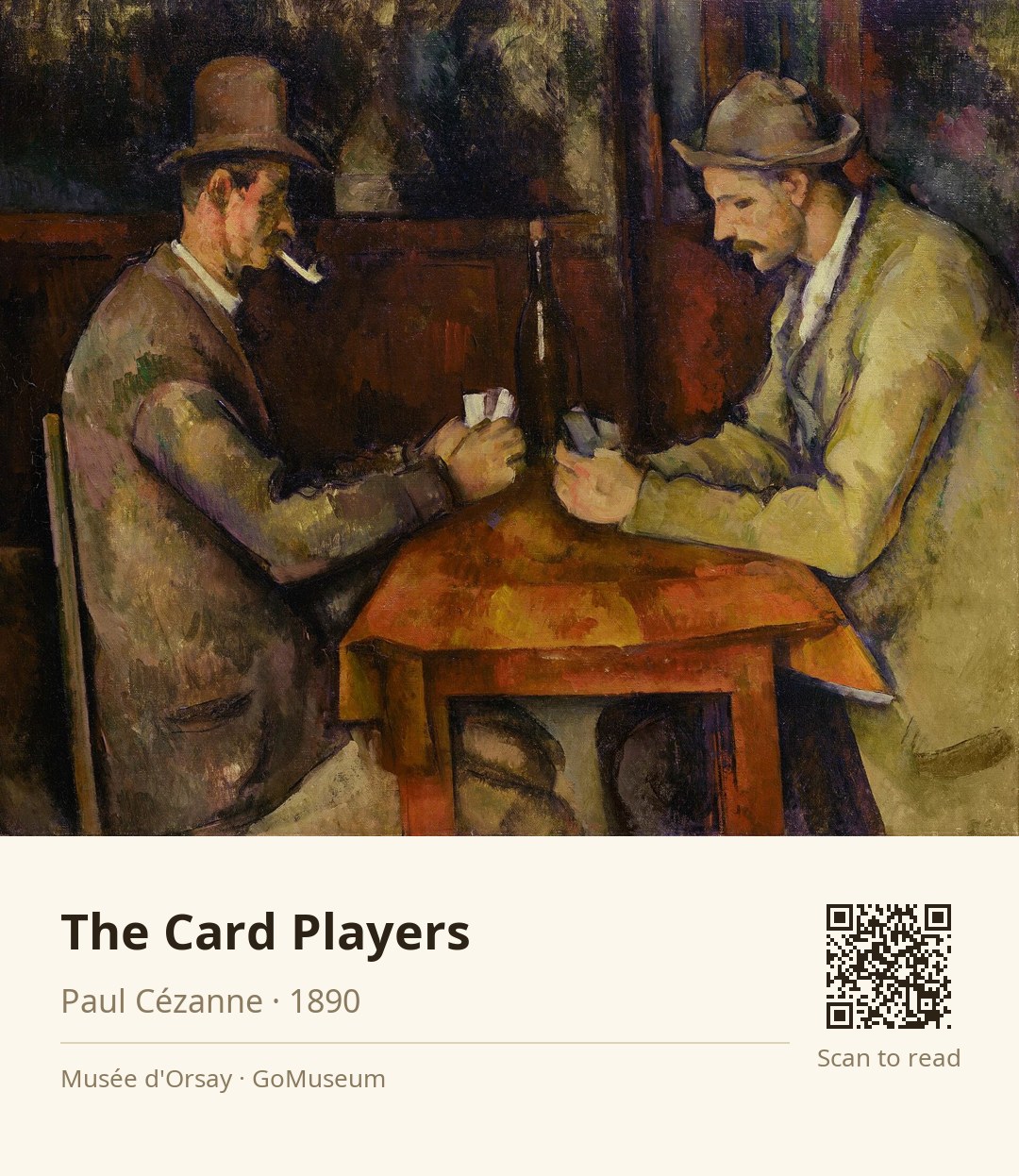
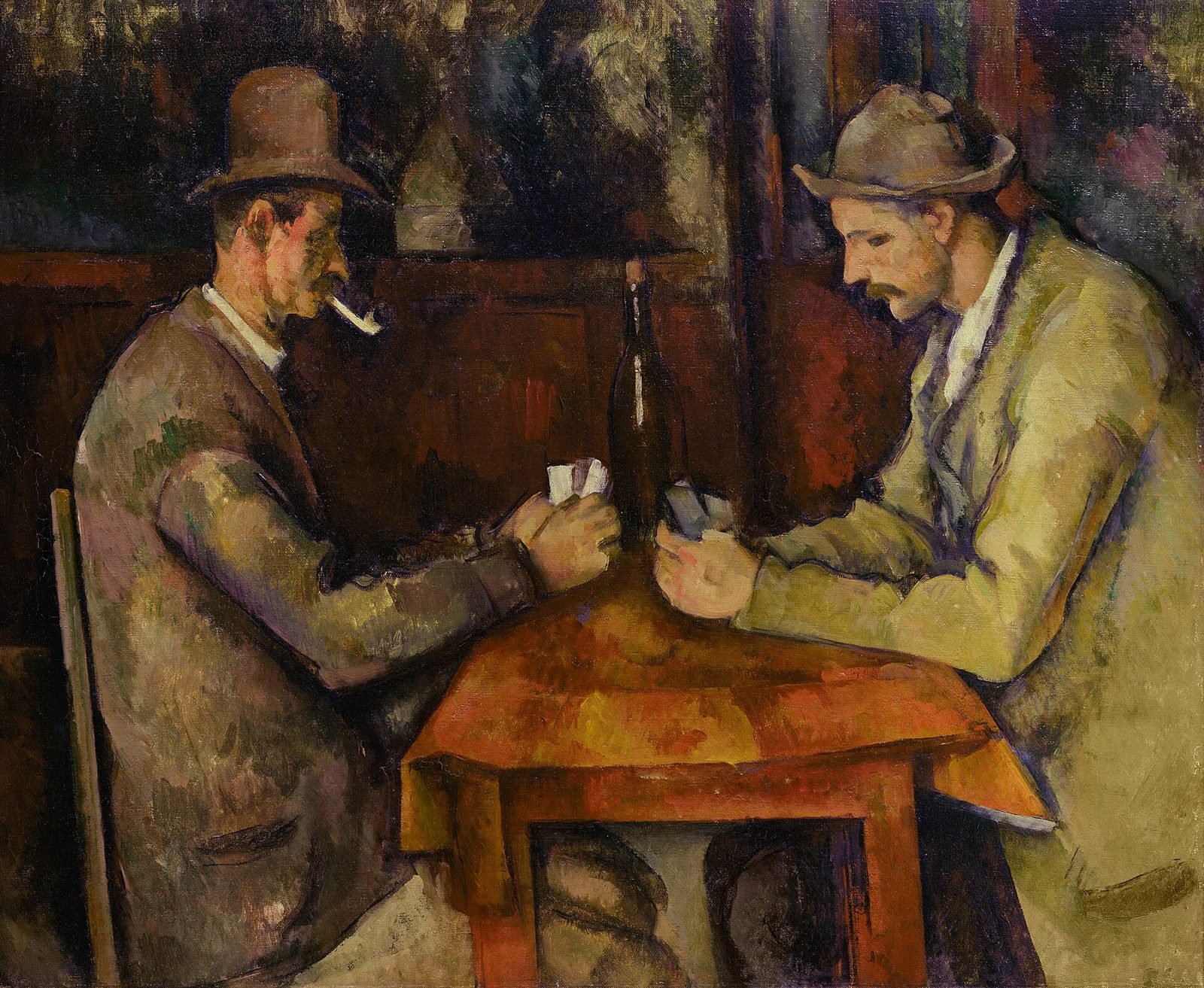
🎧 This work has audio narration — listen in the appTake a moment to really look at "The Card Players" by Paul Cézanne. Notice how the figures are almost sculptural, their forms solid and weighty, as if they’re carved from the very table they sit at. The way the light hits their hats and the glint of the bottle draws you in, doesn’t it? These details matter because they reveal Cézanne's revolutionary approach to painting. He wasn’t just capturing a scene; he was exploring the very essence of form and color. The way he layers his brushstrokes creates depth, giving life to the mundane act of playing cards. This was a radical shift from the fleeting impressions of his Impressionist peers, pushing towards a new understanding of structure that would influence the likes of Picasso and Matisse. Created in 1890, this work is a testament to Cézanne's belief that art should reflect the underlying reality of the world, not just its surface. He spent years honing this style, often facing criticism from those who didn’t understand his vision. So, as you stand here, think about the quiet intensity of these players. What stories do you think they’re sharing over their game?
Paul Cézanne was a French Post-Impressionist painter born on January 19, 1839, in Aix-en-Provence. His innovative approach to color and form bridged the gap between Impressionism and the emerging Cubism of the early 20th century. Initially influenced by Romanticism and Realism, Cézanne developed a unique style that emphasized the underlying structure of objects, using repetitive brushstrokes and planes of color to create depth and complexity in his work.
Despite facing ridicule and misunderstanding from critics during his early career, Cézanne garnered support from fellow artists like Camille Pissarro and the art dealer Ambroise Vollard, who recognized his talent. His first solo exhibition in 1895 marked a turning point, leading to greater appreciation of his contributions to art. Cézanne's legacy is profound; both Henri Matisse and Pablo Picasso acknowledged him as a foundational figure in modern art, dubbing him "the father of us all." He passed away on October 22, 1906, leaving behind a transformative body of work that continues to influence artists today.
Cézanne's 'The Card Players' was created in 1890, during a pivotal time in his career. This painting was commissioned by the art dealer Ambroise Vollard, who recognized the genius in Cézanne's work when many others did not. It was part of a series of card-playing scenes that Cézanne painted, showcasing his fascination with the interplay of form and color. Initially, the painting was not widely appreciated; it faced skepticism from critics who were struggling to grasp Cézanne's innovative approach. However, as the years passed, it gained recognition and became a significant piece in the evolution of modern art. The painting has a rich provenance, having passed through the hands of notable collectors and galleries, including the Galerie Durand-Ruel in Paris and the collection of Isaac Camondo. Each owner contributed to its story, enhancing its value and historical importance in the art world.
When you look closely at 'The Card Players,' notice how Cézanne's brushwork creates a sense of solidity and depth. He employs a technique of layering small strokes of color that build up to form the figures and the table. This method gives the painting a tactile quality, as if you could reach out and touch the textured surfaces. The light in the painting is not just a source of illumination; it interacts with the forms, highlighting the contours of the players and the objects around them. The composition is carefully structured, with the players arranged in a triangular formation that draws your eye into the scene. The use of muted colors, punctuated by the vibrant reds and greens, adds to the emotional weight of the moment, making the mundane act of playing cards feel monumental. This is where Cézanne's genius lies—he transforms a simple game into a profound exploration of human interaction and existence.
This painting, created in 1890, is emblematic of the Post-Impressionist movement, showcasing Cézanne's innovative approach to form and color. His emphasis on structure and geometric shapes laid the groundwork for the emergence of Cubism, influencing giants like Picasso and Matisse, who famously regarded him as 'the father of us all.' Cézanne's exploration of everyday subjects, like the simple act of playing cards, elevated genre art to new heights, proving that even the mundane could be profound. This work matters not just for its aesthetic but for its role in bridging the gap between Impressionism and the avant-garde movements that followed, marking a significant turning point in art history.
Initially, 'The Card Players' faced skepticism and was not widely appreciated, as many critics struggled to understand Cézanne's innovative approach to form and color. It wasn't until later that the painting gained recognition and became a significant piece in the evolution of modern art.
Cézanne employed a technique of layering small strokes of color to build up the figures and the table in 'The Card Players.' This method not only creates a tactile quality but also enhances the painting's depth, allowing the viewer to perceive the solidity of the forms.