Empress Eugénie
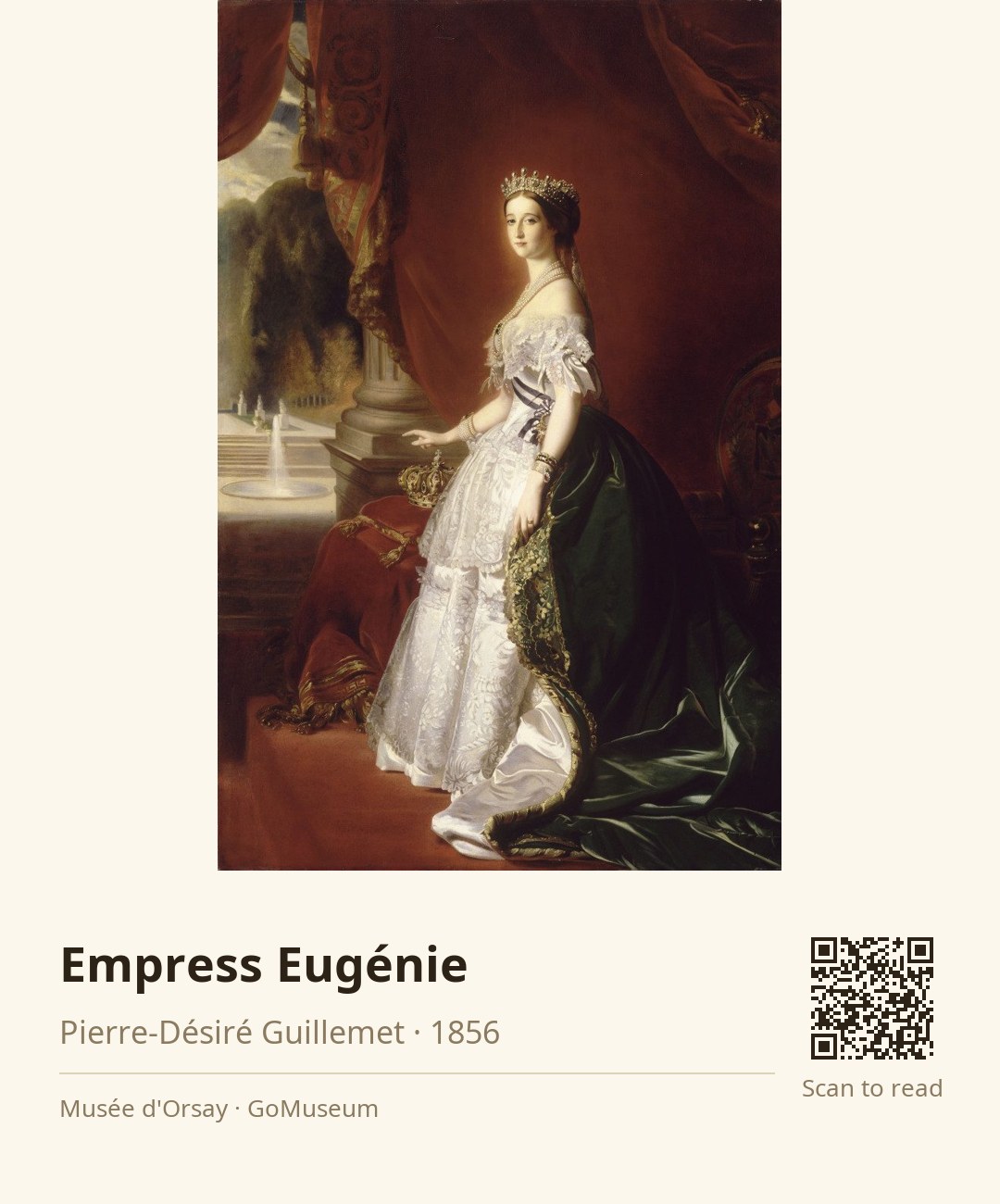
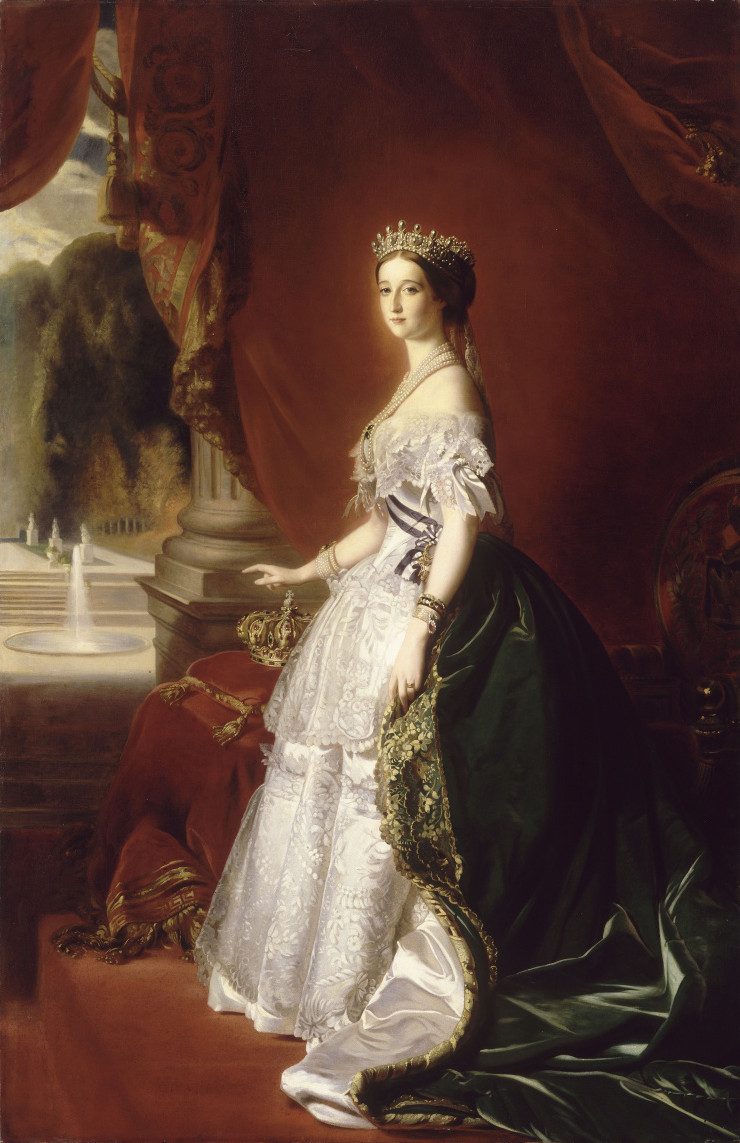
🎧 This work has audio narration — listen in the appEugénie de Montijo stands before you, resplendent in an elaborate white gown that cascades elegantly to the floor, its intricate lace details catching the light. The dark green velvet train, lavishly embroidered in gold, adds a regal touch, while a tiara glimmers atop her head, signifying her status as Empress. Her right hand rests on a richly draped table, where a crown lies, hinting at her authority and the weight of her role.
This portrayal captures not just her beauty but the essence of imperial power during the mid-19th century. The opulent interior, with its large red curtain and the glimpse of a garden fountain behind her, enhances the grandeur of her presence. Guillemet’s choice to depict Eugénie in profile emphasizes her elegance, while the formal composition reflects the decorum expected of royalty.
Created in 1856, this painting is a testament to Guillemet's skill in capturing the likeness and character of his subjects, particularly during a time when portraits served as vital symbols of political and social status. Guillemet, who later became the Palace Painter in Istanbul, was known for his historical scenes and portraits, and this work is a prime example of his early career in France.
Pierre-Désiré Guillemet was a French history painter born in Lyon on March 29, 1827. He studied at the École Nationale Supérieure des Beaux-Arts de Lyon and later in Paris under Hippolyte Flandrin. Guillemet gained recognition for his historical scenes and portraits exhibited at Parisian salons between 1857 and 1863. His work included notable copies of portraits of Napoléon III and the Empress Eugénie, commissioned for government buildings.
In 1865, he moved to Istanbul at the request of Sultan Abdulaziz, who admired European art. Guillemet became the Palace Painter and established a drawing and painting academy in Beyoğlu, introducing Western art techniques to Turkish students. His efforts laid the groundwork for the Imperial Art School, which inspired future art education in Turkey.
Guillemet's life was dedicated to bridging cultures through art, and he played a pivotal role in the early development of Turkish art institutions. He died on April 29, 1878, from typhoid fever while aiding refugees during the Russo-Turkish War, leaving a legacy as a pioneer of Western-style painting in the Ottoman Empire.
This painting, titled 'Empress Eugénie,' was created in 1856 by Pierre-Désiré Guillemet, a French artist who would later become the Palace Painter in Istanbul. Commissioned during a time when portraits were essential symbols of political and social status, this work captures the essence of Empress Eugénie, the wife of Napoleon III. Guillemet, who studied at the École Nationale Supérieure des Beaux-Arts, was known for his historical scenes and portraits, and this piece marked a significant moment in his early career.
Guillemet employed oil paint on canvas to create this striking portrait, utilizing a rich palette that enhances the opulence of the scene. The meticulous brushwork captures the intricate lace of Eugénie's gown and the luxurious texture of her velvet train. The artist's choice to depict her in profile not only emphasizes her regal bearing but also allows the viewer to appreciate the detailed craftsmanship of her attire. The formal composition, with Eugénie positioned against a backdrop of sumptuous red curtains and a glimpse of a garden fountain, draws the eye to her figure while creating a sense of depth. The scale of the painting, towering at 242 by 158 centimeters, further amplifies her presence, making it impossible to ignore the authority she embodies.
Guillemet collaborated with Étienne-Antoine-Eugène Ronjat to create a full-size copy of The Raft of the Medusa, which was commissioned due to the original's deterioration.
Guillemet joined Emmanuel Miller in an expedition to collect ancient Greek and Roman antiquities from the Ottoman Empire's European holdings.
Guillemet established the first drawing and painting academy in Beyoğlu, Istanbul, where he and his wife taught Western-style painting.